Quick Answer
Saying “no” the same way every time can sound repetitive, blunt, or even rude depending on the situation. The top alternatives to “no” include: I’m afraid not, No way, I must decline, Not really, and I’ll have to pass.
“No” is one of the simplest and most direct words in English. People use it to refuse a request, reject an idea, disagree with a statement, or decline an invitation. Because it is so short and direct, it can sometimes sound harsh, especially in professional or polite conversations.
Learning alternatives to “no” helps English learners sound more natural, polite, and confident. Depending on the situation, you may want to sound firm, gentle, formal, or casual. Knowing different ways to disagree or refuse also helps you express excitement in English less often through blunt refusals and more through thoughtful, tone-appropriate language.
This guide breaks down alternatives to “no,” organized by tone and context, so you always know exactly which phrase fits your situation.
“The right tone makes your English sound professional and confident.”
Quick Categories
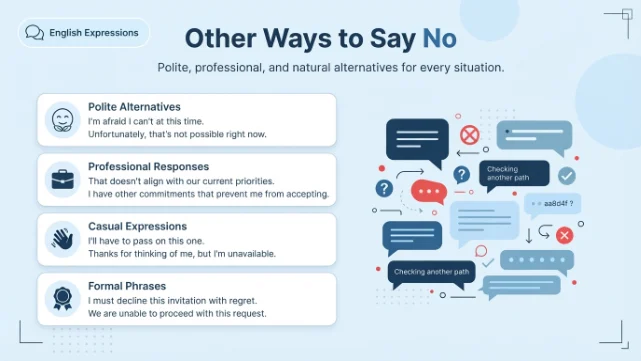
Formal Alternatives to “No”
- I’m afraid not
- Unfortunately, that won’t be possible
- I must decline
- I am unable to accommodate that request
Pro Tip: Formal alternatives work best in emails, meetings, and customer service settings where politeness matters more than speed.
Casual Alternatives
- Nope
- Not a chance
- No way
- Nah
Pro Tip: Save casual alternatives for friends, family, and relaxed conversations. Using them at work can sound unprofessional.
Professional Alternatives
- That’s not feasible right now
- That doesn’t align with our current plans
- We won’t be able to move forward with that
- I’ll have to pass on that
Pro Tip: Professional alternatives soften a refusal while still sounding confident and clear during business communication.
Informal Expressions
- No can do
- Hard pass
- Not gonna happen
- Forget it
Pro Tip: Informal expressions are common in spoken English but should be avoided in written business communication.
“Choosing the wrong tone can make a polite refusal sound rude.”
Common Mistakes
- Using casual phrases in formal emails.
Example: “Nah, can’t do that” in a client email. - Overusing “no” without softening language.
Example: “No. I can’t help you.” sounds abrupt. - Mixing formal and informal tone in one sentence.
Example: “I must decline, no way that’s happening.” - Forgetting to explain the refusal.
Example: “No.” with no context can confuse the listener. - Using slang with senior colleagues or clients.
Example: “Hard pass on that idea, boss.”
What Does “No” Mean?
“No” is used to express refusal, disagreement, or denial. Grammatically, it functions as an adverb, a determiner, or an exclamation depending on context.
Example Sentence: “No, I don’t want to attend the meeting today.”
When to Use “No”
- Refusing a request or invitation
- Disagreeing with a statement or opinion
- Denying permission
- Answering a yes/no question negatively
Spoken: Common in everyday conversation, often paired with a short explanation.
Written: Used in emails and messages, usually softened with polite phrasing.
Formal: Requires additional context or a polite lead-in.
Informal: Can be used alone, especially among friends.
Is It Professional or Polite to Say “No”?
Saying “no” directly is polite in casual settings but can sound too blunt in professional environments.
Business Example: “No, I can’t attend the call” sounds abrupt compared to “Unfortunately, I won’t be able to join the call.”
Polite? ✔️ Yes Professional? ❌ No (in most cases)
Pros and Cons of Using “No”
Pros:
- Simple and natural
- Direct and clear
- Common usage
- Easy to understand
Cons:
- Too blunt for work
- Overused
- Limited emotional range
- Not suitable for formal writing
“A single word can change how confident or rude your English sounds.”
Other Ways to Say “No”
These alternatives will help you sound more fluent, confident, and natural in different situations. Use them according to tone, context, and audience to express disagreement, refusal, or denial appropriately.
1. Phrase: No, thank you
Meaning: A polite way to decline an offer. Explanation: Adds courtesy to a simple refusal. Example Sentence: “Would you like more coffee?” “No, thank you.” Best Use: Offers, invitations Worst Use: Serious disagreements Tone: Polite, gentle Context Variability: casual, professional, spoken
2. Phrase: I’m afraid not
Meaning: A formal, gentle refusal. Explanation: Softens bad news with regret. Example Sentence: “Can we reschedule?” “I’m afraid not, the client is arriving today.” Best Use: Formal conversations Worst Use: Casual chats Tone: Formal, apologetic Context Variability: professional, spoken, written
3. Phrase: Not at this time
Meaning: A neutral refusal that leaves room for the future. Explanation: Suggests the answer could change later. Example Sentence: “Are you hiring?” “Not at this time, but check back next quarter.” Best Use: Business communication Worst Use: Personal relationships Tone: Neutral, professional Context Variability: professional, written
4. Phrase: I’d rather not
Meaning: A soft personal refusal. Explanation: Expresses preference instead of a hard rule. Example Sentence: “Want to talk about it?” “I’d rather not right now.” Best Use: Personal boundaries Worst Use: Formal business decisions Tone: Gentle, personal Context Variability: casual, spoken
5. Phrase: That won’t work for me
Meaning: A clear rejection of a plan or suggestion. Explanation: Focuses on practicality rather than emotion. Example Sentence: “Can you meet at 6 a.m.?” “That won’t work for me.” Best Use: Scheduling, logistics Worst Use: Emotional topics Tone: Direct, practical Context Variability: professional, casual
6. Phrase: Unfortunately, I can’t
Meaning: A regretful decline. Explanation: Signals sincerity through the word “unfortunately.” Example Sentence: “Can you cover my shift?” “Unfortunately, I can’t this weekend.” Best Use: Workplace requests Worst Use: Very casual talk Tone: Regretful, polite Context Variability: professional, spoken, written
7. Phrase: I don’t think so
Meaning: An uncertain or soft refusal. Explanation: Leaves slight room for doubt or reconsideration. Example Sentence: “Is this the right file?” “I don’t think so.” Best Use: Everyday conversation Worst Use: Formal contracts Tone: Casual, unsure Context Variability: casual, spoken
8. Phrase: Not right now
Meaning: A temporary refusal. Explanation: Implies the answer could be different later. Example Sentence: “Can we talk?” “Not right now, I’m in a meeting.” Best Use: Time-sensitive situations Worst Use: Permanent decisions Tone: Neutral, brief Context Variability: casual, professional
9. Phrase: I’ll have to pass
Meaning: A casual but firm decline. Explanation: Common in social or informal offers. Example Sentence: “Want to join the game?” “I’ll have to pass tonight.” Best Use: Social invitations Worst Use: Serious business matters Tone: Casual, easygoing Context Variability: casual, spoken
10. Phrase: I’m going to decline
Meaning: A formal and confident refusal. Explanation: Sounds decisive and professional. Example Sentence: “We’d like to offer you this role.” “I’m going to decline, thank you.” Best Use: Job offers, formal invitations Worst Use: Casual small talk Tone: Formal, confident Context Variability: professional, written
11. Phrase: That’s not possible
Meaning: A firm statement of impossibility. Explanation: Focuses on the situation rather than personal choice. Example Sentence: “Can we finish this today?” “That’s not possible with the current deadline.” Best Use: Logistics, planning Worst Use: Emotional conversations Tone: Direct, factual Context Variability: professional, spoken
12. Phrase: I appreciate the offer, but no
Meaning: A grateful yet clear refusal. Explanation: Balances gratitude with a firm answer. Example Sentence: “We’d love to sponsor your event.” “I appreciate the offer, but no, not this year.” Best Use: Business proposals Worst Use: Very casual settings Tone: Polite, appreciative Context Variability: professional, written
13. Phrase: Nope
Meaning: A short, casual refusal. Explanation: Informal shortened form of “no.” Example Sentence: “Did you finish it?” “Nope, still working on it.” Best Use: Friends, informal chat Worst Use: Business emails Tone: Casual, relaxed Context Variability: casual, spoken
14. Phrase: No way
Meaning: A strong, emotional refusal or disbelief. Explanation: Often used to express surprise along with refusal. Example Sentence: “Can you lend me your car?” “No way, sorry.” Best Use: Informal conversation Worst Use: Professional writing Tone: Strong, informal Context Variability: casual, spoken
15. Phrase: Not a chance
Meaning: A very firm and confident refusal. Explanation: Leaves no room for negotiation. Example Sentence: “Will you skip the deadline?” “Not a chance.” Best Use: Strong disagreements Worst Use: Polite business settings Tone: Firm, blunt Context Variability: casual, spoken
16. Phrase: No can do
Meaning: A casual way of saying something isn’t possible. Explanation: Friendly and light in tone. Example Sentence: “Can you fix this by noon?” “No can do, I need until tomorrow.” Best Use: Informal workplace chat Worst Use: Formal reports Tone: Light, casual Context Variability: casual, spoken
17. Phrase: I’m not able to
Meaning: A polite statement of inability. Explanation: Focuses on capability rather than desire. Example Sentence: “Can you join the call?” “I’m not able to today.” Best Use: Work requests Worst Use: Casual banter Tone: Polite, neutral Context Variability: professional, spoken, written
18. Phrase: That doesn’t work for me
Meaning: A personal rejection of a plan. Explanation: Centers the refusal on personal fit. Example Sentence: “Let’s meet on Sunday.” “That doesn’t work for me.” Best Use: Scheduling Worst Use: Formal contracts Tone: Direct, personal Context Variability: casual, professional
19. Phrase: I must decline
Meaning: A very formal refusal. Explanation: Sounds official and firm. Example Sentence: “We invite you to the board meeting.” “I must decline due to a scheduling conflict.” Best Use: Formal invitations Worst Use: Everyday conversation Tone: Formal, serious Context Variability: professional, written
20. Phrase: Regretfully, no
Meaning: A sincere formal refusal. Explanation: Highlights genuine regret. Example Sentence: “Can you extend the contract?” “Regretfully, no.” Best Use: Business correspondence Worst Use: Casual talk Tone: Formal, regretful Context Variability: professional, written
21. Phrase: I’m not interested
Meaning: A clear statement of disinterest. Explanation: Often used to end unwanted offers. Example Sentence: “Would you like to invest?” “I’m not interested, thank you.” Best Use: Sales pitches Worst Use: Close relationships Tone: Direct, neutral Context Variability: professional, casual
22. Phrase: Sorry, but no
Meaning: An apologetic refusal. Explanation: Combines politeness with a firm decision. Example Sentence: “Can I borrow this?” “Sorry, but no, I need it today.” Best Use: Everyday requests Worst Use: Formal legal documents Tone: Apologetic, gentle Context Variability: casual, spoken
23. Phrase: Not for me, thanks
Meaning: A polite personal decline. Explanation: Common when refusing food, drinks, or offers. Example Sentence: “Want some dessert?” “Not for me, thanks.” Best Use: Social settings Worst Use: Business decisions Tone: Polite, casual Context Variability: casual, spoken
24. Phrase: I’ll skip this one
Meaning: A casual way to opt out. Explanation: Implies the choice is optional. Example Sentence: “Want to join the trivia round?” “I’ll skip this one.” Best Use: Games, group activities Worst Use: Serious commitments Tone: Relaxed, casual Context Variability: casual, spoken
25. Phrase: Not this time
Meaning: A refusal that allows future possibility. Explanation: Keeps the door open for later. Example Sentence: “Want to come along?” “Not this time, maybe next week.” Best Use: Invitations Worst Use: Final decisions Tone: Friendly, open Context Variability: casual, spoken
26. Phrase: I’m going to say no
Meaning: A thoughtful, deliberate refusal. Explanation: Suggests the decision was considered carefully. Example Sentence: “Should we move forward?” “I’m going to say no for now.” Best Use: Team discussions Worst Use: Quick casual replies Tone: Thoughtful, calm Context Variability: professional, spoken
27. Phrase: Absolutely not
Meaning: A very strong and certain refusal. Explanation: Leaves no room for doubt. Example Sentence: “Should we cut corners on safety?” “Absolutely not.” Best Use: Strong objections Worst Use: Mild disagreements Tone: Strong, firm Context Variability: professional, spoken
28. Phrase: Never mind
Meaning: A dismissive way to end a request or offer. Explanation: Signals the topic is no longer worth pursuing. Example Sentence: “Do you still need help?” “Never mind, I figured it out.” Best Use: Casual conversation Worst Use: Formal business replies Tone: Dismissive, casual Context Variability: casual, spoken
29. Phrase: On second thought, no
Meaning: A refusal after reconsideration. Explanation: Shows a change of mind. Example Sentence: “Should we sign today?” “On second thought, no, let’s review it first.” Best Use: Decision-making moments Worst Use: Fixed agreements Tone: Reflective, cautious Context Variability: professional, spoken
30. Phrase: Thanks, but I’ll pass
Meaning: A grateful yet casual decline. Explanation: Balances appreciation with refusal. Example Sentence: “Want a slice of cake?” “Thanks, but I’ll pass.” Best Use: Social offers Worst Use: Formal business writing Tone: Polite, casual Context Variability: casual, spoken
“Every alternative to ‘no’ carries its own shade of tone and intention.”
Mini Quiz
1. Which phrase is most appropriate in a formal business email?
a) Nah b) I’m afraid that’s not something we can do c) Hard pass d) Nuh-uh
2. Which phrase best fits a casual conversation with friends?
a) I must decline b) Regrettably, I cannot agree to that c) No way d) I am unable to accommodate that request
3. “Let’s hold off on that for now” is best used in:
a) A team meeting b) A text to a friend c) A joke d) An angry argument
4. Which phrase adds humor or drama to a refusal?
a) That’s not feasible right now b) Not in a million years c) I respectfully disagree d) We won’t be able to move forward with that
Answers: 1-b, 2-c, 3-a, 4-b
Comparison Table: Top Alternatives
| Phrase | Tone | Best Use |
|---|---|---|
| I’m afraid not | Polite, gentle | Customer service |
| I must decline | Formal, firm | Formal invitations |
| That’s not feasible right now | Professional | Business meetings |
| I’ll have to pass on that | Professional-friendly | Work assignments |
| Nope | Casual | Friendly chats |
| No way | Casual, expressive | Informal talk |
| Not really | Soft, casual | Everyday talk |
| No can do | Informal, friendly | Casual work chats |
| Hard pass | Firm, informal | Social media |
| Sorry, can’t do that | Polite, casual | Everyday requests |
FAQs
1. What is a polite way to say no?
“I’m afraid not” or “I’m unable to accommodate that request” are polite and respectful alternatives to a direct “no.”
2. What are professional alternatives to “no” in emails?
Phrases like “That’s not feasible right now” or “We won’t be able to move forward with that” sound professional in business writing.
3. What is a casual way to say no to a friend?
Casual options include “Nope,” “Nah,” or “No way,” which suit relaxed, informal conversations
4. Why should I avoid saying “no” too often?
Repeating “no” can sound blunt, negative, or unfriendly. Using varied alternatives to “no” keeps your English natural and polite.
5. Is “hard pass” formal or informal?
“Hard pass” is informal and best used in casual conversations, not in professional or written business communication.
Conclusion
Learning different ways to say “no” helps you communicate refusals clearly while matching the right tone for each situation. Whether you need a formal alternative for business emails or a casual phrase for everyday conversation, having options makes your English more natural and confident.
Practice using these alternatives daily in real conversations, emails, and messages. Paying attention to tone, whether formal, casual, or professional, will help you sound polished and appropriate in any English-speaking environment.

Laura Adams is a dedicated content writer and blogger known for crafting clear, informative, and engaging articles. As a contributor to Responary.com, she specializes in creating reader-friendly content that educates, inspires, and keeps audiences informed on a wide range of subjects.