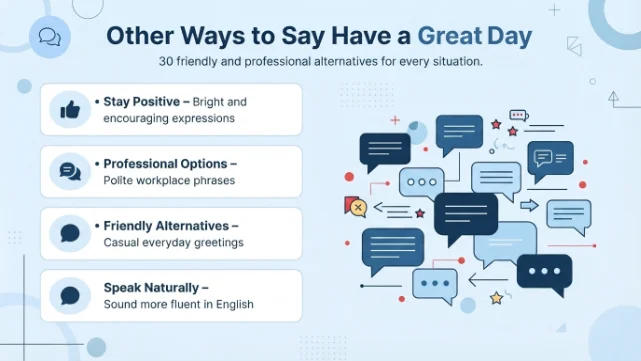
Quick Answer 🔥
Looking for other ways to say have a great day? Try these five instantly: have a wonderful day, enjoy your day, take care and stay well, wishing you a fantastic day, or have a productive day ahead.
Top 5 alternatives: have a wonderful day, enjoy your day, take care and stay well, wishing you a fantastic day, have a productive day ahead.
“The right tone makes your English sound professional and confident.”
“Have a great day” is one of the most common closing phrases in English. People use it to end conversations, emails, phone calls, and everyday interactions in a warm, positive way. It works in almost any casual setting, but repeating the same phrase every day can make your English sound flat or unoriginal.
Learning alternatives to have a great day helps you sound more natural, more fluent, and more emotionally expressive. Whether you are chatting with a friend, emailing a client, or saying goodbye to a coworker, the right closing line shows warmth and intention rather than habit.
Exploring new expressions also helps you express excitement in English more naturally. A well-chosen phrase can make a simple goodbye feel genuine, professional, or cheerful, depending on the situation.
Quick Categories
Formal Alternatives to “Have a Great Day”
- Have a pleasant day ahead
- Wishing you a productive day
- I hope your day goes smoothly
- Have a wonderful rest of your day
Pro Tip: Formal alternatives work best in emails, business meetings, and customer service conversations where a polished tone matters.
Casual Alternatives
- Have a good one
- Enjoy your day
- Take it easy today
- Catch you later, have fun
Pro Tip: Save casual alternatives for friends, family, and relaxed conversations. They sound friendly but too informal for professional writing.
Professional Alternatives
- Have a productive day ahead
- Wishing you continued success today
- I hope the rest of your day goes well
- Take care and have a great meeting
Pro Tip: Professional alternatives work well when closing emails or ending calls with clients, managers, or colleagues you do not know well.
Informal Expressions
- Later, have a blast
- Peace out, enjoy your day
- Have a good one, buddy
- Take care, see ya
Pro Tip: Informal expressions are best for texting friends or casual social media messages, not workplace communication.
“A good closing line leaves a lasting impression, choose it with intention.”
Common Mistakes People Make
- Using casual phrases in business emails. Example mistake: “Have a good one!” at the end of a formal client email.
- Repeating the same phrase in every conversation. Example mistake: Ending every message with “Have a great day” without variation.
- Mismatching tone with the relationship. Example mistake: Saying “Later, have a blast!” to a senior manager.
- Overusing exclamation marks to sound enthusiastic. Example mistake: “Have a great day!!!” in a professional context.
- Translating the phrase literally from another language. Example mistake: “Pass a good day” instead of “Have a great day.”
What Does “Have a Great Day” Mean?
“Have a great day” is a polite expression used to wish someone a positive, enjoyable day. Grammatically, it is an imperative sentence formed with the verb “have” plus the object “a great day.” It functions as a friendly closing remark rather than a literal command.
Example sentence: “Thanks for stopping by, have a great day!”
When to Use “Have a Great Day”
- Ending a casual conversation with a friend or neighbor
- Closing a customer service interaction
- Saying goodbye after a short meeting
- Signing off a friendly text message
Spoken vs Written:
- Spoken: Common in shops, offices, and daily greetings
- Written: Common in emails, chat messages, and notes
Formal vs Informal:
- Informal: Works well among friends, family, and casual acquaintances
- Formal: Needs adjustment for business or professional writing
Is It Professional or Polite to Say “Have a Great Day”?
“Have a great day” is polite, but it is not always professional. In business writing, it can sound casual or generic, especially in client-facing emails or formal reports.
Business example: “Thank you for your patience. Have a great day!” works fine for a retail assistant but feels too informal for a formal business proposal.
Polite? ✔️ Yes Professional? ❌ No (in most cases)
Pros and Cons of Using “Have a Great Day”
Pros:
- Simple and natural
- Friendly tone
- Common usage
- Easy to understand
Cons:
- Too informal for work
- Overused
- Limited emotional range
- Not suitable for formal writing
“Fluency is not about big words, it is about the right words at the right moment.”
Other Ways to Say “Have a Great Day”
These alternatives will help you sound more fluent, confident, and natural in different situations. Use them according to tone, context, and audience to express excitement, admiration, or approval.
1. Phrase: Have a Wonderful Day
Meaning: Wish someone an especially pleasant day.
Explanation: This phrase sounds a little warmer and more sincere than “Have a great day.”
Example Sentence: Thank you for your help. Have a wonderful day!
Best Use: Customer service
Worst Use: Sad situations
Tone: Warm, polite, positive
Context Variability:
- Casual: Have a wonderful day at the beach!
- Professional: Thank you for meeting with us. Have a wonderful day.
- Spoken: See you tomorrow. Have a wonderful day!
2. Phrase: Enjoy Your Day
Meaning: Encourage someone to make the most of their day.
Explanation: A friendly and common farewell suitable for everyday conversations.
Example Sentence: Enjoy your day, and I’ll see you tomorrow.
Best Use: Everyday chats
Worst Use: Formal letters
Tone: Friendly, relaxed, cheerful
Context Variability:
- Casual: Enjoy your day with your family.
- Professional: Enjoy the rest of your day.
- Spoken: Thanks for coming. Enjoy your day!
3. Phrase: Have an Amazing Day
Meaning: Wish someone an exceptionally good day.
Explanation: This expression adds more enthusiasm than the original phrase.
Example Sentence: Good luck with your presentation. Have an amazing day!
Best Use: Friends
Worst Use: Formal meetings
Tone: Enthusiastic, uplifting, warm
Context Variability:
- Casual: Have an amazing day at school!
- Professional: Hope you have an amazing day ahead.
- Spoken: Bye! Have an amazing day!
4. Phrase: Wishing You a Fantastic Day
Meaning: Express a heartfelt wish for a wonderful day.
Explanation: Slightly more formal and thoughtful than “Have a great day.”
Example Sentence: Wishing you a fantastic day and continued success.
Best Use: Emails
Worst Use: Quick greetings
Tone: Warm, professional, encouraging
Context Variability:
- Casual: Wishing you a fantastic day!
- Professional: Wishing you a fantastic day ahead.
- Spoken: Thanks again. Wishing you a fantastic day.
5. Phrase: Have a Beautiful Day
Meaning: Hope someone experiences a joyful and pleasant day.
Explanation: Often used to sound kind, caring, and positive.
Example Sentence: Take care and have a beautiful day.
Best Use: Friendly farewells
Worst Use: Business reports
Tone: Kind, caring, warm
Context Variability:
- Casual: Have a beautiful day outside.
- Professional: Have a beautiful day ahead.
- Spoken: It was nice meeting you. Have a beautiful day!
Choosing the right farewell helps your English sound more natural and memorable.
6. Phrase: Take Care
Meaning: Wish someone safety and well-being.
Explanation: A versatile farewell suitable for many situations.
Example Sentence: It was great talking to you. Take care!
Best Use: Any farewell
Worst Use: Formal speeches
Tone: Caring, friendly, polite
Context Variability:
- Casual: Take care, buddy!
- Professional: Thank you for your time. Take care.
- Spoken: See you next week. Take care!
7. Phrase: Have a Good One
Meaning: Wish someone a good day or enjoyable time.
Explanation: A very casual expression commonly heard in North American English.
Example Sentence: Thanks for stopping by. Have a good one!
Best Use: Friends
Worst Use: Formal business
Tone: Casual, relaxed, friendly
Context Variability:
- Casual: Have a good one!
- Professional: Rarely used.
- Spoken: See you later. Have a good one!
8. Phrase: Hope You Have a Great Day
Meaning: Express a sincere wish for someone’s happiness.
Explanation: This version sounds more personal and thoughtful.
Example Sentence: I hope you have a great day at work.
Best Use: Text messages
Worst Use: Formal documents
Tone: Sincere, warm, friendly
Context Variability:
- Casual: Hope you have a great day!
- Professional: Hope you have a great day ahead.
- Spoken: Hope you have a great day!
9. Phrase: Have a Pleasant Day
Meaning: Wish someone a calm and enjoyable day.
Explanation: More formal than “Have a great day.”
Example Sentence: Thank you for visiting. Have a pleasant day.
Best Use: Professional settings
Worst Use: Close friends
Tone: Formal, polite, respectful
Context Variability:
- Casual: Less common.
- Professional: Have a pleasant day.
- Spoken: Goodbye, and have a pleasant day.
10. Phrase: Wishing You a Lovely Day
Meaning: Hope someone enjoys a delightful day.
Explanation: Sounds thoughtful and slightly elegant.
Example Sentence: Wishing you a lovely day with your family.
Best Use: Greeting cards
Worst Use: Corporate meetings
Tone: Sweet, warm, gentle
Context Variability:
- Casual: Wishing you a lovely day!
- Professional: Appropriate in friendly emails.
- Spoken: Have a lovely day!
Small changes in wording can make your conversations sound much more fluent.
11. Phrase: Have a Fantastic Day
Meaning: Wish someone an exciting and enjoyable day.
Explanation: More energetic than “Have a great day.”
Example Sentence: Have a fantastic day at your new job!
Best Use: Celebrations
Worst Use: Serious occasions
Tone: Cheerful, energetic, positive
Context Variability:
- Casual: Have a fantastic day!
- Professional: Suitable for friendly workplaces.
- Spoken: Bye! Have a fantastic day!
12. Phrase: Have a Productive Day
Meaning: Wish someone success in completing their work.
Explanation: Frequently used in professional communication.
Example Sentence: Good luck with your meetings. Have a productive day.
Best Use: Workplace
Worst Use: Vacations
Tone: Professional, encouraging, respectful
Context Variability:
- Casual: Rare.
- Professional: Have a productive day ahead.
- Spoken: Hope you have a productive day!
13. Phrase: Best Wishes for Your Day
Meaning: Send kind and positive thoughts.
Explanation: A polite phrase suitable for both written and spoken English.
Example Sentence: Best wishes for your day and your upcoming project.
Best Use: Emails
Worst Use: Quick conversations
Tone: Polite, sincere, respectful
Context Variability:
- Casual: Best wishes!
- Professional: Best wishes for your day.
- Spoken: Best wishes to you.
14. Phrase: Hope Everything Goes Well Today
Meaning: Wish someone success throughout the day.
Explanation: Ideal when someone has an important event or task.
Example Sentence: Hope everything goes well today during your interview.
Best Use: Encouragement
Worst Use: Routine farewells
Tone: Supportive, thoughtful, caring
Context Variability:
- Casual: Hope everything goes well today.
- Professional: Hope everything goes well with today’s meeting.
- Spoken: Good luck! Hope everything goes well today.
15. Phrase: Have a Positive Day
Meaning: Encourage someone to stay optimistic.
Explanation: A motivational expression suitable for many situations.
Example Sentence: Keep smiling and have a positive day.
Best Use: Motivation
Worst Use: Formal reports
Tone: Encouraging, optimistic, friendly
Context Variability:
- Casual: Have a positive day!
- Professional: Wishing you a positive and productive day.
- Spoken: Have a positive day ahead!
The best speakers don’t always know more words they know which words fit the moment.
16. Phrase: Have an Excellent Day
Meaning: Wish someone an exceptionally good day.
Explanation: A polished alternative that works well in both professional and everyday conversations.
Example Sentence: Thank you for your support. Have an excellent day!
Best Use: Business emails
Worst Use: Very emotional situations
Tone: Professional, positive, respectful
Context Variability:
- Casual: Have an excellent day!
- Professional: Have an excellent day ahead.
- Spoken: Thanks for coming. Have an excellent day!
17. Phrase: Have a Blessed Day
Meaning: Wish someone a peaceful and meaningful day.
Explanation: Common in religious or faith-based communities.
Example Sentence: Thank you for your kindness. Have a blessed day.
Best Use: Personal conversations
Worst Use: Secular corporate emails
Tone: Warm, caring, sincere
Context Variability:
- Casual: Have a blessed day!
- Professional: Appropriate only if culturally suitable.
- Spoken: Have a blessed day, everyone.
18. Phrase: Have a Fabulous Day
Meaning: Wish someone a fun and exciting day.
Explanation: More enthusiastic than “Have a great day.”
Example Sentence: Happy birthday! Have a fabulous day!
Best Use: Celebrations
Worst Use: Formal business
Tone: Cheerful, lively, upbeat
Context Variability:
- Casual: Have a fabulous day!
- Professional: Rarely used.
- Spoken: Have a fabulous day ahead!
19. Phrase: Have a Nice Day
Meaning: Wish someone an enjoyable day.
Explanation: One of the most widely used alternatives worldwide.
Example Sentence: Thank you for shopping with us. Have a nice day!
Best Use: Customer service
Worst Use: Emotional conversations
Tone: Friendly, polite, neutral
Context Variability:
- Casual: Have a nice day!
- Professional: Common in customer interactions.
- Spoken: Bye! Have a nice day!
20. Phrase: Have a Wonderful Rest of Your Day
Meaning: Wish someone well for the remaining part of the day.
Explanation: Ideal when speaking in the afternoon or evening.
Example Sentence: It was great meeting you. Have a wonderful rest of your day.
Best Use: Meetings
Worst Use: Morning greetings
Tone: Warm, thoughtful, professional
Context Variability:
- Casual: Enjoy the rest of your day!
- Professional: Have a wonderful rest of your day.
- Spoken: Thanks again. Have a wonderful rest of your day.
A thoughtful farewell can make even a short conversation memorable.
21. Phrase: All the Best Today
Meaning: Wish someone success throughout the day.
Explanation: Especially suitable before an important event.
Example Sentence: All the best today with your presentation.
Best Use: Encouragement
Worst Use: Routine goodbyes
Tone: Supportive, encouraging, positive
Context Variability:
- Casual: All the best today!
- Professional: All the best with today’s meeting.
- Spoken: Good luck. All the best today.
22. Phrase: Enjoy the Rest of Your Day
Meaning: Hope someone enjoys whatever remains of the day.
Explanation: A common farewell after meetings or appointments.
Example Sentence: Thanks for joining the call. Enjoy the rest of your day.
Best Use: Workplace
Worst Use: Early mornings
Tone: Friendly, professional, relaxed
Context Variability:
- Casual: Enjoy the rest of your day!
- Professional: Enjoy the rest of your day.
- Spoken: See you tomorrow. Enjoy the rest of your day.
23. Phrase: Make Today Amazing
Meaning: Encourage someone to create a positive day.
Explanation: Motivational and uplifting.
Example Sentence: You’ve got this. Make today amazing!
Best Use: Motivation
Worst Use: Formal emails
Tone: Inspiring, energetic, optimistic
Context Variability:
- Casual: Make today amazing!
- Professional: Rarely used.
- Spoken: Go out there and make today amazing!
24. Phrase: Hope Your Day Is Wonderful
Meaning: Express a sincere wish for a pleasant day.
Explanation: Sounds thoughtful and personal.
Example Sentence: Hope your day is wonderful and relaxing.
Best Use: Friends
Worst Use: Official letters
Tone: Warm, caring, friendly
Context Variability:
- Casual: Hope your day is wonderful!
- Professional: Suitable in friendly workplaces.
- Spoken: Hope your day is wonderful.
25. Phrase: Have a Terrific Day
Meaning: Wish someone an outstanding day.
Explanation: A cheerful expression often used in North American English.
Example Sentence: Have a terrific day at work!
Best Use: Everyday conversations
Worst Use: Serious situations
Tone: Cheerful, upbeat, positive
Context Variability:
- Casual: Have a terrific day!
- Professional: Friendly offices.
- Spoken: See you soon. Have a terrific day!
Using varied expressions helps you sound fluent instead of repetitive.
26. Phrase: Stay Safe
Meaning: Wish someone safety and well-being.
Explanation: Particularly appropriate during travel or difficult weather.
Example Sentence: Drive carefully. Stay safe!
Best Use: Travel
Worst Use: Standard business emails
Tone: Caring, thoughtful, supportive
Context Variability:
- Casual: Stay safe!
- Professional: Stay safe during your trip.
- Spoken: Bye. Stay safe!
27. Phrase: See You Soon
Meaning: Express the expectation of meeting again.
Explanation: A friendly farewell when you’ll meet again shortly.
Example Sentence: Thanks for today. See you soon!
Best Use: Friends
Worst Use: Permanent farewells
Tone: Friendly, informal, warm
Context Variability:
- Casual: See you soon!
- Professional: See you at tomorrow’s meeting.
- Spoken: See you soon!
28. Phrase: Keep Smiling
Meaning: Encourage someone to remain cheerful.
Explanation: Positive and motivational.
Example Sentence: Keep smiling and enjoy your day.
Best Use: Friends
Worst Use: Formal correspondence
Tone: Encouraging, cheerful, positive
Context Variability:
- Casual: Keep smiling!
- Professional: Rarely appropriate.
- Spoken: Keep smiling. See you later!
29. Phrase: Take It Easy
Meaning: Encourage someone to relax.
Explanation: An informal farewell used among friends and coworkers.
Example Sentence: I’ll call you later. Take it easy!
Best Use: Close friends
Worst Use: Formal meetings
Tone: Casual, relaxed, friendly
Context Variability:
- Casual: Take it easy!
- Professional: Generally avoid.
- Spoken: Take it easy. Bye!
30. Phrase: Until Next Time
Meaning: End a conversation while looking forward to meeting again.
Explanation: A pleasant closing for ongoing relationships.
Example Sentence: It was wonderful talking with you. Until next time!
Best Use: Repeat meetings
Worst Use: First impressions
Tone: Friendly, warm, optimistic
Context Variability:
- Casual: Until next time!
- Professional: Until our next meeting.
- Spoken: Until next time. Take care!
“Small changes in word choice create big changes in tone.”
Mini Quiz
1. Which phrase is most suitable for a formal business email?
A) Have a good one B) Wishing you a great day ahead C) Peace out, enjoy your day D) Later, have a blast
Answer: B
2. Which phrase is best used with close friends?
A) I hope your day goes smoothly B) Wishing you continued success today C) Have a good one, buddy D) Have a smooth and successful day
Answer: C
3. True or False: “Have a great day” is always professional in business writing.
Answer: False
4. Which phrase best expresses concern for someone’s wellbeing?
A) Take care of yourself today B) Peace out, enjoy your day C) Have a fabulous day D) Catch you later, have fun
Answer: A
Comparison Table: Top Alternatives
| Phrase | Tone | Best Use |
|---|---|---|
| Have a wonderful day | Warm, friendly | Friendly farewell |
| Enjoy your day | Light, cheerful | Retail, casual talk |
| Have a productive day ahead | Professional | Workplace emails |
| Have a pleasant day ahead | Polite, formal | Customer service |
| I hope your day goes smoothly | Caring, thoughtful | Supportive talk |
| Have a good one | Casual, relaxed | Casual goodbyes |
| Wishing you continued success today | Formal, encouraging | Corporate emails |
| Take care, see ya | Casual, brief | Quick goodbyes |
| Have an amazing day | Enthusiastic, warm | Celebrations |
| Wishing you a great day ahead | Polished, polite | Professional emails |
FAQs
1. What is a professional way to say “Have a great day”?
“Wishing you a great day ahead” or “Have a productive day ahead” are strong professional alternatives.
2. Is “Have a great day” too casual for emails?
It can sound casual in formal business emails, so a more polished alternative is often better.
3. What are casual alternatives to “Have a great day”?
“Have a good one,” “enjoy your day,” and “take it easy today” all work well in casual conversations.
4. Can I use “Have a great day” with clients?
Yes, but a slightly more formal version like “Wishing you a great day ahead” sounds more polished.
5. Why should I learn different ways to say “Have a great day”?
Learning alternatives helps you avoid repetition and match your tone to different situations, making your English sound more natural.
Conclusion
Learning other ways to say have a great day helps you sound more fluent, thoughtful, and adaptable in everyday English. Instead of repeating the same phrase, you can choose expressions that match the tone of each conversation, whether casual, professional, or heartfelt.
Practice using a few new alternatives every day, and pay attention to formal vs informal contexts. Over time, this small habit will make your spoken and written English sound more confident, natural, and professional.
Try it now: Pick three alternatives from this list and use them in your conversations today.
Discover More Related article:
- Other Ways to Say Goodnight | Friends, Family & Loved Ones In 2026
- Other Ways to Say Good Night | Formal, Casual & Cute Expressions In 2026

Laura Adams is a dedicated content writer and blogger known for crafting clear, informative, and engaging articles. As a contributor to Responary.com, she specializes in creating reader-friendly content that educates, inspires, and keeps audiences informed on a wide range of subjects.