Quick Answer
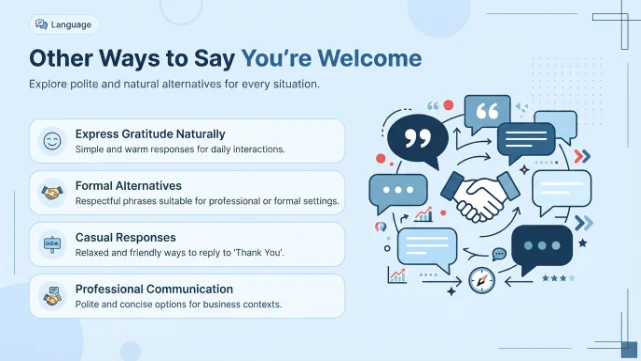
Looking for other ways to say you’re welcome? The most natural alternatives are: my pleasure, no problem, anytime, glad I could help, and happy to help. Each carries a slightly different tone, so choosing the right one depends on whether you are speaking casually, professionally, or formally.
“You’re welcome” is the default response English speakers use after someone says “thank you.” It is polite, simple, and universally understood, which is exactly why it gets repeated so often in daily conversation, emails, and customer service interactions.
However, relying on the same phrase every time can make your English sound repetitive or even robotic. Learning alternatives to you’re welcome helps you sound more natural, adjust your tone to the situation, and build stronger fluency across formal and informal contexts. It also helps you express excitement in English when someone is especially grateful, instead of giving a flat, generic reply.
This guide breaks down alternatives to “you’re welcome” by tone and context, so you always know which phrase fits the moment, whether you’re in a business meeting or chatting with a friend.
“The right tone makes your English sound professional and confident.”
Quick Categories
Formal Alternatives to “You’re Welcome”
- You’re very welcome
- It’s my pleasure
- Not a problem at all
- Certainly
Pro Tip: Use formal alternatives in emails, client meetings, or when addressing someone senior. They signal respect without sounding cold.
Casual Alternatives
- No problem
- No worries
- Sure thing
- No sweat
Pro Tip: Save these for friends, close colleagues, or relaxed conversations. They can sound too informal in professional writing.
Professional Alternatives
- I’m happy to help
- Of course
- It was my pleasure to assist
- Glad I could help
Pro Tip: These are ideal professional reaction phrases for customer service, workplace emails, and client-facing conversations.
Informal Expressions
- Anytime
- You got it
- It’s all good
- No prob
Pro Tip: Informal expressions in English work well in texting and spoken conversation, but avoid them in written business communication.
“Small changes in wording create big changes in how confident you sound.”
Common Mistakes
- Overusing “no problem” in formal writing. Example: “No problem, please find the attached report.” (Too casual for a client email.)
- Using “you’re very welcome” sarcastically without realizing the tone shift. Example: “You’re very welcome!” said flatly can sound passive-aggressive.
- Repeating “you’re welcome” too many times in one conversation. Example: Saying it after every small thank-you makes responses feel mechanical.
- Mixing formal and informal phrases in the same message. Example: “Certainly! No worries at all.” (Inconsistent tone.)
- Forgetting punctuation, which changes tone. Example: “No problem.” vs “No problem!” carry different levels of warmth.
What Does “You’re Welcome” Mean?
“You’re welcome” is a polite response used to acknowledge someone’s thanks. Grammatically, it is a contraction of “you are welcome,” functioning as a fixed expression rather than a literal sentence about being invited somewhere.
Example Sentence: “Thank you for helping me move.” “You’re welcome.”
When to Use “You’re Welcome”
- After someone directly thanks you for a favor or assistance
- In customer service replies
- In casual conversations with friends or family
- In formal written responses, such as emails
Spoken vs Written: In speech, it is often shortened or replaced with casual alternatives like “no problem.” In writing, especially formal writing, “you’re welcome” or “it’s my pleasure” is preferred.
Formal vs Informal: Formal settings favor phrases like “certainly” or “you’re very welcome,” while informal settings favor “no worries” or “anytime.”
Is It Professional or Polite to Say “You’re Welcome”?
“You’re welcome” is polite in almost every situation, but it is not always the most professional choice depending on context.
Business Example: “Thank you for the quick turnaround on this project.” “You’re welcome, happy to help whenever you need.”
Polite? Yes Professional? No, in most cases it needs a slight upgrade for formal business writing.
Pros and Cons of Using “You’re Welcome”
Pros:
- Simple and natural
- Friendly tone
- Common usage
- Easy to understand
Cons:
- Too informal for work in some contexts
- Overused
- Limited emotional range
- Not suitable for highly formal writing
“Fluency isn’t about big words. It’s about choosing the right words.”
Other Ways to Say “You’re Welcome”
These alternatives will help you sound more fluent, confident, and natural in different situations. Use them according to tone, context, and audience to express excitement, admiration, or approval when responding to thanks.
1. Phrase: My pleasure
Meaning: A warm way to say helping was enjoyable. Explanation: Shows genuine willingness rather than obligation. Example Sentence: “Thanks for waiting.” “My pleasure.” Best Use: Customer service, hospitality Worst Use: Very casual chats Tone: Warm, polite, sincere Context Variability: professional, spoken
2. Phrase: No problem
Meaning: A casual assurance that the favor was easy. Explanation: Downplays the effort involved. Example Sentence: “Thanks for the ride.” “No problem.” Best Use: Everyday conversation Worst Use: Formal emails Tone: Relaxed, friendly Context Variability: casual, spoken
3. Phrase: Anytime
Meaning: Signals willingness to help again in the future. Explanation: Builds ongoing rapport with the listener. Example Sentence: “Thanks for tutoring me.” “Anytime.” Best Use: Friends, close colleagues Worst Use: Formal writing Tone: Friendly, reassuring Context Variability: casual, spoken
4. Phrase: Don’t mention it
Meaning: Suggests the favor was too small to acknowledge. Explanation: Minimizes the effort in a humble way. Example Sentence: “Thanks for covering my shift.” “Don’t mention it.” Best Use: Casual favors Worst Use: Serious business matters Tone: Humble, easygoing Context Variability: casual, spoken
5. Phrase: You’re very welcome
Meaning: A stronger, more emphatic version of “you’re welcome.” Explanation: Adds sincerity or emphasis to the response. Example Sentence: “Thank you so much for your patience.” “You’re very welcome.” Best Use: Formal or heartfelt moments Worst Use: Sarcastic tone situations Tone: Formal, sincere Context Variability: formal, professional, spoken
6. Phrase: It was nothing
Meaning: Downplays the size of the favor. Explanation: Suggests modesty about the help given. Example Sentence: “Thanks for fixing my laptop.” “It was nothing.” Best Use: Casual settings Worst Use: Professional emails Tone: Humble, casual Context Variability: casual, spoken
7. Phrase: Glad I could help
Meaning: Expresses satisfaction in being useful. Explanation: Focuses on the positive outcome of helping. Example Sentence: “Thanks for the advice.” “Glad I could help.” Best Use: Workplace, mentoring Worst Use: Overly formal contracts Tone: Supportive, professional Context Variability: professional, spoken
8. Phrase: Happy to help
Meaning: Communicates enthusiasm about assisting. Explanation: Common professional reaction phrase in service industries. Example Sentence: “Thank you for resolving my issue.” “Happy to help.” Best Use: Customer support Worst Use: Very informal texting Tone: Positive, professional Context Variability: professional, spoken
9. Phrase: No worries
Meaning: Reassures the listener that nothing needs to be repaid. Explanation: Removes any sense of obligation. Example Sentence: “Sorry for the delay, thanks for waiting.” “No worries.” Best Use: Informal chats Worst Use: Formal reports Tone: Relaxed, casual Context Variability: casual, spoken
10. Phrase: Sure thing
Meaning: A quick, casual acknowledgment of thanks. Explanation: Common in spoken American English. Example Sentence: “Thanks for grabbing coffee.” “Sure thing.” Best Use: Friendly conversation Worst Use: Written business documents Tone: Casual, upbeat Context Variability: casual, spoken
11. Phrase: Of course
Meaning: Suggests helping was expected and natural. Explanation: Works well in both professional and casual tone. Example Sentence: “Thank you for explaining that again.” “Of course.” Best Use: Workplace conversation Worst Use: Highly emotional moments Tone: Neutral, professional Context Variability: professional, casual, spoken
12. Phrase: Not a problem at all
Meaning: A slightly more formal version of “no problem.” Explanation: Adds politeness while keeping it approachable. Example Sentence: “Thanks for staying late.” “Not a problem at all.” Best Use: Workplace favors Worst Use: Very casual texting Tone: Polite, reassuring Context Variability: professional, spoken
13. Phrase: It’s my pleasure
Meaning: A formal way to express willingness to help. Explanation: Common in hospitality and client service. Example Sentence: “Thank you for your assistance today.” “It’s my pleasure.” Best Use: Formal service settings Worst Use: Texting friends Tone: Formal, warm Context Variability: formal, professional
14. Phrase: I’m happy to help
Meaning: A first-person version emphasizing personal willingness. Explanation: Sounds proactive and service-oriented. Example Sentence: “Thank you for the quick response.” “I’m happy to help.” Best Use: Emails, workplace chats Worst Use: Very formal ceremonies Tone: Professional, friendly Context Variability: professional, spoken
15. Phrase: Think nothing of it
Meaning: Tells the listener not to worry about the favor. Explanation: Slightly old-fashioned but still used. Example Sentence: “Thanks for the ride home.” “Think nothing of it.” Best Use: Polite casual talk Worst Use: Modern business writing Tone: Gracious, old-fashioned Context Variability: casual, spoken
16. Phrase: That’s what friends are for
Meaning: Highlights the personal relationship behind the favor. Explanation: Adds emotional warmth to the response. Example Sentence: “Thanks for listening to me vent.” “That’s what friends are for.” Best Use: Close friendships Worst Use: Professional settings Tone: Warm, personal Context Variability: casual, spoken
17. Phrase: No thanks necessary
Meaning: Politely tells the listener that gratitude is not required. Explanation: Slightly formal and humble in tone. Example Sentence: “Thank you for your help with the report.” “No thanks necessary.” Best Use: Workplace, formal writing Worst Use: Very casual texting Tone: Humble, polite Context Variability: formal, professional
18. Phrase: It was my pleasure to assist
Meaning: A polished, formal acknowledgment of thanks. Explanation: Common in client-facing or hospitality roles. Example Sentence: “Thank you for your excellent service.” “It was my pleasure to assist.” Best Use: Formal customer service Worst Use: Everyday texting Tone: Formal, professional Context Variability: formal, professional
19. Phrase: Anytime, that’s what I’m here for
Meaning: Reinforces ongoing availability to help. Explanation: Combines reassurance with warmth. Example Sentence: “Thanks for always answering my questions.” “Anytime, that’s what I’m here for.” Best Use: Mentorship, teamwork Worst Use: Strictly formal writing Tone: Supportive, friendly Context Variability: professional, spoken
20. Phrase: It’s the least I could do
Meaning: Suggests the help given was minor compared to what could be offered. Explanation: Adds humility to the response. Example Sentence: “Thanks for driving me to the airport.” “It’s the least I could do.” Best Use: Personal favors Worst Use: Corporate emails Tone: Humble, sincere Context Variability: casual, spoken
21. Phrase: I’m glad it worked out
Meaning: Focuses on the positive result rather than the effort. Explanation: Useful when the outcome mattered more than the process. Example Sentence: “Thanks for helping me fix the schedule.” “I’m glad it worked out.” Best Use: Problem-solving contexts Worst Use: Very formal documents Tone: Positive, reassuring Context Variability: professional, spoken
22. Phrase: You got it
Meaning: A quick, confident acknowledgment. Explanation: Common in casual American workplaces. Example Sentence: “Thanks for sending that file over.” “You got it.” Best Use: Informal teams Worst Use: Formal client letters Tone: Confident, casual Context Variability: casual, spoken
23. Phrase: No sweat
Meaning: Suggests the task required no real effort. Explanation: Very informal and conversational. Example Sentence: “Thanks for carrying the boxes.” “No sweat.” Best Use: Friends, casual work environments Worst Use: Professional writing Tone: Relaxed, informal Context Variability: casual, spoken
24. Phrase: Certainly
Meaning: A brief, formal way to acknowledge thanks. Explanation: Common in customer service scripts. Example Sentence: “Thank you for your patience.” “Certainly, happy to assist.” Best Use: Formal service interactions Worst Use: Casual texting Tone: Formal, polished Context Variability: formal, professional
25. Phrase: Absolutely, happy to help
Meaning: Combines enthusiasm with willingness. Explanation: Sounds proactive and engaged. Example Sentence: “Thanks for reviewing my draft.” “Absolutely, happy to help.” Best Use: Workplace collaboration Worst Use: Very formal ceremonies Tone: Enthusiastic, professional Context Variability: professional, spoken
26. Phrase: That’s alright
Meaning: A neutral, casual acknowledgment. Explanation: Common in everyday British and American English. Example Sentence: “Thanks for waiting for me.” “That’s alright.” Best Use: Everyday conversation Worst Use: Business writing Tone: Neutral, casual Context Variability: casual, spoken
27. Phrase: I was happy to do it
Meaning: Emphasizes personal satisfaction in helping. Explanation: Adds a reflective, sincere tone. Example Sentence: “Thanks for organizing the event.” “I was happy to do it.” Best Use: Personal or team settings Worst Use: Strictly formal writing Tone: Sincere, warm Context Variability: professional, spoken
28. Phrase: It’s all good
Meaning: A relaxed way to dismiss the need for thanks. Explanation: Very common in informal spoken English. Example Sentence: “Thanks for understanding.” “It’s all good.” Best Use: Casual conversation Worst Use: Formal emails Tone: Relaxed, informal Context Variability: casual, spoken
29. Phrase: Consider it done
Meaning: Shifts focus to the completion of the task rather than the thanks itself. Explanation: Sounds confident and action-oriented. Example Sentence: “Thanks for taking care of that.” “Consider it done.” Best Use: Workplace tasks Worst Use: Emotional or personal moments Tone: Confident, professional Context Variability: professional, spoken
30. Phrase: No prob
Meaning: A shortened, very casual version of “no problem.” Explanation: Common in texting and informal speech among friends. Example Sentence: “Thanks for the quick reply.” “No prob.” Best Use: Texting, informal chats Worst Use: Any formal communication Tone: Very casual, playful Context Variability: casual, spoken
“Every alternative you learn is a new tool for sounding fluent.”
Mini Quiz
1. Which phrase is most appropriate in a formal business email?
A) No prob B) It’s my pleasure C) No sweat D) You got it
2. A close friend thanks you for a small favor. Which reply fits best?
A) It was my pleasure to assist B) No worries C) Certainly D) No thanks necessary
3. Your manager thanks you for finishing a report early. Best professional reply?
A) No sweat B) Glad I could help C) It’s all good D) No prob
4. Which phrase adds the most warmth and formality together?
A) You’re very welcome B) Sure thing C) No prob D) That’s alright
Answers: 1-B, 2-B, 3-B, 4-A
Comparison Table: Top Alternatives
| Phrase | Tone | Best Use |
|---|---|---|
| My pleasure | Warm, sincere | Customer service |
| No problem | Relaxed, friendly | Everyday conversation |
| Anytime | Friendly, reassuring | Friends, colleagues |
| You’re very welcome | Formal, sincere | Heartfelt moments |
| Glad I could help | Supportive, professional | Workplace |
| Happy to help | Positive, professional | Customer support |
| No worries | Relaxed, casual | Informal chats |
| It’s my pleasure | Formal, warm | Hospitality |
| I’m happy to help | Professional, friendly | Emails |
| Certainly | Formal, polished | Service interactions |
FAQs
1. What is the most professional way to say “you’re welcome”?
“I’m happy to help” or “It’s my pleasure” are the most professional reaction phrases for workplace communication.
2. Is “no problem” rude to say instead of “you’re welcome”?
No, it is not rude, but it is casual, so it works better in informal settings than formal writing.
3. What are formal alternatives to “you’re welcome” for emails?
Formal alternatives include “you’re very welcome,” “certainly,” and “it was my pleasure to assist.”
4. How do I express excitement in English when someone thanks me a lot?
Use enthusiastic phrases like “absolutely, happy to help” or “anytime, that’s what I’m here for.”
5. Can I use “you’re welcome” in both spoken and written English?
Yes, it works in both, but formal writing benefits from slightly more polished alternatives.
Conclusion
Learning multiple other ways to say you’re welcome helps you avoid sounding repetitive and lets you match your tone to any situation, whether formal, professional, or casual. Small shifts in wording can make your English feel more natural and confident.
Practice using a few new alternatives every day, paying attention to tone and context. Over time, this awareness will make your spoken and written English sound noticeably more fluent and polished.
See also: Other Ways to Say Thank You See also: Professional English Communication Guide
Try using three new alternatives from this list in your conversations this week and notice the difference in how natural your English sounds.
Discover More Related article:
- Other Ways to Say Goodnight | Friends, Family & Loved Ones In 2026
- Other Ways to Say Good Night | Formal, Casual & Cute Expressions In 2026

Richard Scott is an experienced author dedicated to creating compelling and well-researched content for online audiences. As a contributor to Responary.com, he enjoys sharing knowledge through clear, engaging, and informative articles that connect with readers worldwide.