Quick Answer
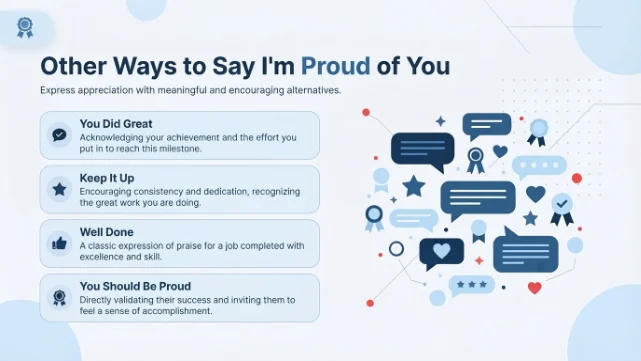
If you want other ways to say I’m proud of you without repeating the same phrase, English offers dozens of natural alternatives for every tone and setting. Top picks: you should be proud, that’s impressive, well done, you earned this, and I’m so pleased with you.
Saying “I’m proud of you” is one of the warmest things you can tell someone, whether it’s a parent praising a child, a manager recognizing an employee, or a friend celebrating a win. But repeating the same line again and again can start to feel flat. That’s why learning alternatives to I’m proud of you is such a useful fluency skill for both spoken and written English.
People reach for this phrase after achievements big and small: a graduation, a promotion, a hard workout finished, or simply a kind decision made under pressure. Knowing multiple ways to express excitement in English and admiration helps you sound genuine rather than repetitive, and it lets you match your tone to the situation, whether that’s a formal work email or a casual text to a friend.
This guide breaks down 30 alternatives, organized by tone, along with meanings, examples, and guidance on when each one fits best. By the end, you’ll have a full toolkit of professional reaction phrases and informal expressions in English to keep your praise sounding fresh and sincere.
“The right tone makes your English sound professional and confident.”
Quick Categories to Say I’m Proud of You
Formal alternatives to “I’m proud of you”
- I commend you for this achievement
- Your dedication is truly admirable
- This reflects great credit on you
- I hold you in high regard for this
Pro Tip: Save formal alternatives for written communication, ceremonies, or professional recognition, where warmth still needs to sound polished.
Casual alternatives to “I’m proud of you”
- I’m so happy for you
- You did it
- Look at you go
- That’s amazing, honestly
Pro Tip: Casual phrases work best face-to-face or in texts, where tone of voice and emojis can add warmth that plain text sometimes lacks.
Professional alternatives to “I’m proud of you”
- Great work on this project
- Your effort really paid off
- This is a strong result
- You should be proud of this outcome
Pro Tip: In the workplace, pair praise with a specific detail (“great work on the client presentation”) so it sounds sincere, not generic.
Informal expressions to say I’m proud of you
- You crushed it
- Way to go
- You’re killing it
- Nailed it
Pro Tip: Informal expressions are great for close friends and family, but avoid them in emails to supervisors or clients.
“Small changes in phrasing can completely change how sincere your praise sounds.”
Common Mistakes When Using “I’m Proud of You”
- Overusing it until it loses meaning
Example: Saying “I’m proud of you” after every tiny task instead of saving it for genuine milestones. - Using it in place of specific feedback
Example: “I’m proud of you” instead of “I’m proud of how you handled that difficult client call.” - Saying it too formally in casual settings
Example: Telling a close friend “I commend you for this achievement” instead of “You did it.” - Using it condescendingly toward peers or superiors
Example: A junior employee telling a senior manager “I’m proud of you” in a way that feels inappropriate for the hierarchy. - Forgetting to explain why
Example: Just saying “I’m proud of you” with no context, leaving the listener unsure what specifically earned the praise.
What Does “I’m Proud of You” Mean?
“I’m proud of you” is an expression of pride, admiration, and approval directed at someone for an achievement, effort, or positive personal quality. Grammatically, it follows the pattern subject + be + proud + of + object, where “proud” functions as an adjective describing the speaker’s emotional state.
Example Sentence: “I’m proud of you for finishing the marathon despite the injury.”
When to Use “I’m Proud of You”
Common contexts where this phrase fits naturally:
- Celebrating a graduation, promotion, or major life milestone
- Recognizing effort after a difficult challenge or setback
- Encouraging a child, student, or mentee
- Supporting a partner or friend through personal growth
- Acknowledging courage in a hard decision
Spoken vs Written: Spoken use tends to be warmer and more spontaneous, often paired with a smile or hug. Written use, such as in cards or messages, benefits from adding a specific detail to avoid sounding generic.
Formal vs Informal: In formal settings, alternatives like “I commend you” or “this reflects great credit on you” work better. In informal settings, “you crushed it” or “way to go” feel more natural.
Is It Professional or Polite to Say “I’m Proud of You”?
“I’m proud of you” is polite and warm, but it’s not always the most professional choice in a strictly business context, since it can sound personal or hierarchical rather than collegial.
Business Example: Instead of telling a colleague “I’m proud of you” after a successful pitch, a more professional phrasing would be “Excellent work on that pitch, your preparation really showed.”
Polite? ✔️ Yes Professional? ❌ No (in most cases)
Pros and Cons of Using “I’m Proud of You”
Pros:
- Simple and natural to say
- Warm, encouraging tone
- Common and widely understood
- Easy for English learners to use correctly
Cons:
- Can sound too personal for formal workplaces
- Overused if repeated without specifics
- Limited emotional range compared to more descriptive praise
- Not always suitable for formal written communication
“Learning alternatives to I’m proud of you helps your praise feel personal, not repetitive.”
Other Ways to Say “I’m Proud of You”
These alternatives will help you sound more fluent, confident, and natural in different situations. Use them according to tone, context, and audience to express excitement, admiration, or approval.
1. Phrase: You should be proud
Meaning: Encourages someone to recognize their own achievement. Explanation: Shifts the focus to the listener’s own sense of accomplishment. Example Sentence: “You should be proud of how far you’ve come this year.” Best Use: Encouragement, mentoring Worst Use: Very formal writing Tone: Warm, encouraging Context Variability: casual, spoken, professional
2. Phrase: That’s impressive
Meaning: Expresses admiration for a result or skill. Explanation: A short, versatile compliment that works in almost any setting. Example Sentence: “That’s impressive, you finished the report a full day early.” Best Use: Work, casual talk Worst Use: Overly emotional moments Tone: Confident, respectful Context Variability: professional, casual
3. Phrase: Well done
Meaning: A classic congratulatory phrase for a job completed successfully. Explanation: Direct and widely understood, ideal for quick recognition. Example Sentence: “Well done on closing the deal this morning.” Best Use: Workplace, school Worst Use: Deep emotional support Tone: Approving, brisk Context Variability: professional, spoken
4. Phrase: You earned this
Meaning: Highlights that success came from genuine effort. Explanation: Emphasizes hard work rather than luck. Example Sentence: “You earned this promotion after months of extra hours.” Best Use: Career milestones Worst Use: Minor everyday tasks Tone: Respectful, sincere Context Variability: professional, casual
5. Phrase: I’m so pleased with you
Meaning: A gentler, slightly formal way to express pride. Explanation: Common between parents, teachers, and mentors. Example Sentence: “I’m so pleased with you for how you handled that situation.” Best Use: Family, mentoring Worst Use: Business emails Tone: Gentle, affectionate Context Variability: spoken, casual
6. Phrase: I commend you for this achievement
Meaning: A formal statement of praise and approval. Explanation: Suited to ceremonies, awards, or official recognition. Example Sentence: “I commend you for this achievement on behalf of the entire team.” Best Use: Formal ceremonies Worst Use: Texting friends Tone: Formal, respectful Context Variability: professional
7. Phrase: Your dedication is truly admirable
Meaning: Praises consistent effort rather than a single result. Explanation: Focuses on character and work ethic. Example Sentence: “Your dedication is truly admirable, especially given the obstacles this quarter.” Best Use: Performance reviews Worst Use: Quick casual chats Tone: Formal, sincere Context Variability: professional, written
8. Phrase: This reflects great credit on you
Meaning: Suggests the achievement enhances someone’s reputation. Explanation: A more literary, formal expression of pride. Example Sentence: “This reflects great credit on you and the entire department.” Best Use: Award speeches Worst Use: Everyday conversation Tone: Formal, elevated Context Variability: professional, written
9. Phrase: I hold you in high regard for this
Meaning: Expresses respect earned through a specific action. Explanation: Formal and dignified, often used in leadership contexts. Example Sentence: “I hold you in high regard for this level of professionalism.” Best Use: Leadership feedback Worst Use: Casual friendships Tone: Formal, respectful Context Variability: professional
10. Phrase: I’m so happy for you
Meaning: Shares joy in someone else’s success. Explanation: Focuses on shared happiness rather than judgment of effort. Example Sentence: “I’m so happy for you, you deserve this new job.” Best Use: Friends, family Worst Use: Formal business writing Tone: Warm, genuine Context Variability: casual, spoken
11. Phrase: You did it
Meaning: A simple, energetic acknowledgment of success. Explanation: Short and celebratory, often said with excitement. Example Sentence: “You did it! You finally passed the exam!” Best Use: Celebrations Worst Use: Formal reports Tone: Excited, casual Context Variability: spoken, casual
12. Phrase: Look at you go
Meaning: A playful way to acknowledge progress or success. Explanation: Light and friendly, often used between peers. Example Sentence: “Look at you go, three promotions in two years.” Best Use: Friends, coworkers Worst Use: Formal writing Tone: Playful, warm Context Variability: casual, spoken
13. Phrase: That’s amazing, honestly
Meaning: An enthusiastic, informal compliment. Explanation: The word “honestly” adds sincerity and emphasis. Example Sentence: “That’s amazing, honestly, I didn’t think you’d finish that fast.” Best Use: Texting, casual talk Worst Use: Professional emails Tone: Enthusiastic, informal Context Variability: casual, spoken
14. Phrase: Great work on this project
Meaning: Recognizes effort and results on a specific task. Explanation: Common workplace phrase that stays professional and specific. Example Sentence: “Great work on this project, the client was very impressed.” Best Use: Workplace feedback Worst Use: Personal relationships Tone: Professional, appreciative Context Variability: professional
15. Phrase: Your effort really paid off
Meaning: Connects hard work directly to a good outcome. Explanation: Reinforces that the result came from genuine effort. Example Sentence: “Your effort really paid off, the numbers look fantastic this quarter.” Best Use: Performance reviews Worst Use: Casual small talk Tone: Encouraging, professional Context Variability: professional, spoken
16. Phrase: This is a strong result
Meaning: A measured, professional way to acknowledge success. Explanation: Keeps focus on outcomes rather than emotions. Example Sentence: “This is a strong result given the tight deadline.” Best Use: Business reports Worst Use: Personal celebrations Tone: Neutral, professional Context Variability: professional, written
17. Phrase: You should be proud of this outcome
Meaning: Encourages ownership of a professional achievement. Explanation: Balances praise with a nod to the listener’s own effort. Example Sentence: “You should be proud of this outcome, the whole team noticed your leadership.” Best Use: Team feedback Worst Use: Very casual chats Tone: Respectful, encouraging Context Variability: professional
18. Phrase: You crushed it
Meaning: Informal way to say someone did extremely well. Explanation: Popular in casual and youth-oriented conversation. Example Sentence: “You crushed it in that presentation today.” Best Use: Friends, casual teams Worst Use: Formal emails Tone: Energetic, informal Context Variability: casual, spoken
19. Phrase: Way to go
Meaning: A quick, encouraging phrase of approval. Explanation: Common in everyday spoken English. Example Sentence: “Way to go on finishing that project early.” Best Use: Casual encouragement Worst Use: Formal documents Tone: Friendly, upbeat Context Variability: casual, spoken
20. Phrase: You’re killing it
Meaning: Slang for performing exceptionally well. Explanation: Very informal, common among younger speakers and casual teams. Example Sentence: “You’re killing it with this new workout routine.” Best Use: Close friends, informal chats Worst Use: Professional settings Tone: Slang, energetic Context Variability: casual, spoken
21. Phrase: Nailed it
Meaning: Informal way to say something was done perfectly. Explanation: Short and punchy, often used after a specific task. Example Sentence: “You nailed it on the first try.” Best Use: Casual praise Worst Use: Formal writing Tone: Casual, confident Context Variability: spoken, casual
22. Phrase: I couldn’t be prouder
Meaning: An intensified version of pride, often emotional. Explanation: Suggests the highest possible level of pride. Example Sentence: “I couldn’t be prouder of the person you’ve become.” Best Use: Family milestones Worst Use: Routine workplace tasks Tone: Emotional, sincere Context Variability: spoken, casual
23. Phrase: You’ve made me so proud
Meaning: Directly attributes the speaker’s pride to the listener’s actions. Explanation: Common between parents, teachers, and close mentors. Example Sentence: “You’ve made me so proud with how you handled that challenge.” Best Use: Family, mentoring Worst Use: Business communication Tone: Warm, personal Context Variability: spoken, casual
24. Phrase: That’s a huge accomplishment
Meaning: Emphasizes the scale or difficulty of the achievement. Explanation: Works well for major milestones rather than small tasks. Example Sentence: “That’s a huge accomplishment, finishing the degree while working full time.” Best Use: Major milestones Worst Use: Minor daily wins Tone: Respectful, admiring Context Variability: professional, casual
25. Phrase: I’m impressed by your growth
Meaning: Praises long-term development rather than a single event. Explanation: Useful for progress over time, such as in coaching or mentoring. Example Sentence: “I’m impressed by your growth since you joined the team.” Best Use: Mentoring, reviews Worst Use: One-time small tasks Tone: Reflective, encouraging Context Variability: professional, spoken
26. Phrase: You should feel really good about this
Meaning: Encourages the listener to internalize their success. Explanation: Focuses on the listener’s own emotional response. Example Sentence: “You should feel really good about this, you handled it perfectly.” Best Use: Encouragement Worst Use: Very formal writing Tone: Supportive, warm Context Variability: casual, spoken
27. Phrase: Kudos to you
Meaning: A brief, friendly congratulatory expression. Explanation: Common in workplace chats and casual professional settings. Example Sentence: “Kudos to you for handling that difficult client so calmly.” Best Use: Team chats, casual work Worst Use: Very formal documents Tone: Friendly, appreciative Context Variability: professional, casual
28. Phrase: You’ve outdone yourself
Meaning: Suggests the achievement exceeded the person’s own previous best. Explanation: Implies ongoing improvement and high standards. Example Sentence: “You’ve outdone yourself with this year’s event planning.” Best Use: Repeated achievers Worst Use: First-time attempts Tone: Admiring, warm Context Variability: casual, professional
29. Phrase: That took real courage
Meaning: Praises bravery behind a difficult decision or action. Explanation: Focuses on character rather than outcome alone. Example Sentence: “That took real courage to speak up in that meeting.” Best Use: Difficult decisions Worst Use: Routine achievements Tone: Respectful, sincere Context Variability: professional, spoken
30. Phrase: I’m rooting for you, and this proves it
Meaning: Combines ongoing support with recognition of current success. Explanation: Reinforces long-term encouragement alongside praise. Example Sentence: “I’m rooting for you, and this proves it, you’re exactly where you should be.” Best Use: Ongoing encouragement Worst Use: Brief formal acknowledgments Tone: Supportive, sincere Context Variability: casual, spoken
“Every alternative to I’m proud of you carries its own shade of meaning, choose the one that matches the moment.”
Mini Quiz: Test Your Understanding
1. Which phrase is most appropriate for a formal award ceremony?
A) You crushed it B) I commend you for this achievement C) Nailed it D) You’re killing it
2. Which phrase best fits a quick text to a close friend?
A) I hold you in high regard for this B) This reflects great credit on you C) Way to go D) Your dedication is truly admirable
3. In a professional performance review, which phrase works best?
A) Your effort really paid off B) You’re killing it C) Nailed it D) Look at you go
4. Which phrase focuses on courage rather than results?
A) That’s impressive B) That took real courage C) Well done D) Kudos to you
Answers: 1-B, 2-C, 3-A, 4-B
Comparison Table: Top Alternatives
| Phrase | Tone | Best Use |
|---|---|---|
| You should be proud | Warm, encouraging | Mentoring |
| That’s impressive | Confident, respectful | Work, casual talk |
| Well done | Approving, brisk | Workplace, school |
| You earned this | Respectful, sincere | Career milestones |
| I commend you for this achievement | Formal, respectful | Ceremonies |
| I’m so happy for you | Warm, genuine | Friends, family |
| Great work on this project | Professional, appreciative | Workplace feedback |
| You crushed it | Energetic, informal | Friends, casual teams |
| I couldn’t be prouder | Emotional, sincere | Family milestones |
| Kudos to you | Friendly, appreciative | Team chats |
FAQs
Q1: What is the most professional way to say I’m proud of you?
“Great work on this project” or “your effort really paid off” are strong professional alternatives that keep praise specific and workplace-appropriate.
Q2: What is a casual way to say I’m proud of you to a friend?
“You did it” or “you crushed it” work well for casual, spoken conversations with friends.
Q3: Is it okay to say I’m proud of you to a coworker?
It’s polite but can feel personal; phrases like “kudos to you” or “well done” are safer for coworker relationships.
Q4: How can I make I’m proud of you sound more sincere?
Add a specific detail about what earned the praise, rather than stating the phrase alone.
Q5: What’s a stronger way to express pride than the standard phrase?
“I couldn’t be prouder” or “you’ve made me so proud” intensify the emotion for major milestones.
Conclusion
Learning multiple ways to say I’m proud of you gives your English more range, warmth, and precision. Instead of relying on a single phrase, you can now choose from formal, professional, casual, and informal expressions that match the exact moment, whether it’s a graduation, a promotion, or a quiet personal victory.
Make it a habit to practice a few new alternatives each week, paying close attention to tone. Over time, this awareness will help your praise sound more natural, sincere, and fluent, whether you’re speaking with a colleague, a friend, or a loved one.
Practice using three of these alternatives today in a real conversation or message, and notice how the reaction changes.
Discover More Related Articles:
- Other Ways to Say Congratulations | Synonyms & Better Alternatives In 2026
- Other Ways to Say Good Luck |for Every Situation In 2026

Richard Scott is an experienced author dedicated to creating compelling and well-researched content for online audiences. As a contributor to Responary.com, he enjoys sharing knowledge through clear, engaging, and informative articles that connect with readers worldwide.