Quick Answer
If you want fresh alternatives to “good night,” you have plenty of natural options for every situation. These alternatives to good night work in casual chats, formal emails, and professional messages alike.
Top picks include: sleep well, sweet dreams, rest well, take care and sleep tight, have a peaceful night.
“Good night” is one of the most common closing phrases in English. People say it before going to bed, at the end of a phone call, or when leaving a friend’s house late in the evening. It signals warmth, care, and a polite farewell.
Learning alternatives to good night helps you sound more natural and avoid repeating the same phrase every day. Whether you want to express excitement in English for a fun evening ending or simply sound more polished in writing, having a variety of expressions makes your communication richer.
This guide breaks down formal, casual, professional, and informal expressions in English so you always know the right words for the right moment.
“The right tone makes your English sound professional and confident.”
Quick Categories
Formal alternatives to “good night”
- Have a restful night
- Wishing you a peaceful evening
- I hope you sleep well tonight
- Rest well this evening
Pro Tip: Use formal alternatives in emails to clients, colleagues, or anyone in a professional hierarchy above you.
Casual alternatives
- Sleep tight
- Catch you tomorrow
- Night night
- Sweet dreams
Pro Tip: Save casual alternatives for close friends and family members, not for workplace conversations.
Professional alternatives
- I will follow up in the morning
- Have a good evening
- Speak soon, take care
- Wishing you a relaxing night
Pro Tip: In professional settings, pair your phrase with a clear next step, such as “Have a good evening, I will send the report tomorrow.”
Informal expressions
- Nighty night
- Off to bed
- See you in dreamland
- Sleep well, don’t let the bugs bite
Pro Tip: Informal expressions work best in texting and casual voice messages, not in written business communication.
“Small changes in vocabulary create a big shift in tone.”
Common Mistakes
- Using it too formally in casual chats
Saying “I bid you good night” to a close friend sounds unnatural. - Repeating the same phrase in every message
Typing “good night” daily without variation feels robotic. - Mixing tone with context
Saying “night night” to your boss can seem unprofessional. - Forgetting punctuation in texts –
Writing “goodnight” as one word is common in texting but incorrect in formal writing. - Overusing exclamation marks
Writing “Good night!!!” in a business email looks unprofessional.
What Does “Good Night” Mean?
“Good night” is a farewell expression used when parting ways in the evening or before sleep. Grammatically, it functions as an interjection or a short exchange phrase, and it is written as two separate words in standard English, though “goodnight” as one word is common informally.
Example Sentence: She smiled, said good night, and closed the door softly.
When to Use “Good Night”
- Before going to bed
- At the end of an evening phone call
- When leaving a friend’s home late at night
- In text messages to close contacts
- Spoken: Common in daily conversation with family and friends
- Written: Used in casual texts, less common in formal emails
Is It Professional or Polite to Say “Good Night”?
“Good night” is polite, but it is not always professional. In business communication, a more neutral phrase like “have a good evening” is often preferred.
Business-style example: Instead of “Good night, boss,” try “Thank you for your time today, have a good evening.”
Polite? Yes Professional? No (in most formal business contexts)
Pros and Cons of Using “Good Night”
Pros
- Simple and natural
- Friendly tone
- Common usage
- Easy to understand
Cons
- Too informal for work
- Overused
- Limited emotional range
- Not suitable for formal writing
“Variety in language is the secret to sounding fluent.”
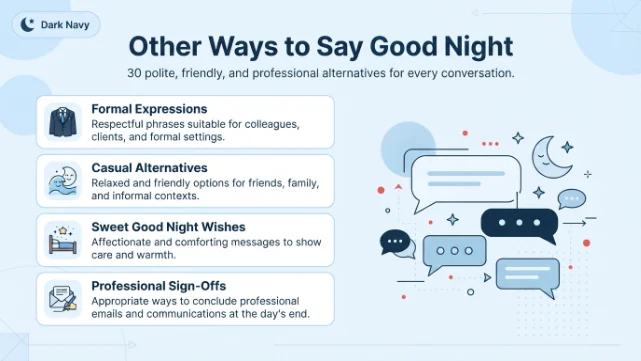
Other Ways to Say “Good Night”
These alternatives will help you sound more fluent, confident, and natural in different situations. Use them according to tone, context, and audience to express excitement, admiration, or approval as the evening ends.
1. Phrase: Sleep well
Meaning: A wish for restful, quality sleep. Explanation: A gentle, warm way to end a conversation before bedtime. Example Sentence: Sleep well, I will see you tomorrow morning. Best Use: Friends, family Worst Use: Formal emails Tone: Warm, caring Context Variability: casual, spoken
2. Phrase: Sweet dreams
Meaning: A wish for pleasant dreams during sleep. Explanation: Often used with children, partners, or close friends. Example Sentence: Sweet dreams, talk to you tomorrow. Best Use: Close relationships Worst Use: Business settings Tone: Affectionate, gentle Context Variability: casual, spoken
3. Phrase: Sleep tight
Meaning: A traditional wish for a safe, comfortable sleep. Explanation: A classic idiom often paired with good night. Example Sentence: Sleep tight, see you at breakfast. Best Use: Family, friends Worst Use: Professional emails Tone: Friendly, nostalgic Context Variability: casual, spoken
4. Phrase: Rest well
Meaning: A wish for good, restorative rest. Explanation: Slightly more neutral and works in semi-formal settings. Example Sentence: Rest well tonight, you had a long day. Best Use: Colleagues, acquaintances Worst Use: Very casual texting Tone: Caring, neutral Context Variability: casual, professional
5. Phrase: Have a peaceful night
Meaning: A wish for calm and stress-free evening rest. Explanation: Sounds thoughtful and slightly formal. Example Sentence: Have a peaceful night, we will talk tomorrow. Best Use: Semi-formal messages Worst Use: Quick casual texts Tone: Calm, considerate Context Variability: professional, spoken
6. Phrase: Wishing you a restful evening
Meaning: A formal wish for relaxation before sleep. Explanation: Common in polite written communication. Example Sentence: Wishing you a restful evening after a busy week. Best Use: Emails, formal notes Worst Use: Casual chats Tone: Polished, respectful Context Variability: professional, written
7. Phrase: Take care and sleep well
Meaning: Combines a farewell with a sleep wish. Explanation: Adds warmth by including a caring phrase. Example Sentence: Take care and sleep well, see you soon. Best Use: Friends, coworkers Worst Use: Strictly formal writing Tone: Warm, friendly Context Variability: casual, professional
8. Phrase: I hope you sleep well tonight
Meaning: A direct, personal wish for good sleep. Explanation: Feels more sincere and specific. Example Sentence: I hope you sleep well tonight after such a long day. Best Use: Personal messages Worst Use: Group emails Tone: Sincere, warm Context Variability: casual, spoken
9. Phrase: Have a good evening
Meaning: A general farewell for the end of the day. Explanation: Neutral and works across most situations. Example Sentence: Have a good evening, thank you for the meeting. Best Use: Work, casual settings Worst Use: None, very versatile Tone: Neutral, polite Context Variability: casual, professional
10. Phrase: Catch you tomorrow
Meaning: An informal way to say goodbye until the next day. Explanation: Popular among younger speakers and friends. Example Sentence: Catch you tomorrow, good luck with the exam. Best Use: Friends, casual texts Worst Use: Professional communication Tone: Relaxed, informal Context Variability: casual, spoken
11. Phrase: Night night
Meaning: A playful, repeated version of good night. Explanation: Often used with children or in affectionate texting. Example Sentence: Night night, sleep tight, see you soon. Best Use: Close friends, family Worst Use: Formal writing Tone: Playful, sweet Context Variability: casual, spoken
12. Phrase: Off to bed
Meaning: A statement announcing you are going to sleep. Explanation: Simple and direct, often used before saying goodbye. Example Sentence: I am off to bed, talk tomorrow. Best Use: Texting, casual chats Worst Use: Business emails Tone: Casual, straightforward Context Variability: casual, spoken
13. Phrase: See you in the morning
Meaning: A farewell that points toward the next meeting time. Explanation: Practical and forward-looking. Example Sentence: See you in the morning, rest up. Best Use: Roommates, coworkers Worst Use: Formal documents Tone: Practical, friendly Context Variability: casual, professional
14. Phrase: Sleep soundly
Meaning: A wish for deep, undisturbed sleep. Explanation: Slightly more descriptive than sleep well. Example Sentence: Sleep soundly, you deserve the rest. Best Use: Personal messages Worst Use: Group announcements Tone: Gentle, caring Context Variability: casual, spoken
15. Phrase: Have a good night’s rest
Meaning: A wish for a full, quality night of sleep. Explanation: Slightly more formal phrasing than sleep well. Example Sentence: Have a good night’s rest before the interview. Best Use: Semi-formal messages Worst Use: Quick texts Tone: Thoughtful, polite Context Variability: professional, spoken
16. Phrase: Nighty night
Meaning: An affectionate, informal variation of good night. Explanation: Common in close or playful relationships. Example Sentence: Nighty night, see you bright and early. Best Use: Family, partners Worst Use: Workplace messages Tone: Cute, informal Context Variability: casual, spoken
17. Phrase: I am heading to bed
Meaning: A statement that signals the end of the day. Explanation: Practical way to excuse yourself from a conversation. Example Sentence: I am heading to bed, good luck tomorrow. Best Use: Group chats, calls Worst Use: Formal emails Tone: Direct, casual Context Variability: casual, spoken
18. Phrase: Enjoy your rest
Meaning: A wish encouraging relaxation and sleep. Explanation: Warm and slightly more formal than casual options. Example Sentence: Enjoy your rest, you earned it today. Best Use: Coworkers, acquaintances Worst Use: Very casual texting Tone: Warm, respectful Context Variability: professional, spoken
19. Phrase: Sleep well and take care
Meaning: Combines a sleep wish with general care. Explanation: Balances warmth and politeness. Example Sentence: Sleep well and take care, see you next week. Best Use: Friends, semi-formal contacts Worst Use: Strictly formal writing Tone: Caring, balanced Context Variability: casual, professional
20. Phrase: Have a relaxing evening
Meaning: A wish for calm and stress-free time before bed. Explanation: Useful when someone has had a busy day. Example Sentence: Have a relaxing evening after that long meeting. Best Use: Work colleagues Worst Use: Very casual friend groups Tone: Considerate, polite Context Variability: professional, spoken
21. Phrase: Until tomorrow
Meaning: A short farewell implying the conversation will continue later. Explanation: Elegant and slightly formal in tone. Example Sentence: Until tomorrow, rest well tonight. Best Use: Semi-formal writing Worst Use: Very casual texting Tone: Elegant, calm Context Variability: professional, written
22. Phrase: Get some good sleep
Meaning: A direct suggestion to rest properly. Explanation: Practical and often used for someone who seems tired. Example Sentence: Get some good sleep, you looked exhausted today. Best Use: Friends, family Worst Use: Formal emails Tone: Caring, direct Context Variability: casual, spoken
23. Phrase: I will let you sleep
Meaning: A polite way to end a call or conversation late at night. Explanation: Shows consideration for the other person’s time. Example Sentence: It is late, I will let you sleep, talk soon. Best Use: Phone calls Worst Use: Written messages Tone: Considerate, polite Context Variability: casual, spoken
24. Phrase: Rest up
Meaning: A short, casual instruction to relax and sleep. Explanation: Common after a tiring day or event. Example Sentence: Rest up, we have a big day tomorrow. Best Use: Friends, teammates Worst Use: Formal communication Tone: Casual, energetic Context Variability: casual, spoken
25. Phrase: Have a wonderful night
Meaning: An upbeat wish for a good remainder of the evening. Explanation: Slightly more enthusiastic than a plain good night. Example Sentence: Have a wonderful night, thank you for today. Best Use: General farewells Worst Use: None, broadly versatile Tone: Cheerful, warm Context Variability: casual, professional
26. Phrase: Sleep peacefully
Meaning: A wish for calm, undisturbed rest. Explanation: Often used when someone seems stressed or tired. Example Sentence: Sleep peacefully, tomorrow is a new day. Best Use: Personal messages Worst Use: Business writing Tone: Soothing, gentle Context Variability: casual, spoken
27. Phrase: Talk to you tomorrow
Meaning: A farewell that signals when the next conversation will happen. Explanation: Practical and commonly used in texting. Example Sentence: It is getting late, talk to you tomorrow. Best Use: Texting, casual chats Worst Use: Formal reports Tone: Practical, friendly Context Variability: casual, spoken
28. Phrase: May you have a restful sleep
Meaning: A formal, almost poetic wish for good sleep. Explanation: Used in more elegant or written communication. Example Sentence: May you have a restful sleep after such a long journey. Best Use: Formal notes, cards Worst Use: Quick texting Tone: Formal, poetic Context Variability: professional, written
29. Phrase: See you bright and early
Meaning: A farewell that hints at an early start the next day. Explanation: Playful and forward-looking. Example Sentence: See you bright and early, sleep well tonight. Best Use: Friends, family Worst Use: Formal emails Tone: Playful, casual Context Variability: casual, spoken
30. Phrase: Wishing you a good night’s sleep
Meaning: A polished, complete wish for quality rest. Explanation: Works well in both spoken and written formal contexts. Example Sentence: Wishing you a good night’s sleep before the big presentation. Best Use: Professional emails, formal notes Worst Use: Very casual texting Tone: Polished, sincere Context Variability: professional, written
“Learning new expressions is the fastest path to natural fluency.”
Mini Quiz
- Which phrase is best for a formal business email?
a) Nighty night b) Wishing you a restful evening c) Catch you tomorrow d) Off to bed - Which phrase would you avoid saying to your boss?
a) Have a good evening b) Night night c) Rest well d) Sleep well and take care - Which phrase fits a playful text to a close friend?
a) May you have a restful sleep b) See you bright and early c) Wishing you a good night’s sleep d) Have a relaxing evening - Which phrase works well after a long, tiring work meeting?
a) Nighty night b) Have a relaxing evening c) Off to bed d) Catch you tomorrow
Answers: 1-b, 2-b, 3-b, 4-b
“Context is everything when choosing the right farewell phrase.”
Comparison Table: Top Alternatives
| Phrase | Tone | Best Use |
|---|---|---|
| Sleep well | Warm, caring | Friends, family |
| Sweet dreams | Affectionate | Close relationships |
| Sleep tight | Friendly, nostalgic | Family, friends |
| Rest well | Caring, neutral | Colleagues |
| Have a peaceful night | Calm, considerate | Semi-formal messages |
| Wishing you a restful evening | Polished, respectful | Emails, formal notes |
| Have a good evening | Neutral, polite | Work, casual |
| Enjoy your rest | Warm, respectful | Coworkers |
| Have a wonderful night | Cheerful, warm | General farewells |
| Wishing you a good night’s sleep | Polished, sincere | Professional emails |
FAQs
Is “good night” formal or informal?
It is neutral and can work in both contexts, though very casual versions like “night night” are informal.
What is a professional way to say good night?
Phrases like “have a good evening” or “wishing you a restful evening” work well in professional communication.
Can I say “sleep well” instead of “good night”?
Yes, “sleep well” is a warm, natural alternative used in casual and semi-formal contexts.
Is “goodnight” one word or two?
In standard formal writing, it is two words, “good night,” though “goodnight” is common in casual texting.
What are some informal expressions in English for saying good night?
Options like “night night,” “nighty night,” and “off to bed” are popular informal expressions in English.
For more vocabulary building, see also our guide on other ways to say have a great day and our professional English communication guide for workplace phrasing tips.
Conclusion
Learning alternatives to good night gives you the flexibility to match your tone to any situation, whether you are texting a close friend, writing a professional email, or wishing someone a peaceful rest. These 30 expressions help you sound more fluent, warm, and confident in everyday English.
Practice using a few new phrases each week and pay attention to tone before choosing your words. Small, consistent changes in vocabulary will make your English communication feel more natural and polished over time.
If you found these alternatives helpful, try using three new phrases from this list in your conversations this week.

Jennifer Wilson is an experienced writer and content creator with over 20 years of expertise in digital publishing, lifestyle, and informative content. Holding a degree in English Literature, she contributes to Responary.Com, where she shares engaging, well-researched articles that help readers stay informed and inspired.