Quick Answer
Looking for other ways to say you’re welcome? The most natural alternatives are: my pleasure, no problem, happy to help, anytime, and glad I could help. Each phrase carries a different tone, so choosing the right one depends on whether you’re speaking casually, professionally, or formally.
“The right tone makes your English sound professional and confident.”
“You’re welcome” is the standard English response to “thank you.” It signals that you accepted someone’s gratitude and, often, that helping them was no burden at all. People use it in everyday conversations, customer service, emails, and business meetings alike.
Relying on the same phrase every time can make your English sound repetitive or robotic. Learning alternatives to you’re welcome helps you match your response to the situation, whether you want to sound warm, formal, or professional. It also helps you express excitement in English when someone’s thanks feels especially meaningful.
This guide breaks down 30 alternatives, when to use them, and common mistakes to avoid, so you can respond with confidence in any setting.
Quick Categories
Formal Alternatives to “You’re Welcome”
- You’re most welcome
- It was my pleasure
- I’m glad I could help
- It was no trouble at all
Pro Tip: Use formal alternatives in emails, client conversations, and written business communication where a polished tone matters.
Casual Alternatives
- No problem
- No worries
- Sure thing
- Anytime
Pro Tip: Save casual alternatives for friends, family, and relaxed conversations, not client-facing emails.
Professional Alternatives
- Happy to help
- Glad I could assist
- It’s the least I could do
- Always here to help
Pro Tip: Professional alternatives work well in workplace chats, meetings, and customer service, since they sound warm but still polished.
Informal Expressions
- No biggie
- No sweat
- You got it
- It’s all good
Pro Tip: Informal expressions are best for texting or spoken English with close contacts, not formal writing.
“Small word choices shape how confident and fluent you sound.”
Common Mistakes People Make
- Overusing “you’re welcome” in every response. Repeating it constantly can sound flat and unnatural. Example: “Thanks!” “You’re welcome.” “Thanks again!” “You’re welcome.” (repetitive)
Overusing “you’re welcome” in every response. Repeating it constantly can sound flat and unnatural. Example: “Thanks!” “You’re welcome.” “Thanks again!” “You’re welcome.” (repetitive) - Using casual phrases in formal emails.
Example: Writing “No biggie!” to a client instead of “It was my pleasure.” - Sounding sarcastic with the wrong tone.
Example: Saying “Oh, you’re SO welcome” in a professional meeting. - Forgetting context when choosing a phrase.
Example: Saying “Anytime” to a stranger after a formal favor. - Mixing formal and informal phrases in the same message.
Example: “It was my pleasure, no biggie at all.”
What Does “You’re Welcome” Mean?
“You’re welcome” is a polite response used after someone says “thank you.” It acknowledges their gratitude and signals that helping them was not a burden.
Grammar note: It combines the pronoun “you” with the adjective “welcome,” functioning as a fixed conversational phrase rather than a literal statement.
Example sentence: “Thanks for waiting.” “You’re welcome, take your time.”
When to Use “You’re Welcome”
- After receiving thanks for a small or large favor
- In everyday spoken conversations
- In customer service interactions
- In semi-formal written replies, such as short emails
Spoken vs Written: In speech, it sounds natural and quick. In writing, it can feel abrupt unless softened with a phrase like “You’re very welcome.”
Formal vs Informal: It works in both, but formal settings often benefit from a warmer variation like “It was my pleasure.”
Is It Professional or Polite to Say “You’re Welcome”?
“You’re welcome” is polite, but it is not always the most professional choice in business settings. It can sound plain or even slightly abrupt in formal emails.
Business example: Instead of replying “You’re welcome” to a client’s thank-you email, try “I’m glad I could help. Please reach out anytime.”
Polite? Yes Professional? No, in most formal business contexts
Pros and Cons of Using “You’re Welcome”
Pros:
- Simple and natural
- Friendly tone
- Common usage
- Easy to understand
Cons:
- Too informal for work
- Overused
- Limited emotional range
- Not suitable for formal writing
“Variety in your vocabulary is what separates fluent speakers from beginners.”
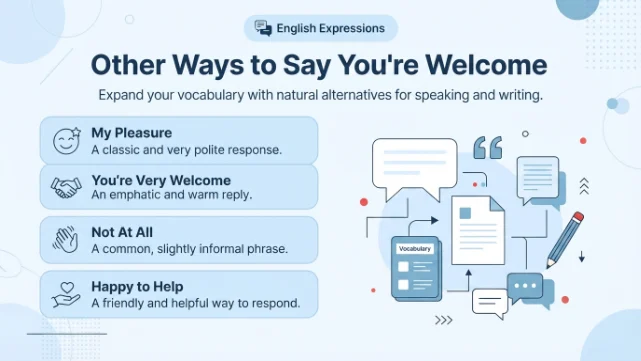
Other Ways to Say You’re Welcome
These alternatives will help you sound more fluent, confident, and natural in different situations. Use them according to tone, context, and audience to express excitement, admiration, or approval when responding to thanks.
1. Phrase: My pleasure
Meaning: A polite way to say helping was enjoyable. Explanation: Common in formal and professional interactions. Example Sentence: “Thank you for the quick delivery.” “My pleasure.” Best Use: customer service, formal Worst Use: casual texting Tone: warm, formal, polished Context Variability: professional, spoken
2. Phrase: It was my pleasure
Meaning: An extended, more expressive version of “my pleasure.” Explanation: Adds emotional warmth to a formal response. Example Sentence: “Thanks for your help today.” “It was my pleasure.” Best Use: business emails, meetings Worst Use: casual chats Tone: gracious, formal, sincere Context Variability: professional, written
3. Phrase: You’re most welcome
Meaning: A more emphatic and formal version of “you’re welcome.” Explanation: Adds politeness for formal or respectful situations. Example Sentence: “Thank you for your patience.” “You’re most welcome.” Best Use: formal speech, hospitality Worst Use: texting friends Tone: formal, respectful, polished Context Variability: formal, spoken
4. Phrase: I’m glad I could help
Meaning: Expresses satisfaction from being useful. Explanation: Shows genuine willingness to assist. Example Sentence: “Thanks for fixing my laptop.” “I’m glad I could help.” Best Use: workplace, tech support Worst Use: overly formal contracts Tone: friendly, sincere, professional Context Variability: professional, spoken
5. Phrase: It was no trouble at all
Meaning: Reassures someone that helping was effortless. Explanation: Removes any guilt the other person may feel. Example Sentence: “Sorry to bother you.” “It was no trouble at all.” Best Use: service settings, favors Worst Use: quick casual replies Tone: reassuring, polite, calm Context Variability: formal, spoken
6. Phrase: No problem
Meaning: A relaxed way to accept thanks. Explanation: Very common in everyday spoken English. Example Sentence: “Thanks for waiting.” “No problem.” Best Use: casual talk, friends Worst Use: formal writing Tone: casual, easygoing, friendly Context Variability: casual, spoken
7. Phrase: No worries
Meaning: A friendly, relaxed acceptance of gratitude. Explanation: Popular in informal spoken English, especially Australian and British English. Example Sentence: “Thanks for covering my shift.” “No worries.” Best Use: casual conversations Worst Use: client emails Tone: casual, laid-back, friendly Context Variability: casual, spoken
8. Phrase: Sure thing
Meaning: An upbeat, casual acceptance of thanks. Explanation: Signals ease and willingness without formality. Example Sentence: “Thanks for grabbing coffee.” “Sure thing.” Best Use: friends, informal chats Worst Use: business meetings Tone: casual, cheerful, relaxed Context Variability: casual, spoken
9. Phrase: Anytime
Meaning: Suggests openness to help again in the future. Explanation: Builds rapport and shows willingness. Example Sentence: “Thanks for the ride.” “Anytime.” Best Use: friends, coworkers Worst Use: first-time formal meetings Tone: friendly, warm, casual Context Variability: casual, professional
10. Phrase: Don’t mention it
Meaning: Downplays the effort involved in helping. Explanation: Suggests the favor was minor and not worth thanking for. Example Sentence: “Thanks for the advice.” “Don’t mention it.” Best Use: casual conversations Worst Use: formal writing Tone: modest, casual, relaxed Context Variability: casual, spoken
11. Phrase: Happy to help
Meaning: Expresses genuine willingness to assist. Explanation: A go-to phrase for professional and workplace settings. Example Sentence: “Thanks for reviewing my report.” “Happy to help.” Best Use: workplace, emails Worst Use: overly casual texting Tone: professional, warm, positive Context Variability: professional, written
12. Phrase: Glad I could assist
Meaning: A polished, professional version of “glad to help.” Explanation: Common in customer service and workplace communication. Example Sentence: “Thank you for resolving the issue.” “Glad I could assist.” Best Use: customer support, business Worst Use: casual chats Tone: professional, courteous, polished Context Variability: professional, written
13. Phrase: It’s the least I could do
Meaning: Suggests the help given was minimal compared to what could be offered. Explanation: Shows humility while accepting thanks. Example Sentence: “Thanks for staying late.” “It’s the least I could do.” Best Use: workplace, close colleagues Worst Use: first impressions Tone: humble, sincere, professional Context Variability: professional, spoken
14. Phrase: I’m happy to be of service
Meaning: A formal expression of willingness to help. Explanation: Common in hospitality and customer-facing roles. Example Sentence: “Thank you for the excellent service.” “I’m happy to be of service.” Best Use: hospitality, formal service Worst Use: casual friendships Tone: formal, polished, courteous Context Variability: professional, spoken
15. Phrase: Always here to help
Meaning: Reinforces ongoing support and reliability. Explanation: Builds trust in professional relationships. Example Sentence: “Thanks for the guidance.” “Always here to help.” Best Use: teamwork, mentorship Worst Use: one-time interactions Tone: supportive, professional, warm Context Variability: professional, written
16. Phrase: No biggie
Meaning: A very casual way to say something was not a big deal. Explanation: Common among friends and in relaxed texting. Example Sentence: “Thanks for lending me your charger.” “No biggie.” Best Use: texting, close friends Worst Use: formal settings Tone: casual, playful, relaxed Context Variability: casual, spoken
17. Phrase: No sweat
Meaning: Indicates the favor required no real effort. Explanation: An informal, breezy way to accept thanks. Example Sentence: “Thanks for helping me move.” “No sweat.” Best Use: informal, spoken English Worst Use: professional emails Tone: casual, relaxed, friendly Context Variability: casual, spoken
18. Phrase: You got it
Meaning: A quick, confident acceptance of thanks. Explanation: Common in American casual English. Example Sentence: “Thanks for the recommendation.” “You got it.” Best Use: casual conversations Worst Use: formal writing Tone: casual, confident, friendly Context Variability: casual, spoken
19. Phrase: It’s all good
Meaning: Reassures the other person that no thanks are necessary. Explanation: Popular in relaxed, informal speech. Example Sentence: “Sorry for the delay, and thanks for waiting.” “It’s all good.” Best Use: casual talk, texting Worst Use: business communication Tone: casual, easygoing, relaxed Context Variability: casual, spoken
20. Phrase: Of course
Meaning: Suggests helping was an obvious, natural choice. Explanation: Works in both casual and semi-formal contexts. Example Sentence: “Thanks for explaining that again.” “Of course.” Best Use: everyday conversations Worst Use: overly formal writing Tone: neutral, warm, natural Context Variability: casual, professional
21. Phrase: Not at all
Meaning: Dismisses the need for thanks entirely. Explanation: Common in British English and polite conversation. Example Sentence: “Thanks for holding the door.” “Not at all.” Best Use: polite everyday exchanges Worst Use: enthusiastic responses Tone: polite, modest, neutral Context Variability: casual, professional
22. Phrase: Think nothing of it
Meaning: Encourages the other person not to feel indebted. Explanation: A slightly old-fashioned but polite expression. Example Sentence: “Thank you so much for your patience.” “Think nothing of it.” Best Use: polite, formal speech Worst Use: quick texting Tone: polite, gracious, formal Context Variability: formal, spoken
23. Phrase: That’s what I’m here for
Meaning: Reinforces that helping is part of your role or purpose. Explanation: Common in workplace and support roles. Example Sentence: “Thanks for troubleshooting my account.” “That’s what I’m here for.” Best Use: support roles, teamwork Worst Use: formal written letters Tone: supportive, confident, professional Context Variability: professional, spoken
24. Phrase: It was nothing
Meaning: Minimizes the effort behind the favor. Explanation: A humble, casual way to accept thanks. Example Sentence: “Thanks for the ride home.” “It was nothing.” Best Use: casual, friendly settings Worst Use: formal business contexts Tone: modest, casual, relaxed Context Variability: casual, spoken
25. Phrase: I was happy to do it
Meaning: Confirms genuine willingness behind the action. Explanation: Adds sincerity to a simple response. Example Sentence: “Thanks for organizing the event.” “I was happy to do it.” Best Use: teamwork, personal favors Worst Use: brief casual replies Tone: sincere, warm, professional Context Variability: professional, spoken
26. Phrase: Consider it done
Meaning: Confirms the task was completed willingly. Explanation: Works well when thanks follow a completed request. Example Sentence: “Thanks for sending the files early.” “Consider it done.” Best Use: workplace, task-based thanks Worst Use: emotional or personal thanks Tone: confident, professional, efficient Context Variability: professional, spoken
27. Phrase: My door is always open
Meaning: Signals ongoing availability to help in the future. Explanation: Common in mentorship and management contexts. Example Sentence: “Thanks for the advice on my project.” “My door is always open.” Best Use: mentorship, leadership Worst Use: one-time casual favors Tone: supportive, professional, welcoming Context Variability: professional, spoken
28. Phrase: Whatever you need
Meaning: Expresses full willingness to help with anything further. Explanation: A warm, generous response to thanks. Example Sentence: “Thanks for being so supportive.” “Whatever you need.” Best Use: close relationships, teamwork Worst Use: formal client communication Tone: warm, generous, casual Context Variability: casual, professional
29. Phrase: It’s my honor
Meaning: Expresses that helping was a privilege. Explanation: Adds a formal, respectful tone to your response. Example Sentence: “Thank you for choosing our service.” “It’s my honor.” Best Use: formal, ceremonial contexts Worst Use: casual everyday replies Tone: formal, respectful, sincere Context Variability: formal, spoken
30. Phrase: Anytime, anywhere
Meaning: An enthusiastic promise of continued support. Explanation: Adds emphasis and warmth compared to a simple “anytime.” Example Sentence: “Thanks for always answering my calls.” “Anytime, anywhere.” Best Use: close friendships, loyal support Worst Use: formal business writing Tone: warm, enthusiastic, casual Context Variability: casual, spoken
“Choosing the right response shows emotional intelligence, not just vocabulary.”
Mini Quiz:
- Which phrase is best for a formal business email?
A. No biggie B. It was my pleasure C. You got it - Which phrase fits a casual text to a friend?
A. I’m happy to be of service B. No worries C. It’s my honor - A client thanks you for finishing a project early. Which response sounds most professional?
A. No sweat B. Consider it done C. It’s all good - Which phrase suggests you are open to helping again in the future?
A. Think nothing of it B. My door is always open C. It was nothing
Answers: 1-B, 2-B, 3-B, 4-B
Comparison Table: Top Alternatives
| Phrase | Tone | Best Use |
|---|---|---|
| My pleasure | Warm, formal | Customer service |
| It was my pleasure | Gracious, formal | Business emails |
| You’re most welcome | Formal, respectful | Formal speech |
| I’m glad I could help | Friendly, professional | Workplace |
| No problem | Casual, easygoing | Friends |
| No worries | Casual, friendly | Everyday talk |
| Happy to help | Professional, warm | Emails |
| Glad I could assist | Professional, courteous | Customer support |
| That’s what I’m here for | Supportive, confident | Support roles |
| Anytime | Friendly, warm | Coworkers, friends |
FAQs
What is a formal way to say “you’re welcome”?
“It was my pleasure” or “You’re most welcome” are strong formal alternatives for business or professional settings.
What is a casual way to say “you’re welcome”?
“No problem,” “no worries,” and “sure thing” are common casual expressions in everyday spoken English.
Is “no problem” professional?
“No problem” is polite but generally too casual for formal business writing. Use “happy to help” instead.
Can I use “anytime” in a work email?
Yes, “anytime” works well informally with coworkers, but pair it with a warmer phrase for clients.
Why should I learn other ways to say “you’re welcome”?
Learning alternatives helps you sound fluent, match your tone to the context, and avoid sounding repetitive.
Conclusion
Learning other ways to say you’re welcome helps you respond naturally in any situation, whether you’re chatting with friends, replying to a client, or speaking in a professional meeting. Each alternative carries its own tone, so choosing the right one shows strong command of English.
Practice these phrases daily in real conversations and emails. Paying attention to tone, formality, and context will help you sound more confident, polished, and fluent every time someone says thank you.
Discover More Related Articles:
- Other Ways to Say As Well As | for Students and Professionals In 2026
- Other Ways to Say Because | Academic and Business Writing In 2026

Laura Adams is a dedicated content writer and blogger known for crafting clear, informative, and engaging articles. As a contributor to Responary.com, she specializes in creating reader-friendly content that educates, inspires, and keeps audiences informed on a wide range of subjects.