Quick Answer
Looking for alternatives to “as well as”? The top choices are: in addition to, along with, together with, plus, and on top of. Each fits a different tone, so picking the right one instantly makes your English sound more natural and confident.
“As well as” is one of the most common linking phrases in English. People use it to connect two or more ideas, items, or people in a single sentence, whether they’re writing an email, giving a presentation, or chatting with a friend.
Relying on the same phrase over and over can make your writing feel repetitive. Learning other ways to say “as well as” helps you sound more fluent and gives you the flexibility to match your tone to the situation, whether you’re trying to sound formal in a report or simply express excitement in English about good news.
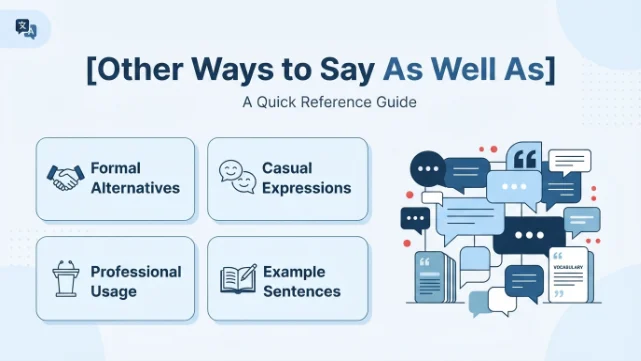
Quick Categories
Formal alternatives to “as well as”
- In addition to
- Along with
- In conjunction with
- Together with
Pro Tip: Use “in conjunction with” and “in addition to” in reports, emails, and academic writing where precision matters more than personality.
Casual alternatives
- Plus
- On top of
- Not to mention
- Too
Pro Tip: Save “plus” and “not to mention” for conversations and casual messages; they sound stiff in formal documents.
Professional alternatives
- Coupled with
- In combination with
- In partnership with
- Supplemented by
Pro Tip: “Coupled with” and “in combination with” work well in business writing when you want to show how two factors work together.
Informal expressions
- Besides
- Also
- As well as that
- Hand in hand with
Pro Tip: “Also” is safe almost everywhere, but “besides” and “hand in hand with” fit best in relaxed, spoken English.
Common Mistakes
- Starting every sentence with “as well as.” Example: “As well as, I finished the report.” (Incorrect placement; it should connect two elements, not stand alone.)
- Using “as well as” and “and” together. Example: “She brought snacks and as well as drinks.” (Redundant; choose one connector.)
- Treating “as well as” like “and” for subject-verb agreement. Example: “The manager, as well as her team, are attending.” (Should be “is attending,” since “as well as” doesn’t make the subject plural.)
- Overusing it in academic writing. Example: “The study, as well as the survey, as well as the interviews, confirmed the results.” (Repetitive; vary your connectors.)
- Using it interchangeably with “not only… but also.” Example: “As well as being late, he forgot the documents.” (Awkward; “not only… but also” fits this structure better.)
What Does “As Well As” Mean?
“As well as” is a linking phrase used to add extra information, showing that something exists or happens in addition to something else. Grammatically, it functions differently from “and”: the phrase after “as well as” is treated as additional information, not a second subject, so the verb agrees with the main subject.
Example: “The team, as well as the client, was satisfied with the results.”
When to Use “As Well As”
- Adding extra details in formal reports or emails
- Introducing a second item without making it the main focus
- Connecting two related facts in spoken conversation
- Spoken: Common in everyday explanations and casual updates
- Written: Frequently used in business writing, essays, and news articles
- Formal: Fits professional and academic contexts
- Informal: Works fine in relaxed conversations, though shorter alternatives like “plus” are often preferred
Is It Professional or Polite to Say “As Well As”?
“As well as” is both polite and professional in most contexts. It’s neutral, clear, and widely accepted in business communication.
Business example: “Please review the budget as well as the timeline before our meeting.”
Polite? ✔️ Yes Professional? ✔️ Yes
Pros and Cons of Using “As Well As”
Pros:
- Simple and natural
- Clear and easy to understand
- Common usage across formal and informal contexts
- Works well in both speech and writing
Cons:
- Can sound repetitive if overused
- Limited emotional range
- Sometimes creates subject-verb agreement confusion
- Less impactful than more specific alternatives in creative writing
Other Ways to Say As Well As
These alternatives will help you sound more fluent, confident, and natural in different situations. Use them according to tone, context, and audience to express excitement, admiration, or approval when adding information.
“Choosing the right connector shows control over your language, not just knowledge of it.”
1. Phrase: In addition to
Meaning: Used to introduce an extra item or detail. Explanation: A formal way to add information without repeating “and.” Example Sentence: “In addition to the report, she submitted the presentation.” Best Use: Reports, emails Worst Use: Casual chats Tone: Formal, precise Context Variability: Professional, written
2. Phrase: Along with
Meaning: Together with something else. Explanation: A neutral connector that works in both speech and writing. Example Sentence: “He submitted the form along with his ID.” Best Use: General writing Worst Use: Highly formal essays Tone: Neutral, clear Context Variability: Casual, professional
3. Phrase: In conjunction with
Meaning: Happening or working together with something else. Explanation: A formal phrase often used in official or business contexts. Example Sentence: “The event is held in conjunction with the annual conference.” Best Use: Business announcements Worst Use: Everyday conversation Tone: Formal, official Context Variability: Professional, written
4. Phrase: Together with
Meaning: Combined with another person or item. Explanation: Slightly more formal than “along with.” Example Sentence: “The invoice, together with the receipt, was emailed.” Best Use: Formal writing Worst Use: Texting friends Tone: Formal, polished Context Variability: Professional, written
5. Phrase: Coupled with
Meaning: Combined or linked with another factor. Explanation: Useful when showing how two things affect an outcome together. Example Sentence: “Low prices, coupled with great service, boosted sales.” Best Use: Business analysis Worst Use: Casual speech Tone: Professional, analytical Context Variability: Professional, written
6. Phrase: Not to mention
Meaning: In addition to, often emphasizing an important extra point. Explanation: Adds emphasis, usually in casual or persuasive contexts. Example Sentence: “The apartment is spacious, not to mention affordable.” Best Use: Persuasive writing Worst Use: Formal reports Tone: Casual, emphatic Context Variability: Casual, spoken
7. Phrase: On top of
Meaning: In addition to something already mentioned. Explanation: A conversational way to add information, often with a hint of surprise. Example Sentence: “On top of the discount, they offered free shipping.” Best Use: Casual conversation Worst Use: Academic writing Tone: Casual, friendly Context Variability: Casual, spoken
8. Phrase: Besides
Meaning: In addition to, apart from. Explanation: Short and versatile, common in both speech and writing. Example Sentence: “Besides English, she speaks French and Spanish.” Best Use: General conversation Worst Use: Highly formal documents Tone: Neutral, simple Context Variability: Casual, professional
9. Phrase: Plus
Meaning: In addition, used to add another point. Explanation: A short, casual connector, common in speech. Example Sentence: “The job pays well, plus the hours are flexible.” Best Use: Everyday conversation Worst Use: Formal writing Tone: Casual, light Context Variability: Spoken, casual
10. Phrase: Moreover
Meaning: In addition, furthermore. Explanation: A formal transition word used to strengthen an argument. Example Sentence: “The plan is efficient. Moreover, it saves costs.” Best Use: Essays, reports Worst Use: Casual texting Tone: Formal, academic Context Variability: Written, professional
11. Phrase: Furthermore
Meaning: In addition, used to add supporting information. Explanation: Common in academic and formal writing to build an argument. Example Sentence: “The data is accurate. Furthermore, it is up to date.” Best Use: Academic essays Worst Use: Casual conversation Tone: Formal, structured Context Variability: Written, professional
12. Phrase: Additionally
Meaning: As an extra point or detail. Explanation: A clear, formal way to introduce new information. Example Sentence: “Additionally, the team will provide training.” Best Use: Business writing Worst Use: Informal chats Tone: Formal, clear Context Variability: Written, professional
13. Phrase: Also
Meaning: In addition, too. Explanation: One of the most versatile and widely used connectors in English. Example Sentence: “She also finished the assignment early.” Best Use: Any context Worst Use: None; very flexible Tone: Neutral, simple Context Variability: Casual, professional, spoken
14. Phrase: Too
Meaning: In addition, as well. Explanation: Placed at the end of a sentence for a casual, natural tone. Example Sentence: “I love coffee. I like tea too.” Best Use: Everyday speech Worst Use: Formal reports Tone: Casual, friendly Context Variability: Spoken, casual
15. Phrase: Alongside
Meaning: Next to or together with. Explanation: Often used to show two things happening or existing together. Example Sentence: “The new policy works alongside the existing rules.” Best Use: Professional writing Worst Use: Very casual chats Tone: Neutral, professional Context Variability: Professional, written
16. Phrase: In combination with
Meaning: Together with, mixed with. Explanation: Useful when describing how elements work as a team. Example Sentence: “Diet, in combination with exercise, improves health.” Best Use: Reports, health writing Worst Use: Casual conversation Tone: Formal, analytical Context Variability: Professional, written
17. Phrase: Combined with
Meaning: Joined together with something else. Explanation: A flexible phrase that fits both casual and formal contexts. Example Sentence: “Hard work, combined with talent, leads to success.” Best Use: General writing Worst Use: None; broadly useful Tone: Neutral, balanced Context Variability: Casual, professional
18. Phrase: Accompanied by
Meaning: Joined or supported by. Explanation: Common when describing something that comes with something else. Example Sentence: “The meal was accompanied by a glass of wine.” Best Use: Descriptive writing Worst Use: Quick casual notes Tone: Formal, descriptive Context Variability: Written, professional
19. Phrase: Not only… but also
Meaning: Used to add emphasis to two connected points. Explanation: A structured phrase that highlights both parts of a sentence equally. Example Sentence: “She is not only talented but also hardworking.” Best Use: Persuasive or formal writing Worst Use: Simple casual remarks Tone: Formal, emphatic Context Variability: Written, professional
20. Phrase: In tandem with
Meaning: Working together at the same time as. Explanation: A slightly formal phrase used to show coordination. Example Sentence: “The marketing team works in tandem with sales.” Best Use: Business writing Worst Use: Everyday chats Tone: Formal, collaborative Context Variability: Professional, written
21. Phrase: Paired with
Meaning: Matched or combined with something else. Explanation: Often used in casual or descriptive contexts, especially fashion or food. Example Sentence: “The dress is paired with simple accessories.” Best Use: Descriptive, lifestyle writing Worst Use: Formal reports Tone: Casual, descriptive Context Variability: Casual, spoken
22. Phrase: Joined by
Meaning: Accompanied by another person. Explanation: Common when describing people appearing or acting together. Example Sentence: “The speaker was joined by two guest experts.” Best Use: Event descriptions Worst Use: Abstract topics Tone: Neutral, descriptive Context Variability: Written, spoken
23. Phrase: Supplemented by
Meaning: Added to or strengthened by something extra. Explanation: Common in academic or professional writing. Example Sentence: “The lecture was supplemented by a reading list.” Best Use: Academic, professional writing Worst Use: Casual conversation Tone: Formal, precise Context Variability: Written, professional
24. Phrase: Complemented by
Meaning: Made better or completed by something else. Explanation: Suggests two things work well together. Example Sentence: “The main course was complemented by a light dessert.” Best Use: Descriptive, professional writing Worst Use: Blunt statements Tone: Formal, elegant Context Variability: Written, professional
25. Phrase: Apart from
Meaning: In addition to, aside from. Explanation: Often used when listing an exception along with an addition. Example Sentence: “Apart from English, he speaks two other languages.” Best Use: General conversation Worst Use: Highly formal writing Tone: Neutral, simple Context Variability: Casual, spoken
26. Phrase: Aside from
Meaning: In addition to, other than. Explanation: Similar to “apart from,” common in both speech and writing. Example Sentence: “Aside from the cost, the plan looks solid.” Best Use: General writing Worst Use: Very formal reports Tone: Neutral, conversational Context Variability: Casual, professional
27. Phrase: Over and above
Meaning: In addition to, beyond what is expected. Explanation: Emphasizes that something extra is being added. Example Sentence: “He received a bonus over and above his salary.” Best Use: Business, financial writing Worst Use: Casual chats Tone: Formal, emphatic Context Variability: Professional, written
28. Phrase: As well as that
Meaning: In addition to what was just mentioned. Explanation: A conversational way to add a new point. Example Sentence: “As well as that, we need to confirm the schedule.” Best Use: Spoken conversation Worst Use: Formal essays Tone: Casual, conversational Context Variability: Spoken, casual
29. Phrase: In partnership with
Meaning: Working together with another party. Explanation: Common in business and collaborative announcements. Example Sentence: “The app was built in partnership with a design agency.” Best Use: Business announcements Worst Use: Personal conversation Tone: Formal, professional Context Variability: Professional, written
30. Phrase: Hand in hand with
Meaning: Closely connected or working together with. Explanation: A vivid, informal phrase showing close connection between two things. Example Sentence: “Success goes hand in hand with consistent effort.” Best Use: Motivational, casual writing Worst Use: Technical reports Tone: Informal, expressive Context Variability: Casual, spoken
“Small word choices signal big things about your fluency.”
Mini Quiz
1. Which phrase is most appropriate in a formal business email?
a) Plus b) In conjunction with c) Hand in hand with d) Too
2. Complete the sentence: “The manager, as well as her team, | attending the event.”
a) are b) is c) were d) be
3. Which phrase fits best in casual spoken conversation?
a) Supplemented by b) In combination with c) On top of d) Over and above
4. Which alternative works best to emphasize two equally important points?
a) Besides b) Not only… but also c) Too d) Plus
“Matching tone to context is the real test of fluency.”
Comparison Table: Top Alternatives
| Phrase | Tone | Best Use |
|---|---|---|
| In addition to | Formal | Reports, emails |
| Along with | Neutral | General writing |
| In conjunction with | Formal | Business announcements |
| Coupled with | Professional | Business analysis |
| Not to mention | Casual | Persuasive writing |
| On top of | Casual | Casual conversation |
| Besides | Neutral | General conversation |
| Plus | Casual | Everyday conversation |
| Moreover | Formal | Essays, reports |
| Also | Neutral | Any context |
FAQs
1. What is the most formal way to say “as well as”?
“In conjunction with” and “in addition to” are among the most formal alternatives, ideal for reports and official communication.
2. Can “as well as” and “and” be used interchangeably?
Not always. “As well as” adds emphasis to the second item without making the subject plural, while “and” treats both items equally.
3. What is a casual alternative to “as well as”?
“Plus,” “on top of,” and “too” are common casual alternatives to “as well as” used in everyday conversation.
4. Does “as well as” affect subject-verb agreement?
Yes. The verb agrees with the main subject, not the phrase after “as well as.” For example, “The teacher, as well as the students, is ready.”
5. Is “as well as” suitable for academic writing?
Yes, but for variety, academic writers often alternate with “in addition to,” “furthermore,” or “moreover.”
Conclusion
Learning other ways to say “as well as” gives you more control over tone, whether you’re writing a formal report, a business email, or a casual message. Instead of repeating the same phrase, you can choose words that match the exact mood and context of your message.
Practice using a few of these alternatives every day, paying close attention to tone and setting. Over time, this small habit will make your English sound noticeably more fluent, natural, and professional.
Discover More Related Articles :

Jennifer Wilson is an experienced writer and content creator with over 20 years of expertise in digital publishing, lifestyle, and informative content. Holding a degree in English Literature, she contributes to Responary.Com, where she shares engaging, well-researched articles that help readers stay informed and inspired.