Quick Answer
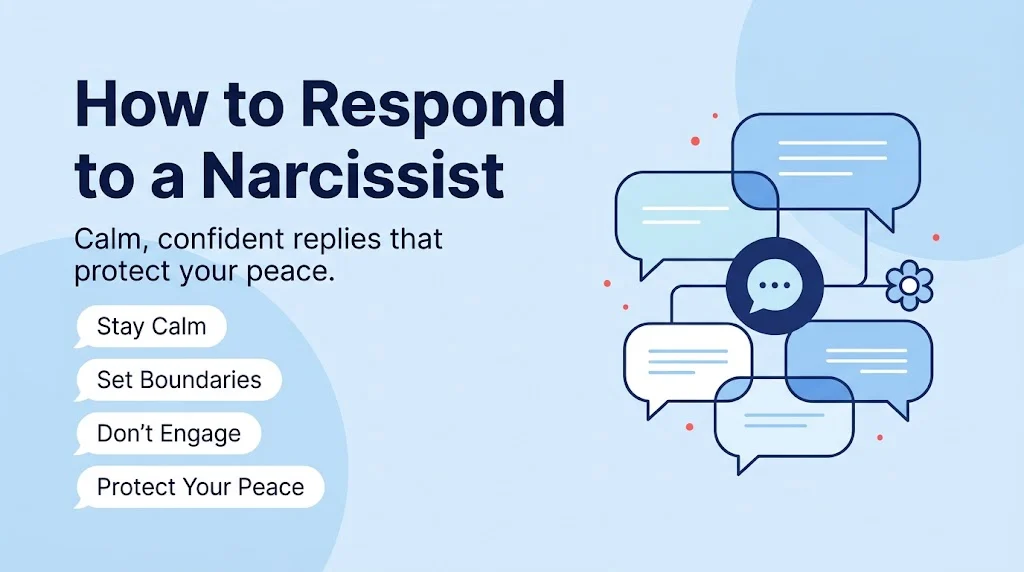
The best way to respond to a narcissist is to stay calm, set clear boundaries, and avoid getting pulled into endless arguments. You can be firm without being rude or explaining yourself over and over.
Top responses: I see it differently, I’m not discussing this further, That doesn’t work for me, I know what I experienced, Let’s agree to disagree.
Ever had a conversation where someone twists your words, refuses to take responsibility, or somehow makes everything your fault? You start explaining yourself, the conversation gets more frustrating, and suddenly you are defending things you never even said. It can be exhausting.
Knowing how to respond to a narcissist can help you handle difficult conversations with more confidence, whether you are dealing with a partner, family member, coworker, friend, or someone who always needs to be right. The goal is not to win every argument or prove your point at any cost. Instead, focus on protecting your peace, communicating clearly, and setting boundaries without getting dragged into unnecessary drama. You do not need a perfect comeback to handle a difficult person. Sometimes, the strongest response is a calm sentence followed by the decision to stop engaging.
Note: Narcissistic behavior does not automatically mean someone has narcissistic personality disorder. These responses are designed for difficult or manipulative interactions, regardless of diagnosis.
Calm Responses to a Narcissist
When someone tries to provoke you, a calm response can help you avoid escalating the situation. Keep your tone neutral and your words simple.
– I hear what you’re saying. Use this when someone keeps repeating their opinion and expects you to agree. Meaning: You acknowledge their words without automatically accepting their viewpoint.
– I see things differently. Use this when someone insists that their version of events is the only correct one. Meaning: You express disagreement without starting an argument.
– Let’s keep this conversation respectful. Use this when the discussion becomes insulting or unnecessarily hostile. Meaning: You establish a clear expectation for respectful communication.
– I’m not going to argue about this. Use this when a conversation starts going in circles. Meaning: You choose not to participate in a pointless argument.
– We don’t have to agree on everything. Use this when someone treats disagreement as a personal attack. Meaning: You remind them that different opinions can coexist.
– I understand that you feel strongly about this. Use this when someone becomes emotional about their position. Meaning: You acknowledge their feelings without surrendering your own perspective.
– Let’s take a step back. Use this when the conversation becomes too heated to be productive. Meaning: You suggest creating space before continuing.
– I’m comfortable with my decision. Use this when someone repeatedly questions a choice you have already made. Meaning: You communicate confidence without seeking their approval.
– I don’t need to convince you. Use this when someone refuses to consider your perspective. Meaning: You release yourself from the responsibility of changing their mind.
– Let’s focus on the issue, not personal attacks. Use this when someone shifts a discussion toward your character. Meaning: You redirect the conversation toward the actual problem.
– I can listen without agreeing. Use this when someone expects you to validate every claim they make. Meaning: You distinguish listening from accepting their opinion.
– I’m going to stay calm, and I expect the same from you. Use this when a discussion becomes emotionally charged. Meaning: You communicate your expectation for a more controlled conversation.
– That is your perspective, and this is mine. Use this when someone refuses to recognize differences in opinion. Meaning: You acknowledge that you do not share the same interpretation.
– We can discuss this when we’re both ready. Use this when the conversation is no longer constructive. Meaning: You postpone the discussion until it can be more productive.
– I’m choosing not to make this an argument. Use this when someone seems determined to provoke a reaction. Meaning: You make a deliberate choice to avoid unnecessary conflict.
Firm Responses That Set Boundaries
Boundaries are about what you will accept and what you will do if a situation continues. You do not need the other person to agree with your boundary for it to matter.
– I won’t accept being spoken to that way. Use this when someone insults or belittles you. Meaning: You clearly state that disrespectful communication is unacceptable to you.
– Please don’t raise your voice at me. Use this when someone starts shouting during a disagreement. Meaning: You set a direct boundary around how you are treated.
– I’m not available for this conversation right now. Use this when you feel overwhelmed or need space. Meaning: You give yourself permission to disengage.
– My answer is no, and it isn’t changing. Use this when someone keeps pressuring you after you have declined. Meaning: You make your decision clear without inviting further negotiation.
– You don’t have to like my boundary, but you do need to respect it. Use this when someone challenges your limits. Meaning: You reinforce that your boundaries are not dependent on their approval.
– I won’t continue while I’m being insulted. Use this when personal attacks replace a meaningful discussion. Meaning: You state the condition under which you are willing to continue talking.
– My personal decisions are mine to make. Use this when someone tries to control your choices. Meaning: You assert your independence and personal agency.
– I need some space, and I’ll reach out when I’m ready. Use this when you need time away from a stressful interaction. Meaning: You establish distance without promising immediate reconciliation.
– I won’t explain the same boundary repeatedly. Use this when someone continues challenging a limit you have already explained. Meaning: You refuse to get caught in an endless cycle of justification.
– If this continues, I’m ending the conversation. Use this when someone ignores your requests for respectful communication. Meaning: You communicate a clear consequence that you can follow through on.
– I’m allowed to change my mind. Use this when someone uses an earlier decision to pressure you. Meaning: You affirm your right to reconsider your choices.
– My time and energy matter, too. Use this when someone expects you to prioritize their needs constantly. Meaning: You remind them that your needs deserve consideration.
– I won’t take responsibility for choices I didn’t make. Use this when someone attempts to blame you for their decisions. Meaning: You distinguish your responsibilities from theirs.
– I’m not comfortable with that, so I won’t participate. Use this when someone asks you to do something that crosses your limits. Meaning: You decline without needing to defend your discomfort.
– I’ve made my decision, and I’m moving forward. Use this when someone keeps reopening a settled issue. Meaning: You communicate closure and confidence in your choice.
Short Responses to Shut Down Arguments
Sometimes, fewer words are more effective. These short replies can help you avoid overexplaining, especially when the same disagreement keeps resurfacing.
– I’m not debating this. Use this when someone tries to turn a simple disagreement into a prolonged argument. Meaning: You decline to keep defending your position.
– That’s not up for discussion. Use this when a personal boundary has already been established. Meaning: You make it clear that the issue is not open for negotiation.
– I’ve already answered that. Use this when someone keeps asking the same question to pressure you. Meaning: You avoid repeating an answer unnecessarily.
– Let’s leave it there. Use this when the conversation has reached a natural stopping point. Meaning: You signal that you are ready to end the discussion.
– I disagree. Use this when you need to communicate a different opinion directly. Meaning: You express disagreement without adding unnecessary explanations.
– That doesn’t work for me. Use this when someone proposes an arrangement you cannot accept. Meaning: You decline clearly and calmly.
– I’m not engaging with insults. Use this when someone resorts to name-calling. Meaning: You refuse to treat personal attacks as productive communication.
– We’ve covered this already. Use this when a settled subject keeps coming back. Meaning: You point out the repetition without reopening the issue.
– I have nothing more to add. Use this when you have explained your position and do not wish to continue. Meaning: You close the conversation without further justification.
– That’s your opinion. Use this when someone presents a subjective judgment as unquestionable fact. Meaning: You separate their viewpoint from your own understanding.
– I’m done discussing this for now. Use this when you need to end a draining exchange. Meaning: You communicate that the conversation needs to stop.
– No, thank you. Use this when someone pressures you to accept something you do not want. Meaning: You decline politely without inviting a debate.
– I won’t be drawn into this. Use this when a conversation seems designed to provoke you. Meaning: You choose not to participate in the conflict.
– Let’s stick to the facts. Use this when accusations and assumptions are taking over the discussion. Meaning: You redirect attention toward specific, verifiable details.
– I’ve said what I needed to say. Use this when you want to end a repetitive exchange. Meaning: You establish that you have finished explaining your position.
Responses to Gaslighting
Gaslighting refers to behavior that causes someone to doubt their memory, perception, or understanding of events. If a person repeatedly denies what happened or insists your feelings prove you are wrong, focus on specific facts and your own experience.
– I remember the situation differently. Use this when someone denies an event you recall clearly. Meaning: You state your recollection without getting trapped in a debate over memory.
– I know what I experienced. Use this when someone repeatedly dismisses your account of an event. Meaning: You affirm your experience without requiring their agreement.
– My feelings are real, even if you disagree with them. Use this when someone tells you that you have no reason to feel upset. Meaning: You distinguish your emotional experience from their interpretation.
– Let’s look at what was actually said. Use this when someone disputes the details of a conversation. Meaning: You encourage a return to specific information rather than accusations.
– I don’t agree with your version of events. Use this when their account conflicts with your own recollection. Meaning: You express disagreement without claiming that every difference is deliberate manipulation.
– I don’t need you to validate my memory. Use this when someone repeatedly insists that your recollection is wrong. Meaning: You communicate confidence in your own perspective.
– That isn’t how I experienced it. Use this when someone describes an interaction in a way that dismisses your feelings. Meaning: You acknowledge the difference between your experiences.
– I would rather discuss specific actions than general accusations. Use this when the conversation becomes vague or blaming. Meaning: You ask for concrete examples instead of sweeping judgments.
– I won’t dismiss my feelings just to end this disagreement. Use this when you feel pressured to pretend nothing happened. Meaning: You protect your emotional honesty.
– We clearly remember this differently. Use this when neither person agrees about a past interaction. Meaning: You acknowledge the disagreement without trying to force a resolution.
– I need time to think about what happened. Use this when someone is pressuring you to accept their explanation immediately. Meaning: You give yourself room to reflect before reaching a conclusion.
– I prefer to rely on the information I have documented. Use this when dates, messages, or agreements are disputed. Meaning: You turn to available records instead of relying only on conflicting recollections.
– Please don’t tell me what I felt. Use this when someone claims to know your emotions better than you do. Meaning: You set a boundary around your emotional experience.
– I can consider your perspective without abandoning mine. Use this when someone expects you to accept their interpretation completely. Meaning: You remain open to discussion while preserving your own judgment.
– I’m not going to argue about whether my feelings are justified. Use this when someone keeps invalidating your emotional response. Meaning: You refuse to turn your feelings into a debate you must win.
Responses to a Narcissist Who Blames You for Everything
When every disagreement becomes your fault, focus on what you are actually responsible for. You can acknowledge genuine mistakes without accepting blame for everything that goes wrong.
– I’m willing to own my part, but not everything. Use this when someone assigns you all the blame for a shared problem. Meaning: You accept appropriate responsibility without taking on unfair blame.
– Let’s discuss what each of us contributed to this situation. Use this when both people were involved in a disagreement. Meaning: You encourage a more balanced discussion of responsibility.
– I can acknowledge my mistake without accepting false accusations. Use this when a real error is mixed with exaggerated claims. Meaning: You separate accountability from unfair criticism.
– Your choices are your responsibility. Use this when someone blames you for a decision they made themselves. Meaning: You clarify that each person is accountable for their own actions.
– Please be specific about what you’re saying I did. Use this when someone makes sweeping accusations. Meaning: You ask for concrete details instead of accepting vague blame.
– I won’t accept responsibility for something I didn’t do. Use this when someone accuses you of an action you did not take. Meaning: You defend your position without attacking the other person.
– We both have a role in how we communicate. Use this when someone claims that every conflict is caused by you. Meaning: You highlight that communication involves more than one person.
– I can apologize for my actions, not for your assumptions. Use this when someone expects you to apologize for their interpretation of events. Meaning: You distinguish your behavior from conclusions they have drawn.
– Blaming me won’t solve the actual problem. Use this when accusations prevent a practical conversation. Meaning: You redirect attention toward finding a solution.
– Let’s separate facts from assumptions. Use this when someone treats their suspicions as established facts. Meaning: You encourage a more accurate discussion.
– I understand you’re upset, but that doesn’t make me responsible for everything. Use this when someone uses their frustration to assign you all the blame. Meaning: You acknowledge their feelings without accepting unfair responsibility.
– I’m happy to discuss solutions, not trade accusations. Use this when you want to move away from finger-pointing. Meaning: You prioritize problem-solving over personal attacks.
– An apology doesn’t mean I accept every accusation. Use this when you have apologized for one specific action but the blame continues. Meaning: You clarify the limits of your apology.
– I won’t keep defending myself against assumptions. Use this when you are repeatedly asked to prove your innocence without clear evidence. Meaning: You refuse to engage in an endless cycle of self-defense.
– Let’s focus on what we can change moving forward. Use this when an argument keeps revisiting blame without progress. Meaning: You shift the conversation toward practical next steps.
Responses to a Narcissist Who Plays the Victim
Some people respond to boundaries or criticism by presenting themselves as the only person who has been hurt. You can show empathy without abandoning your perspective or taking responsibility for their every emotion.
– I’m sorry you’re upset, but my decision remains the same. Use this when someone reacts emotionally to a boundary. Meaning: You acknowledge their distress without withdrawing your decision.
– I understand that you feel hurt. I see the situation differently. Use this when someone interprets disagreement as rejection. Meaning: You recognize their feelings while maintaining your perspective.
– We can both have feelings about what happened. Use this when someone insists that only their emotions matter. Meaning: You recognize that two people can experience the same event differently.
– Your feelings matter, and so do mine. Use this when your emotional needs are being dismissed. Meaning: You assert that consideration should go both ways.
– I’m not trying to hurt you by setting a boundary. Use this when someone treats your limits as a personal attack. Meaning: You clarify that protecting your needs is not automatically an act of hostility.
– I can care about you without agreeing with you. Use this when someone equates love or friendship with unconditional agreement. Meaning: You separate caring for a person from accepting every opinion.
– I’m willing to listen if we can both speak respectfully. Use this when you want to continue a difficult discussion constructively. Meaning: You leave room for communication while maintaining expectations.
– I don’t want either of us to feel dismissed. Use this when the conversation has become a competition over who is more hurt. Meaning: You encourage mutual understanding rather than one-sided validation.
– I can acknowledge your pain without accepting blame for everything. Use this when someone uses their distress to assign you total responsibility. Meaning: You show compassion without accepting unfair blame.
– Let’s talk about the specific issue rather than who is the victim. Use this when the conversation keeps shifting away from the original problem. Meaning: You redirect attention toward the issue that needs to be addressed.
– I’m not dismissing you; I’m explaining my perspective. Use this when disagreement is repeatedly treated as invalidation. Meaning: You clarify that having a different view does not automatically mean rejecting theirs.
– I hope we can understand each other without assigning blame. Use this when you want a calmer conversation. Meaning: You encourage mutual understanding and less defensiveness.
– I can’t manage every emotion you experience. Use this when someone expects you to prevent all their discomfort. Meaning: You acknowledge that each person has responsibility for managing their own reactions.
– I can be compassionate and still say no. Use this when guilt makes it difficult to maintain a boundary. Meaning: You remind yourself that kindness does not require agreement.
– I don’t think this conversation is helping either of us. Use this when the exchange becomes repetitive and emotionally exhausting. Meaning: You suggest ending an unproductive discussion.
Responses to a Narcissist Who Insults or Belittles You
Insults can be designed to provoke a reaction, undermine confidence, or shift attention away from the real issue. You do not need to respond with another insult to stand up for yourself.
– That comment was unnecessary. Use this when someone makes a personal remark during a disagreement. Meaning: You point out the disrespect without escalating the exchange.
– You can disagree with me without insulting me. Use this when someone attacks your character instead of addressing your point. Meaning: You establish a clear distinction between disagreement and disrespect.
– I’m not going to respond to personal attacks. Use this when someone uses insults to provoke you. Meaning: You refuse to reward the behavior with an argument.
– Please address the issue, not my character. Use this when someone criticizes who you are instead of what happened. Meaning: You redirect the conversation toward the relevant facts.
– That doesn’t define who I am. Use this when someone makes a sweeping judgment about your personality. Meaning: You refuse to let another person’s opinion determine your self-worth.
– I expect to be treated with basic respect. Use this when someone repeatedly speaks down to you. Meaning: You state a reasonable expectation for respectful treatment.
– I’m not interested in exchanging insults. Use this when an argument starts becoming personal. Meaning: You choose not to participate in hostile communication.
– You don’t have to put me down to make your point. Use this when someone belittles you to support their argument. Meaning: You challenge the insulting behavior without attacking them back.
– I’ll continue this conversation when the insults stop. Use this when you want to leave room for a respectful discussion. Meaning: You set a clear condition for continuing.
– I’m comfortable with who I am. Use this when someone repeatedly criticizes your personality or appearance. Meaning: You communicate self-acceptance without seeking approval.
– That was disrespectful, and I won’t pretend otherwise. Use this when someone expects you to ignore a hurtful remark. Meaning: You name the behavior rather than minimizing it.
– I won’t accept humiliation as a form of communication. Use this when someone embarrasses you to gain control of a conversation. Meaning: You make it clear that humiliation is not acceptable to you.
– Your criticism doesn’t change my worth. Use this when a comment affects your confidence. Meaning: You remind yourself that your value is not determined by someone else’s judgment.
– I’m ending this conversation now. Use this when the insults continue despite your requests. Meaning: You take action to protect your emotional space.
– We can try again when we’re both respectful. Use this when you are willing to revisit the issue later. Meaning: You leave the door open to communication under healthier conditions.
Responses to a Narcissist at Work
Workplace conflicts need a slightly different approach. Keep your responses professional, focus on verifiable details, and document important agreements when appropriate.
– Let’s keep this focused on the project. Use this when a coworker turns a work discussion into a personal conflict. Meaning: You redirect attention toward the shared professional task.
– Could you clarify your concern with a specific example? Use this when someone criticizes your work without explaining why. Meaning: You ask for actionable feedback rather than vague criticism.
– I’ll review the feedback and respond appropriately. Use this when someone delivers criticism you need time to consider. Meaning: You respond professionally without reacting impulsively.
– For clarity, let’s confirm the agreed next steps in writing. Use this when instructions or responsibilities are disputed. Meaning: You create a clear record of what was agreed.
– I see the priority differently, based on the current requirements. Use this when a coworker disagrees with your work plan. Meaning: You explain your professional reasoning without making it personal.
– I’m happy to discuss the work, but let’s keep the feedback constructive. Use this when feedback becomes hostile. Meaning: You remain open to improvement while setting a communication boundary.
– Could we refer to the original agreement? Use this when someone changes their account of a previous decision. Meaning: You return the discussion to an established reference point.
– I’ll take responsibility for my assigned tasks. Use this when someone tries to shift unrelated work onto you. Meaning: You clarify your responsibilities without accepting every task.
– Let’s involve our manager if we need a decision. Use this when a disagreement cannot be resolved directly. Meaning: You suggest an appropriate professional process.
– I’d prefer to discuss this in a scheduled meeting. Use this when someone confronts you unexpectedly or repeatedly interrupts your work. Meaning: You move the discussion into a more structured setting.
– I can address specific feedback, but I need clear details. Use this when someone makes broad accusations about your performance. Meaning: You ask for information you can act on.
– Let’s make sure responsibilities are clear to everyone involved. Use this when someone claims you agreed to tasks you do not own. Meaning: You encourage transparency and shared understanding.
– I’ll follow up with a written summary of our discussion. Use this when you need an accurate record of a complicated meeting. Meaning: You establish a professional record of the conversation.
– I disagree with that assessment, and I can explain why. Use this when your work is criticized unfairly. Meaning: You stand up for your professional judgment using reasons.
– Let’s use the established process to resolve this. Use this when someone tries to bypass agreed workplace procedures. Meaning: You bring the issue back to the appropriate professional framework.
Responses to a Narcissistic Partner
Difficult patterns in a romantic relationship can feel especially painful because trust and emotional closeness are involved. Use language that protects your dignity while making your needs clear.
– I deserve a relationship where we both feel heard. Use this when your concerns are repeatedly dismissed. Meaning: You communicate your need for mutual respect and understanding.
– I care about you, but this behavior is hurting me. Use this when you want to address a specific harmful pattern. Meaning: You express care while being honest about the impact of their actions.
– Love doesn’t mean accepting disrespect. Use this when someone uses the relationship to excuse hurtful behavior. Meaning: You separate affection from the obligation to tolerate mistreatment.
– I need consistency between your words and actions. Use this when promises are repeatedly made but not followed through. Meaning: You explain that trust depends on reliable behavior.
– I’m willing to work on our relationship if we both take responsibility. Use this when you want to address recurring conflict. Meaning: You communicate that repair requires effort from both partners.
– My feelings deserve a place in this relationship, too. Use this when every discussion centers on your partner’s needs. Meaning: You ask for a more balanced emotional connection.
– I won’t keep having the same argument without any change. Use this when the same issue returns without progress. Meaning: You express a need for practical change rather than repeated conflict.
– I need actions, not just promises. Use this when apologies are followed by the same behavior. Meaning: You explain that rebuilding trust requires consistent effort.
– We can disagree without hurting each other. Use this when arguments become personal or cruel. Meaning: You set an expectation for healthier conflict.
– I need time to think about what is best for me. Use this when you feel uncertain or emotionally overwhelmed. Meaning: You give yourself space to make a considered decision.
– I’m not responsible for fixing every problem in our relationship alone. Use this when you feel like you are the only one making an effort. Meaning: You emphasize that relationship repair requires shared responsibility.
– I want a conversation, not a competition over who is right. Use this when every disagreement becomes a battle. Meaning: You prioritize understanding over winning.
– I won’t ignore a pattern just because we had a good day. Use this when affectionate moments seem to erase unresolved problems. Meaning: You recognize that lasting change matters more than temporary relief.
– My boundaries are part of what makes this relationship healthy for me. Use this when your partner treats boundaries as rejection. Meaning: You explain that personal limits support your wellbeing.
– I need to consider whether this relationship is healthy for me. Use this when repeated behavior leaves you feeling unsafe, diminished, or emotionally exhausted. Meaning: You acknowledge your right to evaluate the relationship honestly.
Responses to a Narcissistic Family Member
Family dynamics can be complicated because you may want to preserve the relationship while protecting yourself from repeated conflict. Short, respectful boundaries can help you avoid explaining every personal decision.
– I appreciate your concern, but I’ve made my decision. Use this when a relative keeps questioning your choices. Meaning: You acknowledge their input without giving up your independence.
– I would rather not discuss my personal life right now. Use this when family conversations become intrusive. Meaning: You protect your privacy without attacking the other person.
– We don’t need to agree on everything to be family. Use this when a disagreement becomes a test of loyalty. Meaning: You separate family connection from complete agreement.
– Please don’t compare me with other family members. Use this when someone uses comparisons to criticize you. Meaning: You set a boundary around unfair comparisons.
– I won’t discuss this at the dinner table. Use this when a relative brings up a sensitive issue during a family gathering. Meaning: You choose a more appropriate setting for a difficult discussion.
– I’m happy to spend time together if we can be respectful. Use this when you want connection without recurring arguments. Meaning: You express willingness to connect under healthier conditions.
– My choices don’t need to look like everyone else’s. Use this when a family member pressures you to follow a particular path. Meaning: You affirm your right to make individual decisions.
– I don’t want to turn this family gathering into an argument. Use this when tensions rise during a celebration. Meaning: You signal that you want to preserve a peaceful environment.
– I’ll decide what works best for my household. Use this when a relative tries to control your family decisions. Meaning: You assert responsibility for your own household.
– I hear your advice, and I’ll decide what to do with it. Use this when advice becomes pressure. Meaning: You remain polite while retaining control over your decisions.
– Please respect my decision even if you disagree. Use this when a relative repeatedly challenges your choice. Meaning: You ask for respect without demanding agreement.
– I won’t continue a conversation that turns into personal criticism. Use this when a discussion becomes insulting. Meaning: You establish a limit on hurtful communication.
– Let’s talk about something we can both enjoy. Use this when you want to move away from a tense topic. Meaning: You redirect the interaction toward common ground.
– I can love my family and still need boundaries. Use this when guilt makes it difficult to maintain distance. Meaning: You recognize that family affection and self-protection can coexist.
– I’m going to head home now, but I hope we can talk another time. Use this when a gathering becomes emotionally draining. Meaning: You leave the situation while remaining civil.
Responses to a Narcissist Who Gives the Silent Treatment
Silence can mean many things, including needing time to cool down. It becomes concerning when it is repeatedly used to punish, intimidate, or control someone. These responses help you avoid chasing another person for attention.
– I’m open to talking when you’re ready to communicate respectfully. Use this when someone withdraws from a disagreement and later seems ready to talk. Meaning: You leave space for communication without begging for a response.
– I’ll give you space, and I’ll take some for myself, too. Use this when both of you need time to cool down. Meaning: You respect their space while protecting your own wellbeing.
– I’m not going to keep sending messages to get a response. Use this when repeated messages are making you more anxious. Meaning: You stop chasing communication that the other person is not offering.
– When you’re ready to discuss the issue, let me know. Use this when a conversation has been paused. Meaning: You leave an opening for future discussion without applying pressure.
– I respect your need for space, but I also need clarity. Use this when you do not know whether the conversation is paused or over. Meaning: You balance respect for their space with your need for communication.
– I won’t guess what you’re thinking. Use this when someone expects you to figure out their feelings without explanation. Meaning: You encourage direct communication instead of mind-reading.
– I’m willing to talk when we can address the issue directly. Use this when a disagreement remains unresolved. Meaning: You express openness to a constructive conversation.
– I won’t use silence to punish you, and I won’t chase it either. Use this when you want to explain your approach to communication. Meaning: You choose direct communication instead of a cycle of punishment and pursuit.
– Let me know when you’re ready to have a real conversation. Use this when a discussion has been avoided for some time. Meaning: You invite communication without demanding an immediate answer.
– I’ll focus on what I can control while we take this space. Use this when the lack of communication feels stressful. Meaning: You direct your attention toward your own choices and wellbeing.
– I need communication that doesn’t leave important issues unresolved indefinitely. Use this when withdrawal repeatedly prevents problems from being addressed. Meaning: You express a need for a healthier way to handle disagreements.
– We can pause this conversation without ignoring the problem forever. Use this when someone needs time but the issue still matters. Meaning: You distinguish a healthy pause from avoiding responsibility.
– I’m not going to assume what your silence means. Use this when you feel tempted to interpret a lack of response. Meaning: You avoid jumping to conclusions and leave room for clarity.
– I’ll make my own plans while we take some time apart. Use this when another person’s silence is disrupting your routine. Meaning: You continue caring for your life instead of waiting indefinitely.
– I need mutual communication for this relationship to work. Use this when prolonged silence is a recurring relationship issue. Meaning: You state a clear need for two-way communication.
Clever Responses to Manipulation and Guilt-Tripping
When someone uses guilt, pressure, or emotional appeals to influence your decision, you can acknowledge their feelings without agreeing to something you do not want.
– I can care about your feelings without changing my answer. Use this when someone makes you feel guilty for saying no. Meaning: You separate compassion from compliance.
– Feeling disappointed doesn’t mean I’ve done something wrong. Use this when someone treats your refusal as a betrayal. Meaning: You recognize that another person’s disappointment does not automatically make your decision unfair.
– I make decisions based on what I can realistically do. Use this when someone expects you to sacrifice your time or energy. Meaning: You explain that your limits are part of responsible decision-making.
– I won’t agree just to avoid making you upset. Use this when you feel pressured to say yes to keep the peace. Meaning: You prioritize an honest decision over temporary approval.
– A request is not an obligation. Use this when someone acts as though you must fulfill every request. Meaning: You distinguish what another person wants from what you are required to do.
– I can say no without being a bad person. Use this when guilt makes it difficult to refuse. Meaning: You affirm that having limits does not make you unkind.
– Let’s make a decision without using guilt. Use this when a discussion becomes emotionally pressuring. Meaning: You ask for a more direct and fair conversation.
– I understand you wanted a different answer. Use this when someone keeps challenging your refusal. Meaning: You acknowledge their disappointment without reopening your decision.
– I won’t make a promise I cannot keep. Use this when someone pressures you to commit beyond your capacity. Meaning: You prioritize honesty over giving an answer they want to hear.
– I can help when I’m able, but I can’t always be available. Use this when someone expects constant access to your time. Meaning: You offer reasonable support without agreeing to unlimited availability.
– My decision is not a punishment for you. Use this when someone interprets your boundary as revenge. Meaning: You clarify that making a personal choice is not necessarily an attempt to hurt them.
– I won’t take responsibility for keeping everyone happy. Use this when you feel pressured to prevent all disappointment. Meaning: You recognize that you cannot control everyone’s emotions.
– Let’s discuss what is fair to both of us. Use this when someone expects the arrangement to benefit only them. Meaning: You encourage mutual consideration.
– I don’t make decisions based on threats or pressure. Use this when someone threatens consequences to force your agreement. Meaning: You state that coercion will not determine your choices.
– I can reconsider a decision when the facts change, not because I’m pressured. Use this when someone keeps pushing after you have said no. Meaning: You remain open-minded without allowing pressure to control you.
Confident Responses That Protect Your Self-Respect
Confidence does not require a dramatic comeback. Often, it means trusting your judgment, speaking clearly, and refusing to measure your worth by another person’s reaction.
– I know my worth, and I don’t need to prove it. Use this when someone tries to undermine your confidence. Meaning: You remind yourself that your value does not depend on their approval.
– I’m allowed to have my own perspective. Use this when someone expects you to agree with everything they say. Meaning: You affirm your independence of thought.
– I can learn from criticism without accepting disrespect. Use this when feedback is mixed with personal attacks. Meaning: You remain open to growth while maintaining your boundaries.
– I trust myself to make this decision. Use this when someone tries to make you doubt a considered choice. Meaning: You express confidence in your judgment.
– I don’t need everyone’s approval to move forward. Use this when someone disapproves of your personal choices. Meaning: You recognize that external validation is not a requirement for progress.
– My peace matters more than winning this argument. Use this when an argument is draining your energy. Meaning: You prioritize your wellbeing over proving a point.
– I can be kind without being a pushover. Use this when someone mistakes your kindness for unlimited compliance. Meaning: You combine compassion with self-respect.
– I won’t shrink myself to make someone else comfortable. Use this when you feel pressured to hide your opinions or achievements. Meaning: You affirm your right to express yourself appropriately.
– I don’t have to respond to every provocation. Use this when someone repeatedly tries to get a reaction from you. Meaning: You choose which conversations deserve your attention.
– I can walk away from a conversation that isn’t healthy. Use this when staying engaged is causing unnecessary distress. Meaning: You recognize disengagement as a valid choice.
– I respect myself enough to say no. Use this when you need to decline a request confidently. Meaning: You connect personal boundaries with self-respect.
– I won’t confuse being understanding with accepting everything. Use this when empathy is being used to pressure you. Meaning: You recognize that understanding someone does not require tolerating every behavior.
– I am responsible for my actions, not someone else’s assumptions. Use this when someone repeatedly misinterprets your intentions. Meaning: You focus on your own conduct rather than trying to control every opinion.
– I don’t need the last word to know where I stand. Use this when a conversation turns into a battle for the final comment. Meaning: You show confidence without needing to win the exchange.
– I choose how I respond, even when I can’t control what happens. Use this when another person’s behavior feels frustrating. Meaning: You focus on your own agency and choices.
FAQs
What is the best way to respond to a narcissist?
Stay calm, use clear language, and set boundaries you can maintain. Avoid getting trapped in repeated arguments, and focus on what you can control rather than trying to force someone to agree with you.
What should I say to a narcissist who insults me?
Try saying, I won’t continue this conversation while I’m being insulted. Keep your tone steady and disengage if the disrespect continues and it is safe to do so.
How do you respond to a narcissist who blames you for everything?
Ask to discuss specific actions and responsibilities rather than accepting sweeping accusations.
Should you ignore a narcissist?
Not necessarily. Depending on the situation, a brief response, a clear boundary, or ending an unproductive conversation may be more appropriate.
What is the gray rock method?
The gray rock method is an informal strategy of keeping interactions brief, neutral, and uninteresting when dealing with someone who repeatedly seeks conflict or provokes reactions.
Conclusion
Learning how to respond to difficult or narcissistic behavior is less about finding the perfect comeback and more about protecting your confidence, boundaries, and peace of mind. You do not need to answer every accusation, defend every decision, or win every disagreement to prove your worth.
Start with short, calm statements, choose the boundaries that matter most to you, and pay attention to whether the other person respects them. Different situations call for different responses, so use the phrases that feel natural and safe for your circumstances. Save this list for conversations when you need a little extra confidence, and share it with someone who could use a reminder that self-respect does not require anyone else’s permission.
Discover More Related Articles:

Jennifer Wilson is an experienced writer and content creator with over 20 years of expertise in digital publishing, lifestyle, and informative content. Holding a degree in English Literature, she contributes to Responary.Com, where she shares engaging, well-researched articles that help readers stay informed and inspired.