Quick Answer
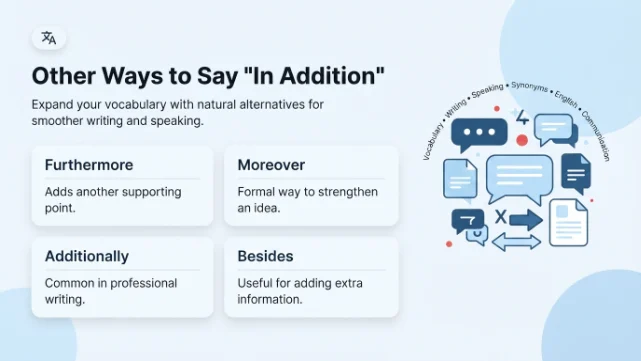
Looking for other ways to say in addition? The most natural alternatives are furthermore, moreover, additionally, what’s more, and on top of that. Each carries a slightly different tone, so picking the right one depends on whether you’re writing a business email, an essay, or having a casual chat.
“The right tone makes your English sound professional and confident.”
“In addition” is one of the most common linking phrases in English. It signals that you are about to add extra information, another point, or a supporting idea to what you just said. People use it constantly in essays, emails, presentations, and everyday conversation because it keeps ideas connected and easy to follow.
Learning alternatives to in addition helps you avoid repeating the same phrase over and over, which can make your writing feel flat or robotic. It also helps you express excitement in English when a phrase like “what’s more” or “on top of that” adds energy to a sentence rather than a plain, neutral connector.
Whether you are writing a formal report or chatting with a colleague, knowing several ways to add information makes your English sound more natural, fluent, and varied.
Quick Categories
Formal alternatives to “in addition”
- Furthermore
- Moreover
- Additionally
- In addition to this
Pro Tip: Use “furthermore” and “moreover” at the start of a new sentence in essays and reports to sound academic and precise.
Casual alternatives
- Plus
- On top of that
- And another thing
- Also
Pro Tip: Save “plus” and “on top of that” for spoken English or friendly emails, not formal documents.
Professional alternatives
- Additionally
- Furthermore
- Beyond that
- Equally important
Pro Tip: In business writing, “additionally” is safer and more versatile than “moreover,” which can sound slightly old-fashioned in some contexts.
Informal expressions
- Not to mention
- Not only that but
- What’s more
- Besides
Pro Tip: “Not to mention” works well when you want to add a surprising or impressive extra detail in conversation.
“Small word choices make a big difference in how confident you sound.”
Common Mistakes
- Starting every sentence with “In addition.”
Example: “In addition, we grew sales. In addition, we cut costs. In addition, we hired staff.” (too repetitive) - Using “besides” and “except” interchangeably.
Example: “Besides John, everyone came” means something different from “In addition, John came.” Mixing them confuses meaning. - Forgetting the comma after “in addition” at the start of a sentence.
Example: Incorrect: “In addition we finished early.” Correct: “In addition, we finished early.” - Using “moreover” in casual speech.
Example: Saying “Moreover, I’m starving” to a friend sounds unnatural and overly formal. - Overusing “also” in academic writing.
Example: A paragraph with five sentences all starting with “Also” feels childish and repetitive.
What Does “In Addition” Mean?
“In addition” is a transitional phrase used to introduce extra information that supports or extends a previous point. Grammatically, it functions as an adverbial phrase and is usually followed by a comma when placed at the start of a sentence.
Example Sentence: “The hotel offers free breakfast. In addition, guests can use the gym at no extra cost.”
When to Use “In Addition”
- Adding a new point to a list of reasons or facts
- Strengthening an argument in an essay
- Introducing an extra benefit in business writing
- Connecting ideas in a formal presentation
Spoken vs Written: In spoken English, people often prefer “plus” or “also.” In written English, “in addition” and “furthermore” are more common.
Formal vs Informal: “In addition” itself sits in a neutral-to-formal register, making it suitable for both academic writing and professional emails.
Is It Professional or Polite to Say “In Addition”?
“In addition” is both polite and professional. It is neutral, clear, and works well in nearly any written context, from emails to reports.
Business Example: “In addition, our team will provide a full report by Friday.”
Polite? ✔️ Yes Professional? ✔️ Yes
Pros and Cons of Using “In Addition”
Pros:
- Simple and natural
- Clear and easy to understand
- Works in both formal and semi-formal writing
- Common usage across all English levels
Cons:
- Can feel repetitive if overused
- Slightly less common in casual speech
- Limited emotional or persuasive impact
- Not ideal for very informal conversation
Other Ways to Say In Addition
These alternatives will help you sound more fluent, confident, and natural in different situations. Use them according to tone, context, and audience to express excitement, admiration, or approval when adding new information.
1. Phrase: Furthermore
Meaning: Used to add another point that strengthens an argument. Explanation: Common in academic and formal writing to introduce a stronger or related point. Example Sentence: “The plan saves money. Furthermore, it reduces waste.” Best Use: essays, reports Worst Use: casual chat Tone: formal, academic Context Variability: professional, written essays
2. Phrase: Moreover
Meaning: Adds a point that is equally or more important than the last one. Explanation: Slightly stronger than “furthermore,” often used in academic argument. Example Sentence: “The product is affordable. Moreover, it’s built to last.” Best Use: academic writing Worst Use: everyday speech Tone: formal, persuasive Context Variability: professional, written
3. Phrase: Additionally
Meaning: Simply adds a new fact or point. Explanation: A neutral, versatile transition word suitable for most writing. Example Sentence: “Additionally, the team finished the project ahead of schedule.” Best Use: emails, reports Worst Use: poetry, fiction Tone: neutral, professional Context Variability: professional, spoken, written
4. Phrase: What’s more
Meaning: Introduces a surprising or impressive extra point. Explanation: Adds energy and emphasis, often used to build excitement. Example Sentence: “The view was stunning. What’s more, the staff were incredibly kind.” Best Use: storytelling, reviews Worst Use: legal documents Tone: enthusiastic, conversational Context Variability: casual, spoken
5. Phrase: On top of that
Meaning: Adds one more thing to an already long list. Explanation: Often used when things are piling up, positively or negatively. Example Sentence: “We were late. On top of that, it started raining.” Best Use: casual conversation Worst Use: formal reports Tone: casual, expressive Context Variability: casual, spoken
6. Phrase: Besides
Meaning: Adds a supporting reason to an existing point. Explanation: Common in spoken English to reinforce a decision or opinion. Example Sentence: “I don’t want to go. Besides, I have work to finish.” Best Use: conversation, opinions Worst Use: academic essays Tone: casual, persuasive Context Variability: casual, spoken
7. Phrase: Also
Meaning: A simple way to add extra information. Explanation: One of the most common and neutral connectors in English. Example Sentence: “She speaks French. She also speaks Spanish.” Best Use: everyday writing Worst Use: formal essays (overuse) Tone: neutral, simple Context Variability: casual, professional, spoken
8. Phrase: Not only that but
Meaning: Adds an extra point that builds on the previous one. Explanation: Creates emphasis by linking two impressive facts together. Example Sentence: “He finished first. Not only that, but he broke the record.” Best Use: storytelling, speeches Worst Use: short formal notes Tone: emphatic, engaging Context Variability: spoken, casual, professional
9. Phrase: Plus
Meaning: A quick, informal way to add information. Explanation: Very common in speech and casual writing. Example Sentence: “The apartment is cheap. Plus, it’s close to the station.” Best Use: texting, casual talk Worst Use: formal reports Tone: casual, friendly Context Variability: casual, spoken
10. Phrase: In addition to that
Meaning: A direct extension of “in addition” for extra emphasis. Explanation: Slightly more formal and specific than “also.” Example Sentence: “In addition to that, the company offers remote work options.” Best Use: business writing Worst Use: texting Tone: formal, clear Context Variability: professional, written
11. Phrase: As well as
Meaning: Connects two related items or points within a sentence. Explanation: Often used mid-sentence rather than at the start. Example Sentence: “The role requires writing skills, as well as strong communication.” Best Use: job descriptions, essays Worst Use: starting a new sentence Tone: neutral, professional Context Variability: professional, written
12. Phrase: Along with that
Meaning: Adds another point that accompanies the first. Explanation: Slightly conversational but still clear and professional. Example Sentence: “Sales increased. Along with that, customer satisfaction improved.” Best Use: presentations, updates Worst Use: legal writing Tone: friendly, professional Context Variability: professional, spoken
13. Phrase: Further
Meaning: Introduces additional detail or explanation. Explanation: Common in formal or technical writing to expand on a point. Example Sentence: “Further, the data shows a rise in demand.” Best Use: technical reports Worst Use: casual chat Tone: formal, precise Context Variability: professional, written
14. Phrase: Not to mention
Meaning: Adds an extra point that is almost too obvious or impressive to leave out. Explanation: Often used for emphasis with a slightly dramatic tone. Example Sentence: “The food was amazing, not to mention the service.” Best Use: reviews, storytelling Worst Use: formal reports Tone: expressive, casual Context Variability: casual, spoken
15. Phrase: To add to that
Meaning: Introduces one more supporting point. Explanation: Useful in discussions and meetings to build on someone’s idea. Example Sentence: “To add to that, the client also requested faster delivery.” Best Use: meetings, discussions Worst Use: essays Tone: conversational, professional Context Variability: professional, spoken
16. Phrase: Beyond that
Meaning: Adds a point that goes further than what was already said. Explanation: Suggests there’s even more to consider beyond the current point. Example Sentence: “The software is fast. Beyond that, it’s incredibly secure.” Best Use: presentations, reviews Worst Use: casual texting Tone: professional, thoughtful Context Variability: professional, written
17. Phrase: Equally important
Meaning: Signals that the next point matters just as much as the last. Explanation: Used to balance the importance of two ideas. Example Sentence: “The budget must be approved. Equally important, the timeline needs review.” Best Use: reports, proposals Worst Use: casual speech Tone: formal, balanced Context Variability: professional, written
18. Phrase: In the same vein
Meaning: Introduces a related point that follows the same idea or theme. Explanation: Useful when connecting similar arguments or examples. Example Sentence: “The design is modern. In the same vein, the packaging feels fresh and clean.” Best Use: essays, critiques Worst Use: everyday conversation Tone: formal, reflective Context Variability: professional, written
19. Phrase: Similarly
Meaning: Adds a point that shares a similar idea or pattern. Explanation: Best used when the new point closely resembles the previous one. Example Sentence: “Costs went down. Similarly, production time improved.” Best Use: reports, comparisons Worst Use: casual chat Tone: neutral, analytical Context Variability: professional, written
20. Phrase: Coupled with that
Meaning: Shows that two factors combine to create an effect. Explanation: Common in analysis when explaining cause and effect. Example Sentence: “Rising costs, coupled with that, low demand hurt profits.” Best Use: business analysis Worst Use: casual speech Tone: formal, analytical Context Variability: professional, written
21. Phrase: Alongside this
Meaning: Adds a point that happens at the same time as another. Explanation: Suggests two things developing or existing together. Example Sentence: “Alongside this, the team launched a new marketing campaign.” Best Use: updates, reports Worst Use: informal texting Tone: professional, neutral Context Variability: professional, written
22. Phrase: On top of this
Meaning: A variation of “on top of that” for extra emphasis. Explanation: Often used when listing multiple demanding or impressive facts. Example Sentence: “The job pays well. On top of this, it offers great benefits.” Best Use: casual professional talk Worst Use: legal documents Tone: casual, expressive Context Variability: casual, spoken
23. Phrase: Another point is
Meaning: Directly introduces a new argument or fact. Explanation: Straightforward and useful in structured discussions or essays. Example Sentence: “Another point is that the deadline may need to be extended.” Best Use: debates, essays Worst Use: casual conversation Tone: clear, structured Context Variability: professional, written
24. Phrase: To further illustrate
Meaning: Introduces an example or detail that supports the previous point. Explanation: Common in academic writing to strengthen an argument with evidence. Example Sentence: “To further illustrate, sales rose by twenty percent last quarter.” Best Use: essays, presentations Worst Use: everyday chat Tone: formal, academic Context Variability: professional, written
25. Phrase: In addition to this
Meaning: A slightly more specific version of “in addition.” Explanation: Refers directly back to something already mentioned. Example Sentence: “In addition to this, the report includes updated figures.” Best Use: reports, essays Worst Use: texting Tone: formal, precise Context Variability: professional, written
26. Phrase: As an added point
Meaning: Introduces an extra detail that supports the main idea. Explanation: Useful for smoothly inserting a bonus fact or benefit. Example Sentence: “As an added point, the warranty covers two full years.” Best Use: sales, proposals Worst Use: academic essays Tone: professional, persuasive Context Variability: professional, spoken
27. Phrase: Adding to this
Meaning: Builds directly on what was just said. Explanation: Natural in meetings when responding to someone else’s point. Example Sentence: “Adding to this, customer feedback has been very positive.” Best Use: meetings, discussions Worst Use: formal essays Tone: conversational, professional Context Variability: professional, spoken
28. Phrase: Over and above that
Meaning: Emphasizes that something goes beyond what was expected. Explanation: Suggests an extra benefit beyond the normal or required amount. Example Sentence: “The team met the target. Over and above that, they exceeded it by ten percent.” Best Use: performance reviews Worst Use: simple statements Tone: formal, emphatic Context Variability: professional, written
29. Phrase: Aside from that
Meaning: Introduces an extra point, often a minor one. Explanation: Can also introduce a small exception before adding more information. Example Sentence: “Aside from that, everything about the trip went smoothly.” Best Use: casual reviews, conversation Worst Use: formal essays Tone: casual, relaxed Context Variability: casual, spoken
30. Phrase: Along the same lines
Meaning: Introduces a point that follows a similar idea or direction. Explanation: Useful for connecting related thoughts smoothly. Example Sentence: “Along the same lines, we should also review our pricing strategy.” Best Use: meetings, essays Worst Use: short casual texts Tone: professional, thoughtful Context Variability: professional, written
“Choosing the right connector shows control, not just vocabulary.”
Mini Quiz
1. Which phrase is most appropriate in an academic essay?
a) Plus b) Furthermore c) On top of that d) Not to mention
2. Which phrase fits best in a casual conversation with a friend?
a) Moreover b) Coupled with that c) Plus d) Equally important
3. Complete the sentence: “| the report also highlights three key risks.”
a) Besides b) Additionally c) Plus d) Aside from that
4. Which phrase is best for building excitement about an impressive extra detail?
a) Further b) What’s more c) In addition to this d) Similarly
Comparison Table: Top Alternatives
| Phrase | Tone | Best Use |
|---|---|---|
| Furthermore | formal, academic | essays, reports |
| Moreover | formal, persuasive | academic writing |
| Additionally | neutral, professional | emails, reports |
| What’s more | enthusiastic, conversational | storytelling, reviews |
| On top of that | casual, expressive | casual conversation |
| Besides | casual, persuasive | conversation, opinions |
| Also | neutral, simple | everyday writing |
| Not only that but | emphatic, engaging | speeches, storytelling |
| Plus | casual, friendly | texting, casual talk |
| Equally important | formal, balanced | reports, proposals |
FAQs
1. What is the most formal way to say “in addition”?
“Furthermore” and “moreover” are the most formal alternatives, ideal for essays and reports.
2. What is a casual way to say “in addition”?
“Plus” and “on top of that” work well in everyday, informal conversation.
3. Is “in addition” the same as “besides”?
They are similar, but “besides” can also mean “except for,” so context matters.
4. Can I start a sentence with “additionally”?
Yes, “additionally” is a common and correct way to start a sentence when adding new information.
5. What’s a good alternative for business emails?
“Additionally” and “furthermore” are safe, professional alternatives to “in addition” for business writing.
Conclusion
Learning multiple other ways to say in addition makes your English sound more natural, confident, and varied across different situations. Instead of repeating the same phrase, you can choose words that match the tone of your message, whether formal, professional, or casual.
Practice using a few new alternatives each day in your writing and conversations. Paying attention to tone and context will help these phrases feel natural over time, making your English communication clearer and more fluent.
If you found this guide helpful, try using three new alternatives in your next email or conversation today.
Discover More Related Articles:
- Other Ways to Say In Other Words | For Better English In 2026
- Other Ways to Say In Conclusion in an Essay | Formal Writing In 2026

Laura Adams is a dedicated content writer and blogger known for crafting clear, informative, and engaging articles. As a contributor to Responary.com, she specializes in creating reader-friendly content that educates, inspires, and keeps audiences informed on a wide range of subjects.