Quick Answer
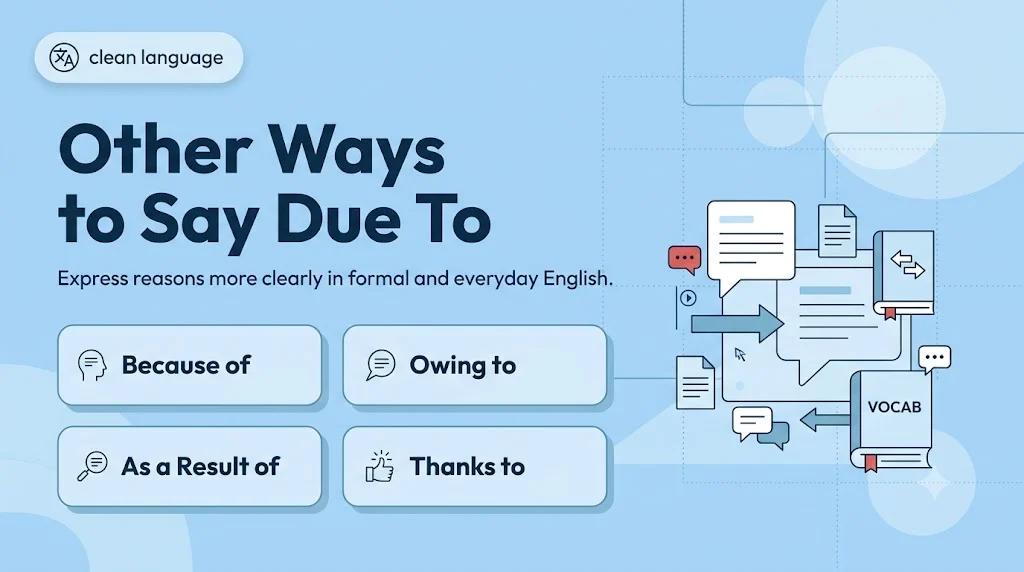
Looking for other ways to say due to? The most natural alternatives are because of, owing to, as a result of, on account of, and thanks to. Each one shifts the tone slightly, so choosing the right one depends on whether you are writing a formal report, a casual message, or a professional email.
Top 5 alternatives: because of, owing to, as a result of, on account of, thanks to
“The right tone makes your English sound professional and confident.”
Due to is one of the most common phrases in English, used to explain a cause or reason behind something. Whether you are writing a business report, an academic paper, or a casual text message, this phrase helps you connect an event to its cause.
People rely on it constantly, but repeating the same phrase makes writing feel flat and repetitive. Learning alternatives to due to allows you to vary your sentence structure, sound more fluent, and match your tone to your audience. It also helps you express excitement in English, sympathy, or professionalism, depending on which synonym you choose.
Mastering these alternatives is a simple way to sharpen both your spoken and written English. Once you understand the small differences in tone between each phrase, you will sound noticeably more natural and confident in everyday conversations and formal writing alike.
Quick Categories
Formal Alternatives to “Due To”
- Owing to
- On account of
- By virtue of
- In view of
Pro Tip: Use formal alternatives in reports, academic essays, and legal or business documents where precision matters more than casual flow.
Casual Alternatives
- Because of
- Thanks to
- On the back of
- Down to
Pro Tip: Casual alternatives work well in everyday conversation and informal writing, such as texts or social posts, where a relaxed tone feels natural.
Professional Alternatives
- As a result of
- Attributable to
- Resulting from
- Stemming from
Pro Tip: In workplace emails or presentations, professional reaction phrases like these show clarity and confidence without sounding overly stiff.
Informal Expressions
- All because of
- Down to
- Thanks to
- On account of that
Pro Tip: Informal expressions in English are best saved for friends, family, or relaxed conversations rather than official documents.
Common Mistakes People Make With “Due To”
- Using “due to” at the start of a sentence incorrectly
Example: “Due to it was raining, we stayed home.” (Incorrect grammar) - Confusing “due to” with “because”
Example: “The meeting was cancelled due to it was raining.” (Should use “because”) - Overusing “due to” in every sentence
Example: “Due to the rain, and due to the traffic, and due to the delay, we were late.” - Using “due to” when “owing to” or “because of” fits better in tone
Example: A formal report that repeats “due to” instead of varying vocabulary. - Placing “due to” incorrectly in a sentence, creating ambiguity
- Example: “She left the office due to her boss early.” (Unclear meaning)
What Does “Due To” Mean?
Due to means “caused by” or “as a result of.” It is a prepositional phrase used to explain the reason behind a situation or event.
Grammar note: “Due to” is traditionally used to modify a noun, not a verb. For example, “The delay was due to weather” is correct, while “We stayed home due to weather” is sometimes considered less formal, though widely accepted in modern usage.
Example sentence: The flight was delayed due to heavy snow.
When to Use “Due To”
- Explaining the cause of an event or situation
- Writing formal reports, news articles, or academic papers
- Giving a reason in business communication
- Describing weather-related delays or cancellations
Spoken vs Written: In speech, people often prefer “because of.” In writing, especially formal writing, “due to” appears more frequently.
Formal vs Informal: “Due to” leans formal. In casual conversation, “because of” or “thanks to” often sounds more natural.
“Small word choices create big impressions in professional communication.”
Is It Professional or Polite to Say “Due To”?
“Due to” is both polite and professional. It works well in emails, reports, and formal explanations without sounding rude or overly casual.
Business example: “The shipment was delayed due to unforeseen circumstances. We appreciate your patience.”
Polite? ✔️ Yes Professional? ✔️ Yes
Pros and Cons of Using “Due To”
Pros:
- Clear and easy to understand
- Widely accepted in formal writing
- Common in professional communication
- Simple to use correctly with practice
Cons:
- Can feel repetitive if overused
- Sometimes confused with “because”
- Grammatically limited to modifying nouns
- May sound stiff in casual conversation
Other Ways to Say Due To
These alternatives will help you sound more fluent, confident, and natural in different situations. Use them according to tone, context, and audience to express excitement, sympathy, or professionalism depending on the message you want to send.
1. Phrase: Because of
Meaning: Explains a direct cause. Explanation: The most common and versatile alternative to “due to.” Example Sentence: The game was cancelled because of the storm. Best Use: everyday conversation Worst Use: formal legal writing Tone: neutral, simple Context Variability: casual, spoken, professional
2. Phrase: Owing to
Meaning: Indicates a formal cause or reason. Explanation: A more elevated, formal version of “due to.” Example Sentence: Owing to budget constraints, the project was delayed. Best Use: formal reports Worst Use: casual texting Tone: formal, precise Context Variability: professional, written
3. Phrase: As a result of
Meaning: Shows a clear cause-and-effect relationship. Explanation: Emphasizes consequence more strongly than “due to.” Example Sentence: As a result of the merger, several roles were restructured. Best Use: business writing Worst Use: casual chat Tone: analytical, formal Context Variability: professional, academic
4. Phrase: On account of
Meaning: Explains a reason behind an action. Explanation: Slightly old-fashioned but still used in formal contexts. Example Sentence: The event was postponed on account of poor weather. Best Use: formal announcements Worst Use: modern casual speech Tone: formal, traditional Context Variability: written, professional
5. Phrase: Thanks to
Meaning: Attributes a positive result to a cause. Explanation: Often used for good outcomes rather than negative ones. Example Sentence: Thanks to her hard work, the team hit its target. Best Use: positive statements Worst Use: negative outcomes Tone: warm, appreciative Context Variability: casual, spoken, professional
6. Phrase: By virtue of
Meaning: Because of a particular quality or position. Explanation: Common in formal or legal explanations. Example Sentence: By virtue of his experience, he was chosen as team lead. Best Use: legal or formal writing Worst Use: everyday conversation Tone: formal, authoritative Context Variability: professional, written
7. Phrase: In view of
Meaning: Considering a particular fact or situation. Explanation: Suggests a decision made after weighing circumstances. Example Sentence: In view of recent events, the policy was updated. Best Use: formal decisions Worst Use: casual chat Tone: formal, considerate Context Variability: professional, written
8. Phrase: Resulting from
Meaning: Caused by a specific event or action. Explanation: Focuses on the outcome linked to a cause. Example Sentence: Delays resulting from the strike affected deliveries. Best Use: reports, analysis Worst Use: casual speech Tone: formal, factual Context Variability: professional, academic
9. Phrase: Attributable to
Meaning: Can be explained by a specific cause. Explanation: Common in academic and statistical writing. Example Sentence: The increase is attributable to seasonal demand. Best Use: academic writing Worst Use: everyday conversation Tone: formal, technical Context Variability: professional, academic
10. Phrase: Stemming from
Meaning: Originating from a particular cause. Explanation: Suggests a root cause rather than an immediate one. Example Sentence: The conflict was stemming from a misunderstanding. Best Use: explanations, storytelling Worst Use: short formal notices Tone: descriptive, formal Context Variability: written, professional
11. Phrase: As a consequence of
Meaning: As a direct effect of something. Explanation: Similar to “as a result of” but slightly more formal. Example Sentence: As a consequence of the delay, costs increased. Best Use: formal reports Worst Use: casual talk Tone: formal, precise Context Variability: professional, written
12. Phrase: Arising from
Meaning: Caused by or developing from a situation. Explanation: Common in legal and formal documentation. Example Sentence: Issues arising from the contract were resolved quickly. Best Use: legal writing Worst Use: everyday speech Tone: formal, legalistic Context Variability: professional, written
13. Phrase: Occasioned by
Meaning: Brought about by a specific event. Explanation: A rare, highly formal alternative. Example Sentence: The delay occasioned by the storm was unavoidable. Best Use: formal or literary writing Worst Use: casual speech Tone: formal, literary Context Variability: written, formal
14. Phrase: In consequence of
Meaning: As a result or outcome of something. Explanation: A formal, slightly older phrase. Example Sentence: In consequence of the vote, new rules were adopted. Best Use: formal documents Worst Use: modern casual writing Tone: formal, traditional Context Variability: written, professional
15. Phrase: Following
Meaning: After and because of an event. Explanation: Common in news and professional updates. Example Sentence: Following the announcement, shares rose sharply. Best Use: news writing Worst Use: casual explanations Tone: neutral, journalistic Context Variability: professional, written
16. Phrase: Courtesy of
Meaning: Because of, often with a hint of appreciation or sarcasm. Explanation: Can be sincere or lightly ironic depending on tone. Example Sentence: We finished early, courtesy of the new software. Best Use: casual or witty writing Worst Use: formal legal text Tone: playful, informal Context Variability: casual, spoken
17. Phrase: Based on
Meaning: Using something as the reason or foundation. Explanation: Often used when a decision follows evidence or data. Example Sentence: Based on the feedback, we updated the design. Best Use: business decisions Worst Use: describing emotions Tone: neutral, professional Context Variability: professional, written
18. Phrase: Brought about by
Meaning: Caused to happen by something. Explanation: Slightly descriptive and narrative in tone. Example Sentence: The change was brought about by new leadership. Best Use: storytelling, reports Worst Use: quick casual notes Tone: descriptive, formal Context Variability: written, professional
19. Phrase: Out of
Meaning: Because of a feeling or motivation. Explanation: Often used with emotions rather than facts. Example Sentence: She apologized out of respect for the team. Best Use: emotional context Worst Use: technical reports Tone: personal, sincere Context Variability: casual, spoken
20. Phrase: For the reason that
Meaning: Because of a specific stated reason. Explanation: Very formal and somewhat old-fashioned. Example Sentence: The request was denied for the reason that funds were low. Best Use: formal or legal writing Worst Use: casual conversation Tone: formal, rigid Context Variability: written, formal
21. Phrase: In the wake of
Meaning: As a result of a significant event, often negative. Explanation: Suggests an aftermath or consequence. Example Sentence: In the wake of the scandal, sales dropped. Best Use: news, formal reports Worst Use: everyday small talk Tone: serious, formal Context Variability: professional, written
22. Phrase: Prompted by
Meaning: Caused by a triggering event or feeling. Explanation: Suggests an action was motivated by something specific. Example Sentence: The review was prompted by customer complaints. Best Use: professional explanations Worst Use: casual speech Tone: formal, analytical Context Variability: professional, written
23. Phrase: Caused by
Meaning: Directly resulting from something. Explanation: Simple and widely understood in any context. Example Sentence: The outage was caused by a system failure. Best Use: technical or general writing Worst Use: highly formal legal text Tone: neutral, clear Context Variability: casual, professional, spoken
24. Phrase: Derived from
Meaning: Coming from a particular source or cause. Explanation: Often used for origins rather than immediate causes. Example Sentence: The policy is derived from earlier research findings. Best Use: academic writing Worst Use: everyday conversation Tone: formal, analytical Context Variability: professional, academic
25. Phrase: In connection with
Meaning: Related to or because of something. Explanation: Common in official or legal statements. Example Sentence: He was questioned in connection with the incident. Best Use: legal or official contexts Worst Use: casual speech Tone: formal, official Context Variability: professional, written
26. Phrase: By reason of
Meaning: Because of a specific circumstance. Explanation: A formal legal expression, rarely used casually. Example Sentence: By reason of illness, he could not attend. Best Use: legal documents Worst Use: everyday writing Tone: formal, legal Context Variability: written, formal
27. Phrase: Down to
Meaning: Because of, often used informally. Explanation: A relaxed way to explain a cause in conversation. Example Sentence: Our win was down to great teamwork. Best Use: casual conversation Worst Use: formal reports Tone: informal, friendly Context Variability: casual, spoken
28. Phrase: All because of
Meaning: Emphasizes a single clear cause. Explanation: Adds emotional emphasis to a reason. Example Sentence: We missed the train, all because of traffic. Best Use: storytelling, casual talk Worst Use: formal documents Tone: expressive, informal Context Variability: casual, spoken
29. Phrase: On the back of
Meaning: As a result of recent success or event. Explanation: Common in business and sports commentary. Example Sentence: Sales rose on the back of a strong marketing campaign. Best Use: business, sports writing Worst Use: formal academic text Tone: professional, dynamic Context Variability: professional, casual
30. Phrase: Given
Meaning: Considering a particular fact as the reason. Explanation: Short and efficient way to introduce a cause. Example Sentence: Given the circumstances, the decision was fair. Best Use: discussions, formal writing Worst Use: highly casual texting Tone: neutral, formal Context Variability: professional, written
“Variety in vocabulary is what separates good English from great English.”
Mini Quiz:
1. Which phrase is most appropriate in a formal business report?
A) Down to B) Owing to C) All because of D) Courtesy of
2. Choose the best alternative for a positive outcome:
A) In the wake of B) Thanks to C) By reason of D) Occasioned by
3. Which phrase is most casual and conversational?
A) By virtue of B) On account of C) Down to D) In consequence of
4. Which alternative fits legal writing best?
A) By reason of B) Thanks to C) Courtesy of D) All because of
Answers: 1-B, 2-B, 3-C, 4-A
Comparison Table: Top Alternatives to “Due To”
| Phrase | Tone | Best Use |
|---|---|---|
| Because of | Neutral | Everyday conversation |
| Owing to | Formal | Formal reports |
| As a result of | Formal | Business writing |
| On account of | Formal | Formal announcements |
| Thanks to | Warm | Positive outcomes |
| Resulting from | Formal | Reports, analysis |
| Attributable to | Technical | Academic writing |
| Caused by | Neutral | General writing |
| Down to | Informal | Casual conversation |
| Given | Neutral | Discussions, formal writing |
FAQs
Is “due to” the same as “because of”?
They are very close in meaning, but “due to” traditionally modifies a noun, while “because of” is more flexible and common in speech.
What is the most formal alternative to “due to”?
“Owing to” and “on account of” are among the most formal alternatives to due to, often used in reports and academic writing.
Can I start a sentence with “due to”?
Yes, though some style guides prefer “because of” at the start of a sentence for smoother grammar.
What are professional reaction phrases similar to “due to”?
Phrases like “as a result of,” “resulting from,” and “attributable to” work well in professional communication.
Which alternative is best for casual conversation?
“Because of,” “down to,” and “thanks to” are common informal expressions in English used in daily speech.
Conclusion
Learning other ways to say due to helps you communicate with more precision, confidence, and variety. Instead of repeating the same phrase, you can now choose from formal, casual, and professional alternatives depending on your audience and purpose.
Practice using these alternatives daily in your writing and conversations. Paying attention to tone, whether formal or informal, will make your English sound more natural, polished, and professional over time.
Discover More Related Articles :
- Ways to Say On the Other Hand | With These Alternatives In 2026
- Other Ways to Say In Addition | Formal, Casual & Academic Alternatives In 2026

Richard Scott is an experienced author dedicated to creating compelling and well-researched content for online audiences. As a contributor to Responary.com, he enjoys sharing knowledge through clear, engaging, and informative articles that connect with readers worldwide.