Quick Answer
Looking for other ways to say even though without repeating yourself? The most natural alternatives are although, though, despite the fact that, notwithstanding, and even if. Each one shifts the tone slightly, so picking the right one depends on whether you are writing formally, speaking casually, or communicating professionally.
Top 5 quick picks: although, though, despite the fact that, notwithstanding, even if
Even though is one of the most common linking phrases in English. People use it to connect two contrasting ideas in a single sentence, usually to show that something happened despite an obstacle or unexpected condition. It appears constantly in conversation, emails, essays, and professional reports.
Learning alternatives to even though helps you avoid sounding repetitive and gives your writing more variety and precision. Whether you want to sound more formal in a report or express excitement in English about an unexpected outcome, choosing the right contrast word makes a real difference in how fluent and confident you sound.
“The right tone makes your English sound professional and confident.”
Quick Categories
Formal alternatives to “even though”
- Notwithstanding
- Despite the fact that
- In spite of the fact that
- Regardless of the fact that
Pro Tips Box: Use these phrases in reports, academic writing, and formal emails. They add weight and precision but can sound stiff in casual conversation.
Casual alternatives
- Even if
- Though
- Still
- Even so
Pro Tips Box: These work well in everyday conversation and texting. They keep your sentence light without losing the contrast meaning.
Professional alternatives
- Although
- That said
- Nevertheless
- Notwithstanding
Pro Tips Box: In business writing, although and nevertheless strike the best balance between clarity and professionalism. Avoid overusing notwithstanding, as it can sound overly formal in everyday emails.
Informal expressions
- But still
- All the same
- Just the same
- Even when
Pro Tips Box: Save these for spoken English or friendly messages. They sound natural among friends but should be avoided in formal documents.
Common Mistakes
- Using “even though” and “despite” interchangeably without adjusting grammar. Incorrect: Even though of the rain, we went outside. Correct: Even though it was raining, we went outside.
- Confusing “even though” with “even if.”
Incorrect: Even though it rains tomorrow, I will go. Correct: Even if it rains tomorrow, I will go. - Overusing “although” at the start of every contrasting sentence.
Incorrect: Although this is repeated overusing weakens fluency. Correct: Vary your sentence openers with though, nevertheless, or that said. - Placing a comma incorrectly with “notwithstanding.”
Incorrect: Notwithstanding, the results were positive. Correct: Notwithstanding the delay, the results were positive. - Mixing formal and informal alternatives in the same document.
Incorrect: Notwithstanding the budget cuts, we still made it, but still it worked out. Correct: Notwithstanding the budget cuts, we still achieved our goal.
“Small grammar mistakes can undercut an otherwise fluent sentence.”
What Does “Even Though” Mean?
Even though is a subordinating conjunction used to introduce a clause that contrasts with the main idea of the sentence. It shows that something is true or happened despite another fact that might suggest otherwise.
Grammar note: Even though is followed by a full clause (subject plus verb), not just a noun phrase. This is different from despite or in spite of, which are followed by a noun or gerund.
Example sentence: Even though she was tired, she finished the report on time.
When to Use “Even Though”
- To introduce an unexpected contrast between two facts
- To acknowledge a challenge before stating a result
- To soften disagreement in conversation
- To add nuance in academic or business writing
Spoken vs Written: In spoken English, even though is common and sounds completely natural. In written English, especially formal writing, alternatives like although or despite the fact that are often preferred for variety.
Formal vs Informal: Even though works in both formal and informal contexts, but it pairs best with a full clause. For more formal writing, consider notwithstanding or despite the fact that instead.
Is It Professional or Polite to Say “Even Though”?
Even though is polite and neutral, but it is not always the most professional choice for formal business writing, where alternatives like although or nevertheless are often preferred for a more polished tone.
Business-style example: Although the deadline was tight, the team delivered a complete draft ahead of schedule.
Polite? Yes Professional? Not always, in most formal contexts
Pros and Cons of Using “Even Though”
Pros:
- Simple and natural
- Friendly tone
- Common usage
- Easy to understand
Cons:
- Too informal for work
- Overused
- Limited emotional range
- Not suitable for formal writing
“Fluency comes from knowing when to switch tone, not just knowing more words.”
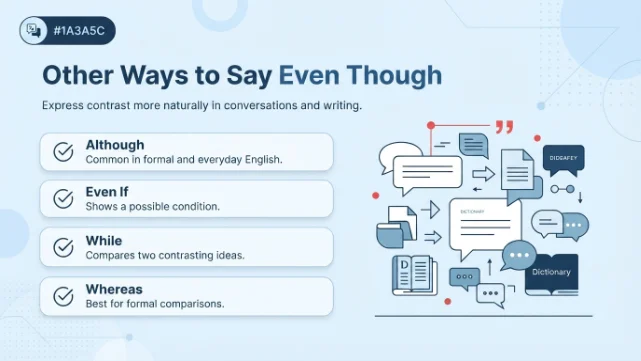
Other Ways to Say Even Though
These alternatives will help you sound more fluent, confident, and natural in different situations. Use them according to tone, context, and audience to express excitement, admiration, or approval when contrasting ideas.
1. Phrase: Although
Meaning: Introduces a contrast between two ideas in a clear and neutral way.
Explanation: Although is one of the most common alternatives to even though. It works well in both spoken and written English without sounding too formal.
Example Sentence: Although the weather was terrible, everyone enjoyed the outdoor concert.
Best Use: essays, emails
Worst Use: none (works almost everywhere)
Tone: neutral, natural
Context Variability: casual, professional, spoken
2. Phrase: Though
Meaning: Expresses contrast in a shorter and more conversational way.
Explanation: Though is less formal than although and often appears at the end of a sentence in everyday speech.
Example Sentence: I wasn’t expecting much. It turned out great, though.
Best Use: conversations, text messages
Worst Use: highly formal documents
Tone: casual, relaxed
Context Variability: casual, spoken
3. Phrase: Even If
Meaning: Introduces a possible or imagined situation rather than a real fact.
Explanation: Unlike even though, even if refers to hypothetical conditions or future possibilities.
Example Sentence: Even if traffic is heavy, we’ll arrive on time.
Best Use: future plans, predictions
Worst Use: confirmed past events
Tone: conditional, flexible
Context Variability: casual, professional, spoken
4. Phrase: Despite the Fact That
Meaning: Shows that something happened regardless of another fact.
Explanation: This formal expression adds emphasis and is commonly used in reports, essays, and academic writing.
Example Sentence: Despite the fact that the budget was limited, the project exceeded expectations.
Best Use: reports, academic writing
Worst Use: casual conversations
Tone: formal, precise
Context Variability: professional
5. Phrase: In Spite of the Fact That
Meaning: Indicates that one situation did not prevent another from happening.
Explanation: Similar to despite the fact that, but slightly more traditional and formal.
Example Sentence: In spite of the fact that she had little experience, she performed exceptionally well.
Best Use: formal documents
Worst Use: everyday speech
Tone: formal, traditional
Context Variability: professional
6. Phrase: Notwithstanding
Meaning: Means “despite” or “regardless of.”
Explanation: Notwithstanding is mostly found in legal, business, and academic writing rather than everyday conversation.
Example Sentence: Notwithstanding several delays, the construction project was completed successfully.
Best Use: legal writing, official reports
Worst Use: casual conversation
Tone: formal, authoritative
Context Variability: professional
7. Phrase: While
Meaning: Introduces a gentle contrast between two ideas.
Explanation: While can soften a comparison or disagreement without sounding too direct.
Example Sentence: While the proposal had some weaknesses, it offered several valuable ideas.
Best Use: presentations, discussions
Worst Use: emphasizing strong contrast
Tone: balanced, polite
Context Variability: casual, professional
8. Phrase: Albeit
Meaning: Means “although,” usually before an adjective or short phrase.
Explanation: Albeit is concise and elegant but is mainly used in formal writing.
Example Sentence: The solution was effective, albeit expensive.
Best Use: articles, formal writing
Worst Use: everyday conversations
Tone: concise, formal
Context Variability: professional
9. Phrase: Regardless of the Fact That
Meaning: Shows that one fact did not affect the final outcome.
Explanation: This phrase emphasizes determination or an unchanged result despite circumstances.
Example Sentence: Regardless of the fact that the deadline was short, the team delivered excellent work.
Best Use: business writing
Worst Use: informal chats
Tone: formal, firm
Context Variability: professional
10. Phrase: For All That
Meaning: Introduces contrast despite a previous statement.
Explanation: This literary expression is uncommon today but still appears in classic or formal writing.
Example Sentence: For all that he struggled, he never gave up.
Best Use: literature, storytelling
Worst Use: business communication
Tone: literary, formal
Context Variability: professional
11. Phrase: Be That as It May
Meaning: Accepts a point before presenting a different opinion.
Explanation: This phrase is useful when politely acknowledging another viewpoint.
Example Sentence: Be that as it may, we still need to complete the project on schedule.
Best Use: meetings, debates
Worst Use: text messages
Tone: diplomatic, formal
Context Variability: professional, spoken
12. Phrase: However
Meaning: Connects two ideas that contrast with each other.
Explanation: However usually begins a new sentence or follows a semicolon instead of joining clauses directly.
Example Sentence: Sales declined in January. However, they recovered quickly in February.
Best Use: reports, articles
Worst Use: directly joining two clauses
Tone: neutral, formal
Context Variability: professional, casual
13. Phrase: That Said
Meaning: Introduces an exception or contrasting point.
Explanation: Common in workplace discussions and professional writing.
Example Sentence: The launch faced delays. That said, customer feedback was overwhelmingly positive.
Best Use: business communication
Worst Use: academic essays
Tone: conversational, professional
Context Variability: professional, spoken
14. Phrase: Nevertheless
Meaning: Means “in spite of that.”
Explanation: A strong transition that emphasizes an unexpected outcome.
Example Sentence: The challenge was difficult. Nevertheless, the team succeeded.
Best Use: formal writing
Worst Use: casual texting
Tone: formal, emphatic
Context Variability: professional
15. Phrase: Nonetheless
Meaning: Indicates that something happened despite previous circumstances.
Explanation: Very similar to nevertheless, but often sounds slightly softer.
Example Sentence: The task was demanding. Nonetheless, everyone completed it successfully.
Best Use: reports, presentations
Worst Use: informal chats
Tone: formal, measured
Context Variability: professional
16. Phrase: Yet
Meaning: Introduces an unexpected contrast.
Explanation: Yet is short, natural, and frequently used in both speech and writing.
Example Sentence: The assignment was difficult, yet she finished it ahead of schedule.
Best Use: storytelling, speeches
Worst Use: highly technical legal documents
Tone: concise, expressive
Context Variability: casual, professional, spoken
17. Phrase: But Still
Meaning: Adds contrast while keeping a conversational tone.
Explanation: This expression is common in informal speech and everyday writing.
Example Sentence: The restaurant was expensive, but still, the experience was worth it.
Best Use: conversations
Worst Use: formal reports
Tone: casual, friendly
Context Variability: casual, spoken
18. Phrase: Granted That
Meaning: Accepts one point before introducing another.
Explanation: Useful when making balanced arguments or acknowledging a fact.
Example Sentence: Granted that the schedule was tight, the team delivered excellent results.
Best Use: discussions, debates
Worst Use: casual texting
Tone: thoughtful, formal
Context Variability: professional, spoken
19. Phrase: Admittedly
Meaning: Honestly recognizes a fact before making a contrasting statement.
Explanation: It helps your argument sound fair and balanced.
Example Sentence: Admittedly, the software has flaws, but its performance is impressive.
Best Use: reviews, essays
Worst Use: quick messages
Tone: honest, balanced
Context Variability: professional, casual
20. Phrase: Even So
Meaning: Means “despite that.”
Explanation: Suitable for both everyday conversations and professional writing.
Example Sentence: The weather was poor. Even so, the event attracted hundreds of visitors.
Best Use: writing, conversation
Worst Use: legal contracts
Tone: natural, balanced
Context Variability: casual, professional, spoken
21. Phrase: All the Same
Meaning: Indicates that something remained true despite previous information.
Explanation: A friendly expression commonly heard in spoken English.
Example Sentence: I was nervous. All the same, I enjoyed giving the presentation.
Best Use: everyday conversations
Worst Use: academic papers
Tone: friendly, informal
Context Variability: casual, spoken
22. Phrase: Whereas
Meaning: Highlights a clear difference between two situations.
Explanation: Frequently used when comparing facts or statistics.
Example Sentence: Whereas online sales increased, in-store purchases declined.
Best Use: comparisons, reports
Worst Use: casual conversations
Tone: analytical, formal
Context Variability: professional
23. Phrase: Despite
Meaning: Shows contrast before a noun or gerund.
Explanation: Remember that despite is not followed by a complete clause.
Example Sentence: Despite the heavy traffic, we arrived on time.
Best Use: everyday writing
Worst Use: before full clauses
Tone: concise, neutral
Context Variability: casual, professional
24. Phrase: In Spite of
Meaning: Expresses contrast before a noun phrase.
Explanation: It has nearly the same meaning as despite but sounds slightly more traditional.
Example Sentence: In spite of the noise, she remained focused.
Best Use: essays, reports
Worst Use: very casual speech
Tone: formal, traditional
Context Variability: professional
25. Phrase: No Matter That
Meaning: Emphasizes that circumstances did not affect the outcome.
Explanation: Often used in storytelling or expressive speech.
Example Sentence: No matter that the journey was long, everyone enjoyed the adventure.
Best Use: storytelling
Worst Use: legal writing
Tone: expressive, determined
Context Variability: casual, spoken
26. Phrase: Even When
Meaning: Describes contrast during repeated or ongoing situations.
Explanation: Best used for habits, routines, or general truths.
Example Sentence: Even when she is busy, she always finds time to help others.
Best Use: daily habits
Worst Use: one-time past events
Tone: practical, neutral
Context Variability: casual, professional
27. Phrase: Still and All
Meaning: Means “nevertheless” in an informal way.
Explanation: This older expression is mostly used in conversational English.
Example Sentence: The drive was exhausting. Still and all, it was a memorable trip.
Best Use: storytelling
Worst Use: business reports
Tone: informal, old-fashioned
Context Variability: casual, spoken
28. Phrase: At the Same Time
Meaning: Shows that two contrasting ideas can both be true.
Explanation: It balances different viewpoints instead of creating strong opposition.
Example Sentence: The position is challenging. At the same time, it offers excellent opportunities.
Best Use: workplace discussions
Worst Use: dramatic contrast
Tone: balanced, professional
Context Variability: professional, spoken
29. Phrase: Having Said That
Meaning: Introduces a contrasting opinion after making a point.
Explanation: Common in meetings, presentations, and business conversations.
Example Sentence: Sales were lower than expected. Having said that, customer satisfaction improved significantly.
Best Use: meetings, presentations
Worst Use: formal academic essays
Tone: professional, conversational
Context Variability: professional, spoken
30. Phrase: Just the Same
Meaning: Means “despite everything that has been mentioned.”
Explanation: This expression adds a gentle contrast in everyday conversation.
Example Sentence: It wasn’t easy. Just the same, I would do it again.
Best Use: casual conversations
Worst Use: formal reports
Tone: warm, informal
Context Variability: casual, spoken
“Variety in language is not decoration, it is clarity in disguise.”
Mini Quiz
1. Which alternative is best for a formal legal document?
a) But still b) Notwithstanding c) Just the same d) Yet
2. Which phrase is followed by a noun, not a full clause?
a) Even though b) Despite c) Although d) Whereas
3. Which alternative fits a casual conversation with a friend?
a) Notwithstanding b) In spite of the fact that c) All the same d) Regardless of the fact that
4. Which phrase best introduces a hypothetical, not-yet-happened contrast?
a) Even if b) Despite c) Whereas d) Nevertheless
Answers: 1-b, 2-b, 3-c, 4-a
Comparison Table: Top Alternatives
| Phrase | Tone | Best Use |
|---|---|---|
| Although | Neutral, versatile | Essays, emails |
| Though | Relaxed, informal | Conversation, texting |
| Even if | Hypothetical, flexible | Predictions, plans |
| Despite the fact that | Formal, precise | Reports, essays |
| Notwithstanding | Formal, authoritative | Legal documents |
| While | Balanced, mild | Presentations, essays |
| Nevertheless | Formal, emphatic | Formal writing, speeches |
| That said | Professional, conversational | Business updates |
| Whereas | Formal, analytical | Comparisons, reports |
| Even so | Balanced, natural | Conversation, writing |
FAQs
What is a more formal way to say even though?
Notwithstanding, despite the fact that, and in spite of the fact that are strong formal alternatives suited to reports and official writing.
Can I use although and even though interchangeably?
Yes, in most cases although and even though can replace each other without changing the meaning of the sentence.
Is even though grammatically different from despite?
Yes, even though is followed by a full clause, while despite is followed by a noun or gerund phrase.
What is a casual way to say even though in conversation?
Though, still, and even so are common informal expressions in English used in everyday speech.
Why should I learn multiple alternatives to even though?
Learning alternatives to even though improves fluency, prevents repetition, and helps you match tone across formal and informal English.
Conclusion
Mastering alternatives to even though gives you the flexibility to match your tone to any situation, from casual conversation to formal business writing. Instead of repeating the same phrase, you can choose words like although, notwithstanding, or even so to sound more precise and natural.
Practice using a few new alternatives every day, paying close attention to context and tone. Over time, this small habit will make your spoken and written English sound noticeably more confident and professional.
Discover More Related Articles:

Jennifer Wilson is an experienced writer and content creator with over 20 years of expertise in digital publishing, lifestyle, and informative content. Holding a degree in English Literature, she contributes to Responary.Com, where she shares engaging, well-researched articles that help readers stay informed and inspired.