Quick Answer
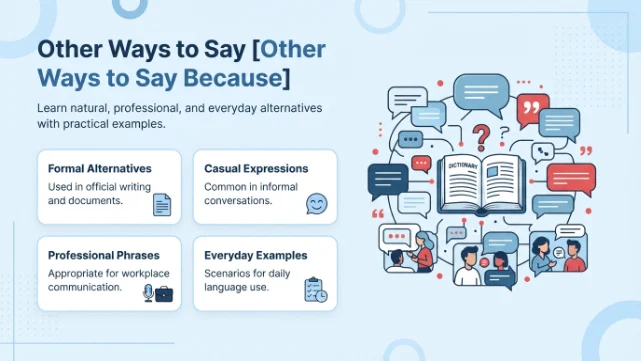
Looking for other ways to say because? The word because is useful, but repeating it in every sentence makes your English sound flat and repetitive. Strong alternatives include since, as, due to, owing to, and given that. Each one shifts your tone from casual to formal, so picking the right one instantly improves how polished you sound.
Because is a subordinating conjunction that introduces a reason or cause for something. It connects a result to its explanation, telling the reader or listener why something happened.
People use because constantly in spoken and written English, from casual conversations to business emails to academic essays. It is one of the most common words in the language, which is exactly why relying on it too much can make writing feel repetitive.
Learning alternatives to because sharpens your fluency and gives you more control over tone. Whether you want to express excitement in English, sound more professional, or simply avoid repeating the same word five times in one paragraph, having a range of causal phrases makes your English feel natural and confident.
“The right tone makes your English sound professional and confident.”
Quick Categories
Formal Alternatives to “Because”
- Owing to
- Due to
- On account of
- In light of
Pro Tip: Use formal alternatives to because in reports, emails to clients, and academic writing. They signal precision and professionalism.
Casual Alternatives
- Since
- As
- Seeing as
- Seeing that
Pro Tip: These casual alternatives keep conversations natural without sounding stiff. Use them with friends, family, or in relaxed spoken English.
Professional Alternatives
- Given that
- Considering that
- In view of
- As a result of
Pro Tip: Professional reaction phrases like these work well in meetings, presentations, and business writing where clarity and authority matter.
Informal Expressions
- Cuz
- Cos
- For
- Now that
Pro Tip: Informal expressions in English like “cuz” and “cos” belong in texting or casual chats only. Avoid them in professional or written contexts.
“Alternatives to because aren’t just decoration, they change how confident you sound.”
Common Mistakes People Make With “Because”
- Starting every sentence with because in formal writing.
Example: “Because it rained, the game was cancelled.” (Better in formal writing: “The game was cancelled due to rain.”) - Using “because of” with a full clause instead of a noun.
Example: Incorrect: “Because of it rained.” Correct: “Because it rained.” - Overusing because and making writing repetitive.
Example: “I stayed home because I was tired because I had a headache.” (Repetitive and unclear.) - Confusing “because” with “since” in time-related contexts.
Example: “Since 2020, I have worked here” refers to time, not reason, so it should not be swapped carelessly. - Using informal versions like “cuz” in professional emails.
Example: Incorrect: “I’m late cuz of traffic.” Correct: “I’m late because of traffic.”
What Does “Because” Mean?
Because introduces a reason, cause, or explanation for an action or situation. Grammatically, it functions as a subordinating conjunction, meaning it connects a dependent clause to an independent clause.
Example Sentence: She left early because she had an appointment.
When to Use “Because”
- Explaining a reason in everyday conversation
- Answering the question “why”
- Writing academic or business explanations
- Spoken English: common and natural in casual dialogue
- Written English: acceptable in most contexts, but formal writing often prefers alternatives like “due to” or “given that”
- Formal contexts: works fine at the sentence’s midpoint, but starting a formal sentence with “because” is often avoided
- Informal contexts: perfectly natural to use freely
Is It Professional or Polite to Say “Because”?
Because is polite and completely acceptable in daily communication, but it is not always the most professional choice for formal business writing.
Business Example: Instead of “We are delayed because of supply issues,” professional writing often prefers “We are delayed due to supply chain issues.”
Polite? Yes Professional? No (in most formal writing contexts)
Pros and Cons of Using “Because”
Pros:
- Simple and natural
- Universally understood
- Common in everyday usage
- Easy to understand for all English levels
Cons:
- Overused in casual and academic writing
- Limited formal tone
- Repetitive if used too often in one piece
- Not ideal for polished business documents
Other Ways to Say Because
These alternatives will help you sound more fluent, confident, and natural in different situations. Use them according to tone, context, and audience to express excitement, admiration, or approval when explaining your reasoning.
“Learning alternatives to because is one of the fastest ways to sound more fluent.”
1. Phrase: Since
Meaning: Introduces a reason, similar to because. Explanation: Commonly used at the start or middle of a sentence for a natural tone. Example Sentence: Since it’s raining, let’s stay inside. Best Use: casual conversation Worst Use: legal documents Tone: natural, easy, conversational Context Variability: casual, spoken
2. Phrase: As
Meaning: Gives a reason in a slightly more formal tone than “since.” Explanation: Works well in both spoken and written English. Example Sentence: As the store was closed, we went home. Best Use: general writing Worst Use: casual texting Tone: neutral, versatile Context Variability: casual, professional
3. Phrase: Due to
Meaning: States a direct cause, usually followed by a noun. Explanation: Common in formal reports, news, and business writing. Example Sentence: The flight was cancelled due to bad weather. Best Use: business reports Worst Use: casual chats Tone: formal, precise Context Variability: professional, written
4. Phrase: Owing to
Meaning: A formal way to introduce a cause. Explanation: Slightly more old-fashioned but still used in academic and legal writing. Example Sentence: Owing to heavy traffic, the meeting started late. Best Use: academic writing Worst Use: casual speech Tone: formal, refined Context Variability: professional, written
5. Phrase: On Account Of
Meaning: Explains a reason, often for a decision or delay. Explanation: Common in slightly formal or explanatory contexts. Example Sentence: The event was postponed on account of the storm. Best Use: formal explanations Worst Use: quick texts Tone: formal, deliberate Context Variability: professional, spoken
6. Phrase: In Light Of
Meaning: Introduces a reason based on new information. Explanation: Often used when a decision changes due to new facts. Example Sentence: In light of recent events, the policy was updated. Best Use: business updates Worst Use: casual conversation Tone: formal, thoughtful Context Variability: professional, written
7. Phrase: Given That
Meaning: Introduces a condition or reason that influences a decision. Explanation: Common in professional discussions and analysis. Example Sentence: Given that sales dropped, we revised the budget. Best Use: meetings, reports Worst Use: casual texting Tone: analytical, professional Context Variability: professional, spoken
8. Phrase: Considering That
Meaning: Introduces a reason while acknowledging a factor. Explanation: Slightly softer and more reflective than “because.” Example Sentence: Considering that it’s a holiday, the office is closed. Best Use: explanations Worst Use: legal writing Tone: thoughtful, measured Context Variability: casual, professional
9. Phrase: For the Reason That
Meaning: A formal, explicit way to state a cause. Explanation: Rarely used in speech, more common in legal or academic writing. Example Sentence: The request was denied for the reason that it lacked documentation. Best Use: legal writing Worst Use: everyday speech Tone: formal, rigid Context Variability: professional, written
10. Phrase: Seeing As
Meaning: A casual way to explain a reason. Explanation: Common in relaxed spoken English. Example Sentence: Seeing as you’re here, let’s start the meeting. Best Use: casual talk Worst Use: formal writing Tone: friendly, informal Context Variability: casual, spoken
11. Phrase: Seeing That
Meaning: Similar to “seeing as,” explains a reason casually. Explanation: Common in everyday conversation. Example Sentence: Seeing that it’s late, we should head home. Best Use: casual talk Worst Use: business emails Tone: relaxed, conversational Context Variability: casual, spoken
12. Phrase: Inasmuch As
Meaning: A formal expression meaning “to the extent that” or “because.” Explanation: Rare, mostly used in legal or academic contexts. Example Sentence: Inasmuch as the terms were violated, the contract is void. Best Use: legal documents Worst Use: casual speech Tone: formal, technical Context Variability: professional, written
13. Phrase: On the Grounds That
Meaning: States an official or logical reason. Explanation: Common in legal, academic, or formal debates. Example Sentence: The appeal was rejected on the grounds that evidence was missing. Best Use: formal arguments Worst Use: casual chats Tone: formal, official Context Variability: professional, written
14. Phrase: Thanks To
Meaning: Attributes a positive outcome to a cause. Explanation: Often used for good results rather than neutral or negative ones. Example Sentence: Thanks to your help, we finished early. Best Use: positive outcomes Worst Use: negative explanations Tone: warm, appreciative Context Variability: casual, professional
15. Phrase: As a Result Of
Meaning: Shows a direct cause-and-effect relationship. Explanation: Common in reports and analytical writing. Example Sentence: As a result of the delay, costs increased. Best Use: reports, analysis Worst Use: casual talk Tone: formal, analytical Context Variability: professional, written
16. Phrase: By Virtue Of
Meaning: Explains a reason based on a quality or status. Explanation: Formal and slightly academic in tone. Example Sentence: By virtue of her experience, she was promoted. Best Use: formal writing Worst Use: everyday speech Tone: formal, elevated Context Variability: professional, written
17. Phrase: In View Of
Meaning: Introduces a reason based on a situation or fact. Explanation: Common in business and official communication. Example Sentence: In view of the budget cuts, hiring is paused. Best Use: business updates Worst Use: casual conversation Tone: formal, considered Context Variability: professional, written
18. Phrase: For
Meaning: A short, literary way to give a reason. Explanation: More common in writing, especially older or literary English. Example Sentence: She smiled, for she was finally home. Best Use: creative writing Worst Use: business emails Tone: literary, poetic Context Variability: written, formal
19. Phrase: In That
Meaning: Explains a reason by clarifying a specific point. Explanation: Common in formal or explanatory writing. Example Sentence: The plan is risky in that it depends on funding. Best Use: academic writing Worst Use: casual speech Tone: formal, precise Context Variability: professional, written
20. Phrase: Given the Fact That
Meaning: Emphasizes a factual reason behind a statement. Explanation: Slightly more formal and emphatic than “given that.” Example Sentence: Given the fact that prices rose, demand fell. Best Use: reports, analysis Worst Use: quick conversation Tone: formal, emphatic Context Variability: professional, written
21. Phrase: On the Basis That
Meaning: States the foundation or reasoning behind a decision. Explanation: Common in formal or legal explanations. Example Sentence: The loan was approved on the basis that income was verified. Best Use: formal decisions Worst Use: casual talk Tone: formal, structured Context Variability: professional, written
22. Phrase: Now That
Meaning: Introduces a reason tied to a recent change or event. Explanation: Common in everyday spoken English. Example Sentence: Now that summer is here, we can travel more. Best Use: everyday conversation Worst Use: legal writing Tone: natural, conversational Context Variability: casual, spoken
23. Phrase: Insofar As
Meaning: Means “to the extent that,” used to give a qualified reason. Explanation: Formal and precise, common in academic or legal writing. Example Sentence: The plan works insofar as funding remains stable. Best Use: academic writing Worst Use: casual speech Tone: formal, technical Context Variability: professional, written
24. Phrase: As a Consequence Of
Meaning: Shows that one event directly caused another. Explanation: Common in analytical or news writing. Example Sentence: As a consequence of the strike, deliveries were delayed. Best Use: news, reports Worst Use: casual chats Tone: formal, analytical Context Variability: professional, written
25. Phrase: By Reason Of
Meaning: A formal way to state a legal or official cause. Explanation: Mostly found in legal or bureaucratic language. Example Sentence: He was excused by reason of illness. Best Use: legal writing Worst Use: everyday speech Tone: formal, official Context Variability: professional, written
26. Phrase: In Consequence Of
Meaning: Similar to “as a consequence of,” shows cause and effect. Explanation: Slightly old-fashioned but still used formally. Example Sentence: In consequence of the merger, roles were restructured. Best Use: formal reports Worst Use: casual speech Tone: formal, dated Context Variability: professional, written
27. Phrase: For the Simple Reason That
Meaning: Emphasizes a clear, straightforward cause. Explanation: Adds emphasis to a reason that seems obvious. Example Sentence: I declined for the simple reason that I was busy. Best Use: explanations, debates Worst Use: legal writing Tone: direct, emphatic Context Variability: casual, professional
28. Phrase: Because of the Fact That
Meaning: A wordier version of because, emphasizing a fact. Explanation: Often considered redundant, but still used in speech. Example Sentence: We left early because of the fact that it got dark. Best Use: casual speech Worst Use: concise writing Tone: informal, wordy Context Variability: casual, spoken
29. Phrase: Cuz
Meaning: An informal shortened version of because. Explanation: Common in texting and casual speech among friends. Example Sentence: I’m tired cuz I stayed up late. Best Use: texting, casual chat Worst Use: professional writing Tone: informal, playful Context Variability: casual, spoken
30. Phrase: Cos
Meaning: A British informal shortened form of because. Explanation: Common in casual British English speech. Example Sentence: We stayed home cos it was raining. Best Use: casual speech Worst Use: formal writing Tone: informal, relaxed Context Variability: casual, spoken
31. Phrase: Seeing As How
Meaning: A casual, regional way to explain a reason. Explanation: Common in informal spoken English, especially in certain dialects. Example Sentence: Seeing as how it’s your birthday, dinner is on me. Best Use: casual conversation Worst Use: written reports Tone: folksy, informal Context Variability: casual, spoken
“Small word choices like these separate fluent English from textbook English.”
Mini Quiz:
- Which alternative to because is most appropriate in a formal business report?
a) Cuz b) Due to c) Seeing as d) Cos - Which phrase is best for expressing a positive cause, like thanking someone?
a) By reason of b) Thanks to c) Insofar as d) On the grounds that - Which sentence uses “since” correctly to give a reason?
a) Since 2010, prices have risen. b) Since you asked, I’ll explain. c) Both a and b are correct, but only b shows reason. d) Neither is correct. - Which phrase fits best in a legal document?
a) Seeing as how b) On the grounds that c) Cuz d) Now that
Answers: 1-b, 2-b, 3-c, 4-b
Comparison Table: Top Alternatives to “Because”
| Phrase | Tone | Best Use |
|---|---|---|
| Since | Natural, casual | Everyday conversation |
| Due to | Formal, precise | Business reports |
| Owing to | Formal, refined | Academic writing |
| Given that | Analytical | Meetings, reports |
| Considering that | Thoughtful | Explanations |
| In light of | Formal, thoughtful | Business updates |
| As a result of | Formal, analytical | Reports, analysis |
| Thanks to | Warm, appreciative | Positive outcomes |
| Seeing as | Friendly, informal | Casual talk |
| On the grounds that | Formal, official | Formal arguments |
FAQs
What is the most professional way to say because?
“Due to,” “owing to,” and “given that” are among the most professional alternatives to because, especially in reports and business emails.
Is it grammatically correct to start a sentence with because?
Yes, starting a sentence with because is grammatically correct as long as the sentence includes both a dependent and an independent clause.
What is a casual way to say because?
Casual alternatives include “since,” “as,” “cuz,” and “seeing as,” which work well in relaxed spoken English.
Can “since” always replace “because”?
Not always. Since can indicate time or reason, so context matters when choosing between the two.
Why should I learn other ways to say because?
Learning other ways to say because improves fluency, prevents repetition, and helps you adjust your tone for formal, professional, or casual situations.
Conclusion
Learning alternatives to because gives you more control over tone, precision, and fluency in English. From formal options like “owing to” and “in light of” to casual choices like “since” and “seeing as,” each phrase helps you communicate more naturally depending on the situation.
Practice using these alternatives daily in your writing and conversations. Paying attention to tone, whether you need formal, professional, or informal language, is one of the fastest ways to sound like a confident, fluent English speaker.
For more vocabulary building, see also our guide on other ways to say excited and our professional English communication guide for the workplace.
Discover More Related Articles :
- Ways to Say On the Other Hand | With These Alternatives In 2026
- Other Ways to Say In Addition | Formal, Casual & Academic Alternatives In 2026

Jennifer Wilson is an experienced writer and content creator with over 20 years of expertise in digital publishing, lifestyle, and informative content. Holding a degree in English Literature, she contributes to Responary.Com, where she shares engaging, well-researched articles that help readers stay informed and inspired.