Quick Answer
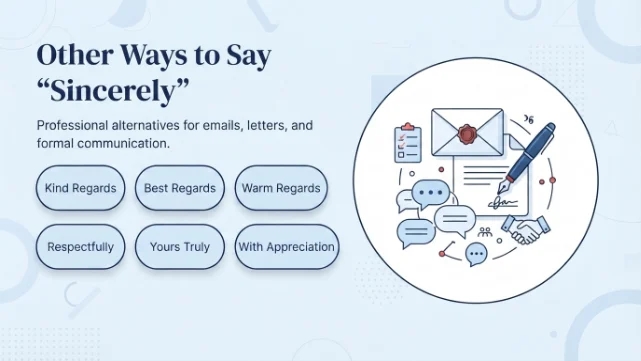
Looking for alternatives to “Sincerely” for your emails and letters? The top choices are Best regards, Kind regards, Respectfully, Warmly, and Yours truly. Each carries a slightly different tone, so choosing the right one depends on your audience and the formality of your message.
“Sincerely” is one of the most common closings used at the end of letters and emails. It signals honesty, respect, and professionalism, and it works as a safe, neutral sign-off in almost any formal context. Because it’s so widely used, many writers rely on it out of habit rather than choice.
People search for alternatives to “sincerely” because using the same closing every time can feel stiff or impersonal. Knowing several options also helps you express excitement in English when the moment calls for warmth, or stay formal when the situation demands distance and respect.
This guide breaks down alternatives across formal, casual, professional, and informal categories, with clear examples so you know exactly when and how to use each one.
“The right closing line leaves the same lasting impression as your opening sentence.”
Quick Categories
Formal alternatives to “Sincerely”
- Yours faithfully – used mainly in British English when the recipient’s name is unknown
- Respectfully – common in official or ceremonial correspondence
- Yours truly – classic, formal, slightly softer than “Sincerely”
- With respect – formal and direct, often used in legal or official letters
Pro Tip: Reserve “Yours faithfully” for formal British letters that begin with “Dear Sir/Madam.”
Casual alternatives
- Take care
- All the best
- Talk soon
- Until next time
Pro Tip: Casual sign-offs work best with people you already have an ongoing relationship with, not first-time contacts.
Professional alternatives
- Best regards
- Kind regards
- With appreciation
- Looking forward to hearing from you
Pro Tip: “Best regards” is the safest professional default when you’re unsure how formal to be.
Informal expressions
- Best
- Warmly
- Thanks again
- Regards
Pro Tip: Single-word closings like “Best” or “Regards” suit quick, everyday work emails, not formal business proposals.
“A well-chosen sign-off can make your message feel warmer without losing professionalism.”
Common Mistakes
- Using “Sincerely” in casual emails to friends or close colleagues. Example: “Sincerely, Ali” in a text to a coworker feels overly stiff.
- Pairing “Sincerely” with an overly informal greeting. Example: Starting with “Hey!” and ending with “Sincerely” creates a mismatched tone.
- Repeating the same closing in every email regardless of context. Example: Using “Sincerely” for both a job application and a thank-you note to a friend.
- Forgetting a comma after the closing phrase. Example: Writing “Sincerely John” instead of “Sincerely, John.”
- Using “Yours faithfully” when you know the recipient’s name. Example: Writing “Dear Mr. Khan” but closing with “Yours faithfully” instead of “Yours sincerely.”
What Does “Sincerely” Mean?
“Sincerely” is an adverb used as a formal closing before a signature in letters and emails. It conveys honesty and genuine respect toward the reader.
Grammar note: It is typically followed by a comma, then a new line for the signature: “Sincerely, [Name].”
Example Sentence: “Thank you for considering my application. Sincerely, Sara Ahmed.”
When to Use “Sincerely”
- Job applications and cover letters
- Formal business correspondence
- Official complaints or requests
- Written communication (letters, formal emails)
- Less common in spoken English, since it’s a written closing convention
- Appropriate in both formal and semi-formal written contexts
Is It Professional or Polite to Say “Sincerely”?
“Sincerely” is both polite and professional. It works well in almost any formal written context, including business letters, job applications, and official emails.
Business example: “We appreciate your continued partnership. Sincerely, the Account Management Team.”
Polite? Yes Professional? Yes
Pros and Cons of Using “Sincerely”
Pros
- Simple and natural
- Widely recognized and accepted
- Suitable for almost any formal document
- Easy to understand across cultures
Cons
- Overused, especially in business emails
- Can feel generic or impersonal
- Limited emotional range
- Not ideal for warm or casual relationships
“Variety in your sign-offs shows attention to detail, and readers notice it.”
Other Ways to Say Sincerely
These alternatives will help you sound more fluent, confident, and natural in different situations. Use them according to tone, context, and audience to express warmth, respect, or professionalism appropriately.
1. Phrase: Best regards
Meaning: A polite, neutral way to close a professional message. Explanation: Works for most business emails without sounding too formal or too casual. Example Sentence: “Best regards, Emma Chen.” Best Use: Business emails Worst Use: Personal letters Tone: Neutral, professional Context Variability: professional, written
2. Phrase: Kind regards
Meaning: A slightly warmer version of “Best regards.” Explanation: Adds a touch of friendliness while staying professional. Example Sentence: “Kind regards, the Support Team.” Best Use: Customer emails Worst Use: Legal documents Tone: Warm, courteous Context Variability: professional, spoken introductions
3. Phrase: Warm regards
Meaning: A friendly, approachable sign-off. Explanation: Suitable when you have an existing relationship with the recipient. Example Sentence: “Warm regards, Michael.” Best Use: Ongoing business relationships Worst Use: First contact emails Tone: Friendly, personal Context Variability: professional, casual
4. Phrase: Warmly
Meaning: A short, affectionate closing. Explanation: Conveys genuine warmth without extra words. Example Sentence: “Warmly, Aisha.” Best Use: Personal notes Worst Use: Formal reports Tone: Affectionate, brief Context Variability: casual, semi-formal
5. Phrase: Regards
Meaning: A brief, neutral closing. Explanation: Common in everyday professional emails when brevity matters. Example Sentence: “Regards, David.” Best Use: Quick work emails Worst Use: Formal cover letters Tone: Neutral, brief Context Variability: professional, informal
6. Phrase: Yours truly
Meaning: A formal, classic sign-off expressing sincerity. Explanation: Common in American English formal letters. Example Sentence: “Yours truly, Robert Lee.” Best Use: Formal letters Worst Use: Text messages Tone: Formal, classic Context Variability: formal, written
7. Phrase: Yours faithfully
Meaning: A formal closing used when the recipient’s name is unknown. Explanation: Common in British English after “Dear Sir/Madam.” Example Sentence: “Yours faithfully, J. Thompson.” Best Use: Unknown recipient letters Worst Use: Known contacts Tone: Formal, distant Context Variability: formal, written
8. Phrase: Respectfully
Meaning: A closing that emphasizes deep respect. Explanation: Often used in official, legal, or ceremonial writing. Example Sentence: “Respectfully, Dr. Amina Farooq.” Best Use: Official letters Worst Use: Casual chats Tone: Formal, respectful Context Variability: formal, professional
9. Phrase: Respectfully yours
Meaning: A more formal variation of “Respectfully.” Explanation: Used in traditional or highly formal correspondence. Example Sentence: “Respectfully yours, The Committee.” Best Use: Legal or official letters Worst Use: Friendly emails Tone: Formal, traditional Context Variability: formal, written
10. Phrase: With respect
Meaning: A direct expression of respect as a closing. Explanation: Suitable for formal disagreements or official requests. Example Sentence: “With respect, I must decline this offer.” Best Use: Formal disagreements Worst Use: Casual emails Tone: Formal, direct Context Variability: formal, professional
11. Phrase: Cordially
Meaning: A polite and courteous closing. Explanation: Common in invitations and formal announcements. Example Sentence: “Cordially, the Event Committee.” Best Use: Invitations Worst Use: Casual notes Tone: Polite, formal Context Variability: formal, professional
12. Phrase: Best wishes
Meaning: A friendly closing that expresses good will. Explanation: Suitable for both personal and semi-formal messages. Example Sentence: “Best wishes, Hannah.” Best Use: Congratulatory notes Worst Use: Legal documents Tone: Friendly, warm Context Variability: casual, semi-formal
13. Phrase: All the best
Meaning: A relaxed way to wish someone well. Explanation: Common between colleagues or acquaintances. Example Sentence: “All the best, Jason.” Best Use: Farewell emails Worst Use: Formal reports Tone: Friendly, casual Context Variability: casual, spoken
14. Phrase: Take care
Meaning: A caring, informal closing. Explanation: Best used with people you know personally. Example Sentence: “Take care, see you next week.” Best Use: Personal messages Worst Use: Business proposals Tone: Caring, informal Context Variability: casual, spoken
15. Phrase: Thanks again
Meaning: A closing that reinforces gratitude. Explanation: Useful after someone has helped you with something. Example Sentence: “Thanks again, I really appreciate it.” Best Use: Follow-up emails Worst Use: Formal legal letters Tone: Grateful, warm Context Variability: casual, professional
16. Phrase: Many thanks
Meaning: A polite way to close with appreciation. Explanation: Common in British professional emails. Example Sentence: “Many thanks, Olivia.” Best Use: Work emails Worst Use: Formal contracts Tone: Polite, appreciative Context Variability: professional, casual
17. Phrase: With appreciation
Meaning: A closing that expresses gratitude clearly. Explanation: Suitable for thank-you letters or acknowledgments. Example Sentence: “With appreciation, the Board of Directors.” Best Use: Thank-you letters Worst Use: Casual chats Tone: Grateful, formal Context Variability: formal, professional
18. Phrase: With gratitude
Meaning: A heartfelt way to express thanks as a closing. Explanation: Common in donation letters or acknowledgment notes. Example Sentence: “With gratitude, the Charity Foundation.” Best Use: Acknowledgment letters Worst Use: Quick emails Tone: Sincere, warm Context Variability: formal, semi-formal
19. Phrase: Thank you for your time
Meaning: A polite closing that acknowledges the reader’s effort. Explanation: Common in job applications and formal requests. Example Sentence: “Thank you for your time, Fatima Noor.” Best Use: Job applications Worst Use: Personal notes Tone: Polite, professional Context Variability: professional, formal
20. Phrase: Looking forward to hearing from you
Meaning: A closing that signals anticipation of a reply. Explanation: Common when a response is expected or requested. Example Sentence: “Looking forward to hearing from you, Mark.” Best Use: Follow-up emails Worst Use: Final farewell notes Tone: Hopeful, professional Context Variability: professional, written
21. Phrase: Yours in service
Meaning: A formal closing showing dedication to duty. Explanation: Common in community, government, or volunteer correspondence. Example Sentence: “Yours in service, Officer Malik.” Best Use: Community letters Worst Use: Casual emails Tone: Formal, dutiful Context Variability: formal, written
22. Phrase: With warm regards
Meaning: A blended closing combining warmth and professionalism. Explanation: Slightly more personal than “Best regards.” Example Sentence: “With warm regards, the HR Department.” Best Use: Ongoing correspondence Worst Use: First-time formal letters Tone: Warm, professional Context Variability: professional, semi-formal
23. Phrase: With sincere thanks
Meaning: A closing that emphasizes genuine gratitude. Explanation: Useful when thanking someone for significant help or effort. Example Sentence: “With sincere thanks, the Project Team.” Best Use: Thank-you letters Worst Use: Routine emails Tone: Genuine, formal Context Variability: formal, professional
24. Phrase: Faithfully yours
Meaning: A traditional variation of “Yours faithfully.” Explanation: Used in formal letters, mainly in older or British writing styles. Example Sentence: “Faithfully yours, the Editorial Office.” Best Use: Traditional formal letters Worst Use: Modern casual emails Tone: Formal, traditional Context Variability: formal, written
25. Phrase: Sincerely yours
Meaning: A slightly extended version of “Sincerely.” Explanation: Adds a small personal touch while staying formal. Example Sentence: “Sincerely yours, Grace Park.” Best Use: Formal letters Worst Use: Text messages Tone: Formal, personal Context Variability: formal, written
26. Phrase: With kind regards
Meaning: A courteous, slightly extended closing. Explanation: Common in professional emails across industries. Example Sentence: “With kind regards, the Client Services Team.” Best Use: Client communication Worst Use: Legal notices Tone: Courteous, professional Context Variability: professional, formal
27. Phrase: Yours respectfully
Meaning: A formal closing showing deference. Explanation: Common when writing to someone in a position of authority. Example Sentence: “Yours respectfully, a Concerned Citizen.” Best Use: Letters to authorities Worst Use: Peer-to-peer emails Tone: Formal, deferential Context Variability: formal, written
28. Phrase: Best
Meaning: A short, informal professional closing. Explanation: Common in quick daily work emails. Example Sentence: “Best, Tom.” Best Use: Internal work emails Worst Use: Formal proposals Tone: Casual, brief Context Variability: informal, professional
29. Phrase: Talk soon
Meaning: A casual closing suggesting future contact. Explanation: Best used with friends or close colleagues. Example Sentence: “Talk soon, catch you later.” Best Use: Friendly emails Worst Use: Formal business letters Tone: Casual, friendly Context Variability: casual, spoken
30. Phrase: Until next time
Meaning: A warm, informal way to sign off before a future meeting. Explanation: Common in newsletters or personal updates. Example Sentence: “Until next time, the Editorial Team.” Best Use: Newsletters Worst Use: Formal contracts Tone: Friendly, casual Context Variability: casual, semi-formal
“Choosing the right sign-off is a small detail that makes a big difference in how professional you sound.”
Mini Quiz
- Which closing is best for a formal letter when you don’t know the recipient’s name?
a) Take care b) Yours faithfully c) Talk soon - Which sign-off would you use in a quick internal work email?
a) Best b) Yours in service c) Faithfully yours - Which closing best fits a thank-you letter to a donor?
a) Regards b) With gratitude c) All the best - True or False: “Sincerely” is appropriate for casual text messages between friends.
“Matching your closing to your context is just as important as choosing the right words in the body of your message.”
Comparison Table: Top Alternatives
| Phrase | Tone | Best Use |
|---|---|---|
| Best regards | Neutral, professional | Business emails |
| Kind regards | Warm, courteous | Customer emails |
| Yours truly | Formal, classic | Formal letters |
| Yours faithfully | Formal, distant | Unknown recipient letters |
| Respectfully | Formal, respectful | Official letters |
| Warmly | Affectionate, brief | Personal notes |
| With appreciation | Grateful, formal | Thank-you letters |
| Cordially | Polite, formal | Invitations |
| Best wishes | Friendly, warm | Congratulatory notes |
| Take care | Caring, informal | Personal messages |
FAQs
What can I say instead of “Sincerely” in a business email?
“Best regards” or “Kind regards” are the most common professional alternatives to “Sincerely” in business emails.
Is “Best regards” more casual than “Sincerely”?
Yes, “Best regards” is slightly more relaxed while still remaining professional and appropriate for most work communication.
What is a formal alternative to “Sincerely” in British English?
“Yours faithfully” is a formal alternative used in British English when you don’t know the recipient’s name.
Can I use “Warmly” in a professional email?
Yes, “Warmly” works well in professional emails, especially with people you already have a friendly working relationship with.
Is it wrong to use “Sincerely” too often? It’s not wrong, but using other ways to say “sincerely” keeps your writing fresh and helps you match tone to context more precisely.
Conclusion
Learning multiple alternatives to “Sincerely” gives you more control over how your writing feels to the reader. Instead of relying on one default closing, you can choose a phrase that fits the formality, warmth, and purpose of each message.
Discover More Related Articles:
- Other Ways to Say Looking Forward to It | That Sound Professional In 2026
- Other Ways to Say In My Opinion| For IELTS & TOEFL In 2026

Jennifer Wilson is an experienced writer and content creator with over 20 years of expertise in digital publishing, lifestyle, and informative content. Holding a degree in English Literature, she contributes to Responary.Com, where she shares engaging, well-researched articles that help readers stay informed and inspired.