Quick Answer
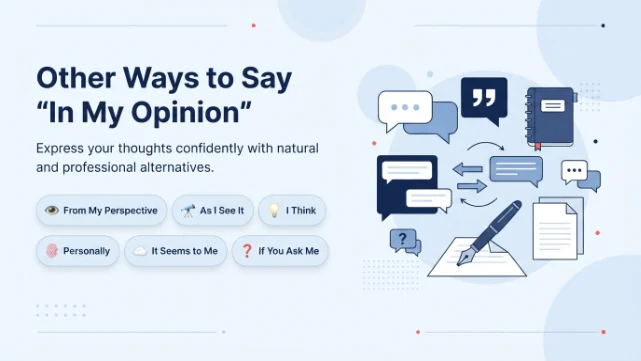
Looking for other ways to say in my opinion? The phrase is useful, but repeating it too often can make your writing and speech sound flat. Strong alternatives include: I believe, from my perspective, as I see it, personally speaking, and to my mind.
“In my opinion” is one of the most common phrases in English. People use it to introduce a personal viewpoint, share a judgment, or soften a statement before disagreeing with someone. It appears constantly in essays, meetings, debates, and everyday conversation.
Learning alternatives to in my opinion helps you sound more fluent and avoid sounding repetitive, especially in writing where variety matters. It also allows you to match your tone to the situation, whether you need something formal for a report or something casual for a chat with friends.
Beyond variety, alternative phrases let you express excitement in English, show confidence, or soften criticism depending on the words you choose. Mastering these options is a simple way to sound more natural and persuasive.
“The right tone makes your English sound professional and confident.”
Quick Categories
Formal Alternatives to “In My Opinion”
- It is my view that
- I would argue that
- From my perspective
- In my assessment
Pro Tip: Use formal alternatives in essays, reports, and business writing where a polished tone is expected.
Casual Alternatives
- If you ask me
- I feel like
- Honestly
- My take is
Pro Tip: Save casual alternatives for conversations with friends or informal messages, not professional emails.
Professional Alternatives
- Based on my experience
- In my professional judgment
- From where I stand
- My assessment is that
Pro Tip: Professional alternatives work well in meetings and reports because they sound confident without being pushy.
Informal Expressions
- Just my two cents
- I could be wrong, but
- If you want my honest opinion
- Not gonna lie
Pro Tip: Informal expressions add personality to spoken English but should be avoided in formal writing.
“Small changes in phrasing can completely shift how confident you sound.”
Common Mistakes
- Overusing the exact phrase in every sentence.
Example: “In my opinion this is good. In my opinion that is bad.” - Using casual alternatives in formal writing.
Example: “If you ask me, the quarterly results were disappointing,” in a formal report. - Forgetting the comma after introductory phrases.
Example: “In my opinion the plan needs work” should be “In my opinion, the plan needs work.” - Using overly formal phrases in casual chats.
Example: “It is my view that this pizza is excellent” sounds unnatural among friends. - Repeating the same alternative too often instead of varying vocabulary.
Example: Using “I feel like” five times in one paragraph.
What Does “In My Opinion” Mean?
“In my opinion” is a phrase used to introduce a personal belief, judgment, or viewpoint. Grammatically, it functions as an introductory phrase, usually followed by a comma when placed at the start of a sentence.
Example: In my opinion, the new policy will improve productivity.
When to Use “In My Opinion”
- Sharing a personal viewpoint in discussions
- Writing essays or opinion pieces
- Softening disagreement in conversation
- Giving feedback in meetings
Spoken vs Written: In speech, it is often shortened or replaced with casual alternatives; in writing, it appears more formally, especially in essays and reports.
Formal vs Informal: Formal writing favors alternatives like “it is my view that,” while informal speech favors “if you ask me” or “I feel like.”
Is It Professional or Polite to Say “In My Opinion”?
The phrase is polite and widely accepted in most settings, but it can sound slightly weak in formal business writing where more assertive phrasing is preferred.
Business Example: “In my opinion, the marketing strategy needs revision before launch.”
Polite? Yes Professional? Yes, though stronger alternatives like “based on my assessment” can sound more authoritative in high-stakes settings.
Pros and Cons of Using “In My Opinion”
Pros:
- Simple and natural
- Widely understood
- Common in both speech and writing
- Easy to use correctly
Cons:
- Can sound repetitive if overused
- Slightly weak for assertive business writing
- Limited emotional range
- Not always suitable for persuasive writing
Other Ways to Say In My Opinion
These alternatives will help you sound more fluent, confident, and natural in different situations. Use them according to tone, context, and audience to express excitement, admiration, or approval when sharing your views.
1. Phrase: I believe
Meaning: Introduces a personal conviction. Explanation: Slightly stronger than “in my opinion,” suggesting confidence. Example Sentence: I believe this approach will work better long-term. Best Use: Discussions, essays Worst Use: Very casual chats Tone: Confident, neutral, clear Context Variability: professional, spoken, casual
2. Phrase: From my perspective
Meaning: Frames the opinion as based on personal viewpoint. Explanation: Common in professional and academic contexts. Example Sentence: From my perspective, the timeline seems unrealistic. Best Use: Meetings, reports Worst Use: Casual texting Tone: Formal, thoughtful, measured Context Variability: professional, spoken
3. Phrase: As I see it
Meaning: Presents a personal interpretation of a situation. Explanation: Slightly conversational but still respectful. Example Sentence: As I see it, we have two clear options. Best Use: Discussions, debates Worst Use: Formal essays Tone: Balanced, conversational, confident Context Variability: spoken, casual, professional
4. Phrase: Personally speaking
Meaning: Emphasizes that the opinion is individual, not universal. Explanation: Useful when distinguishing your view from others. Example Sentence: Personally speaking, I would choose the second option. Best Use: Group discussions Worst Use: Technical reports Tone: Personal, direct, friendly Context Variability: spoken, casual, professional
5. Phrase: To my mind
Meaning: A reflective way of introducing a viewpoint. Explanation: Slightly literary, common in written English. Example Sentence: To my mind, this is the best solution available. Best Use: Essays, articles Worst Use: Casual conversation Tone: Reflective, formal, articulate Context Variability: professional, written
6. Phrase: It is my view that
Meaning: A formal way to state a personal judgment. Explanation: Common in academic and legal writing. Example Sentence: It is my view that the contract requires revision. Best Use: Formal reports Worst Use: Everyday chat Tone: Formal, authoritative, precise Context Variability: professional
7. Phrase: I would argue that
Meaning: Introduces an opinion supported by reasoning. Explanation: Suggests the speaker is prepared to defend the point. Example Sentence: I would argue that remote work increases productivity. Best Use: Essays, debates Worst Use: Casual small talk Tone: Assertive, analytical, formal Context Variability: professional, written
8. Phrase: In my assessment
Meaning: Frames the opinion as based on evaluation or analysis. Explanation: Common in business and technical contexts. Example Sentence: In my assessment, the risks outweigh the benefits. Best Use: Business reports Worst Use: Casual conversation Tone: Analytical, formal, confident Context Variability: professional
9. Phrase: If you ask me
Meaning: A casual way to introduce a personal opinion. Explanation: Common in spoken English among friends. Example Sentence: If you ask me, the movie was overrated. Best Use: Casual chats Worst Use: Formal writing Tone: Casual, friendly, direct Context Variability: spoken, casual
10. Phrase: I feel like
Meaning: Introduces an opinion based on feeling rather than logic. Explanation: Very common in everyday speech. Example Sentence: I feel like we should wait before deciding. Best Use: Everyday conversation Worst Use: Formal essays Tone: Casual, personal, informal Context Variability: spoken, casual
11. Phrase: Honestly
Meaning: Signals a sincere, personal viewpoint. Explanation: Adds emotional weight to an opinion. Example Sentence: Honestly, I think we should reconsider the plan. Best Use: Casual and semi-formal talk Worst Use: Legal or academic writing Tone: Sincere, direct, informal Context Variability: spoken, casual, professional
12. Phrase: My take is
Meaning: A conversational way to share a viewpoint. Explanation: Common in modern spoken English and social media. Example Sentence: My take is that the update improved the app. Best Use: Casual discussions Worst Use: Formal documents Tone: Casual, modern, confident Context Variability: spoken, casual
13. Phrase: Based on my experience
Meaning: Grounds the opinion in personal history or expertise. Explanation: Adds credibility to the statement. Example Sentence: Based on my experience, this method saves time. Best Use: Professional advice Worst Use: Casual small talk Tone: Credible, professional, thoughtful Context Variability: professional, spoken
14. Phrase: In my professional judgment
Meaning: Frames the opinion as expert-based. Explanation: Common among specialists and consultants. Example Sentence: In my professional judgment, the design needs revision. Best Use: Expert reports Worst Use: Casual conversation Tone: Authoritative, formal, precise Context Variability: professional
15. Phrase: From where I stand
Meaning: Introduces a viewpoint shaped by personal position. Explanation: Slightly idiomatic, common in spoken English. Example Sentence: From where I stand, the plan looks solid. Best Use: Discussions, meetings Worst Use: Legal writing Tone: Reflective, confident, conversational Context Variability: spoken, professional
16. Phrase: My assessment is that
Meaning: Similar to “in my assessment,” slightly more direct. Explanation: Common in evaluations and reviews. Example Sentence: My assessment is that the budget needs adjustment. Best Use: Business evaluations Worst Use: Casual talk Tone: Analytical, formal, direct Context Variability: professional
17. Phrase: Just my two cents
Meaning: A humble, casual way to share an opinion. Explanation: Suggests the opinion is minor or optional. Example Sentence: Just my two cents, but I’d go with the blue design. Best Use: Casual feedback Worst Use: Formal presentations Tone: Humble, casual, friendly Context Variability: spoken, casual
18. Phrase: I could be wrong, but
Meaning: Introduces an opinion with humility. Explanation: Softens the statement to avoid sounding overconfident. Example Sentence: I could be wrong, but I think the meeting was rescheduled. Best Use: Polite disagreement Worst Use: Confident assertions Tone: Humble, cautious, polite Context Variability: spoken, casual, professional
19. Phrase: If you want my honest opinion
Meaning: Signals that a direct, unfiltered view is coming. Explanation: Often used before giving critical feedback. Example Sentence: If you want my honest opinion, the report needs work. Best Use: Honest feedback Worst Use: Formal writing Tone: Direct, sincere, informal Context Variability: spoken, casual
20. Phrase: Not gonna lie
Meaning: A very casual way to introduce a candid opinion. Explanation: Popular in informal speech and social media. Example Sentence: Not gonna lie, that presentation was impressive. Best Use: Casual conversation Worst Use: Business writing Tone: Informal, candid, youthful Context Variability: spoken, casual
21. Phrase: As far as I’m concerned
Meaning: Emphasizes a personal boundary of opinion. Explanation: Slightly firm, used when stating a final view. Example Sentence: As far as I’m concerned, the decision is final. Best Use: Firm statements Worst Use: Soft suggestions Tone: Firm, confident, direct Context Variability: spoken, professional
22. Phrase: My honest take
Meaning: A modern, casual phrase introducing sincere opinion. Explanation: Common in reviews and informal writing. Example Sentence: My honest take is that the product is overpriced. Best Use: Reviews, casual writing Worst Use: Academic essays Tone: Candid, modern, casual Context Variability: casual, written
23. Phrase: In my humble opinion
Meaning: A polite, slightly self-deprecating way to share a view. Explanation: Often abbreviated as IMHO in online writing. Example Sentence: In my humble opinion, the first draft was stronger. Best Use: Polite feedback Worst Use: Confident assertions Tone: Polite, humble, respectful Context Variability: spoken, written, casual
24. Phrase: Speaking for myself
Meaning: Clarifies that the opinion represents only the speaker. Explanation: Useful when others may disagree. Example Sentence: Speaking for myself, I prefer the earlier version. Best Use: Group settings Worst Use: Universal statements Tone: Clear, personal, respectful Context Variability: spoken, professional
25. Phrase: The way I see things
Meaning: A conversational way to introduce perspective. Explanation: Slightly more casual than “as I see it.” Example Sentence: The way I see things, we should wait for more data. Best Use: Informal discussions Worst Use: Formal documents Tone: Casual, thoughtful, direct Context Variability: spoken, casual
26. Phrase: I tend to think
Meaning: Suggests a leaning or inclination toward a viewpoint. Explanation: Softer than a firm statement of belief. Example Sentence: I tend to think the smaller option is more practical. Best Use: Gentle suggestions Worst Use: Strong arguments Tone: Gentle, thoughtful, moderate Context Variability: spoken, professional
27. Phrase: For what it’s worth
Meaning: Introduces an opinion while downplaying its importance. Explanation: Often used before offering unsolicited advice. Example Sentence: For what it’s worth, I think the plan is solid. Best Use: Casual advice Worst Use: Formal reports Tone: Modest, casual, polite Context Variability: spoken, casual
28. Phrase: My understanding is
Meaning: Frames an opinion as based on interpretation of facts. Explanation: Common when clarifying a position. Example Sentence: My understanding is that the deadline moved to Friday. Best Use: Clarifications Worst Use: Emotional opinions Tone: Neutral, precise, professional Context Variability: professional, spoken
29. Phrase: If I had to guess
Meaning: Introduces a tentative opinion or prediction. Explanation: Suggests uncertainty while still sharing a view. Example Sentence: If I had to guess, sales will improve next quarter. Best Use: Predictions Worst Use: Confident claims Tone: Tentative, casual, thoughtful Context Variability: spoken, casual
30. Phrase: In my eyes
Meaning: A reflective, slightly poetic way to share opinion. Explanation: Common in both writing and speech. Example Sentence: In my eyes, honesty matters more than talent. Best Use: Reflective writing Worst Use: Technical reports Tone: Reflective, sincere, personal Context Variability: spoken, written, casual
“Choosing the right phrase is not about vocabulary size, it is about matching tone to context.”
Mini Quiz
- Which phrase is most appropriate for a formal business report?
A) If you ask me B) In my assessment C) Not gonna lie D) My two cents - Which phrase softens an opinion with humility?
A) I would argue that B) I could be wrong, but C) In my professional judgment D) As far as I’m concerned - Which phrase is best suited for casual conversation with friends?
A) It is my view that B) My honest take C) In my professional judgment D) My assessment is that - True or False: “In my humble opinion” can be used in both spoken and written English.
“Confidence in English comes from choosing words that match the moment.”
Comparison Table: Top Alternatives
| Phrase | Tone | Best Use |
|---|---|---|
| I believe | Confident | Discussions, essays |
| From my perspective | Formal | Meetings, reports |
| As I see it | Conversational | Debates |
| To my mind | Reflective | Essays |
| It is my view that | Formal | Reports |
| If you ask me | Casual | Casual chats |
| I feel like | Informal | Everyday talk |
| Based on my experience | Professional | Advice |
| In my humble opinion | Polite | Feedback |
| For what it’s worth | Modest | Casual advice |
FAQs
Is “in my opinion” grammatically correct at the start of a sentence?
Yes, it functions as an introductory phrase and should be followed by a comma.
What is a more professional way to say “in my opinion”?
Phrases like “in my assessment” or “based on my experience” sound more professional.
Can I use “in my opinion” in academic writing?
It is acceptable, but phrases like “it is my view that” or “I would argue that” are often preferred in essays.
What is the casual version of “in my opinion”?
Common casual alternatives include “if you ask me” and “I feel like.”
Why should I learn alternatives to “in my opinion”?
Using alternatives improves fluency, prevents repetition, and helps you match tone to different situations.
Conclusion
Learning other ways to say in my opinion strengthens both your spoken and written English. Instead of repeating the same phrase, you can choose expressions that match the formality, confidence, and tone required by each situation.
Practice using these alternatives daily in conversations, emails, and essays. Paying attention to tone will help you sound more natural, confident, and professional every time you share your point of view.
Discover More Related Articles:
- Other Ways to Say I Believe | For Clear Communication In 2026
- Other Ways to Say I Agree| Upgrade Your English In 2026

Jennifer Wilson is an experienced writer and content creator with over 20 years of expertise in digital publishing, lifestyle, and informative content. Holding a degree in English Literature, she contributes to Responary.Com, where she shares engaging, well-researched articles that help readers stay informed and inspired.