Quick Answer
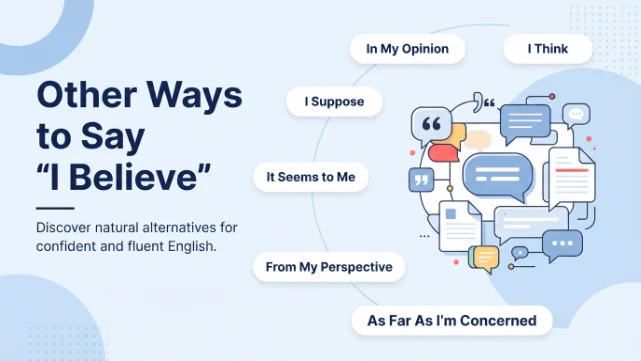
If you want to sound more natural and varied than repeating “I believe” in every sentence, try alternatives like in my opinion, I think, from my perspective, as far as I know, and it seems to me. These phrases carry the same core meaning while adjusting the tone from formal to casual.
Top 5 alternatives: in my opinion, I think, from my perspective, as far as I know, it seems to me
“I believe” is one of the most common phrases in English for sharing an opinion, assumption, or personal conviction. People use it in emails, presentations, debates, and everyday conversation to introduce a viewpoint without sounding overly forceful.
Learning alternatives to “I believe” helps you avoid repetition and adjust your tone depending on the situation. A formal report needs different wording than a casual chat with friends, and knowing the right option lets you express excitement in English, express certainty, or express hesitation with precision.
This guide breaks down 30 alternatives, organized by tone and context, so you can choose the right phrase every time you speak or write.
“The right tone makes your English sound professional and confident.”
Quick Categories
Formal alternatives to “I believe”
- In my opinion
- It is my view that
- I am of the opinion that
- I would argue that
Pro Tip: Use formal alternatives in reports, essays, and business emails where a polished tone matters.
Casual alternatives
- I think
- I guess
- I feel like
- My take is
Pro Tip: Casual alternatives work best in conversations with friends or informal team chats, not in formal writing.
Professional alternatives
- Based on my assessment
- My understanding is
- I would suggest
- I’m inclined to think
Pro Tip: Professional alternatives soften an opinion while still sounding confident, ideal for meetings and client communication.
Informal expressions
- I reckon
- I’m pretty sure
- I bet
- Seems to me
Pro Tip: Informal expressions add personality to spoken English but should be avoided in written business communication.
Common Mistakes
- Overusing “I believe” in formal writing instead of varying vocabulary.
- Example: “I believe this, I believe that, I believe the other” repeated in one paragraph.
- Example: “I believe this, I believe that, I believe the other” repeated in one paragraph.
- Using casual phrases in professional emails.
- Example: “I guess the project is done” sent to a client.
- Example: “I guess the project is done” sent to a client.
- Confusing “I believe” with “I feel.”
- Example: Using “I feel the meeting is at 3pm” when stating a fact, not an emotion.
- Example: Using “I feel the meeting is at 3pm” when stating a fact, not an emotion.
- Adding unnecessary words after the phrase.
- Example: “I believe that maybe possibly it could work” adds confusing filler.
- Example: “I believe that maybe possibly it could work” adds confusing filler.
- Using overly strong alternatives for weak opinions.
- Example: “I firmly believe” when unsure, which misleads the listener about your confidence level.
What Does “I Believe” Mean?
“I believe” is a phrase used to introduce a personal opinion, assumption, or conviction. Grammatically, it functions as an introductory clause followed by a statement, usually connected with “that” (which can be omitted in casual speech).
Example Sentence: “I believe the meeting starts at 10 a.m.”
When to Use “I Believe”
- Sharing a personal opinion in a discussion
- Expressing an assumption without full certainty
- Introducing a recommendation politely
- Spoken: common in debates, interviews, casual talks
- Written: common in essays, emails, and reports
Formal contexts: presentations, academic writing, business proposals Informal contexts: texting, casual chats, social media comments
Is It Professional or Polite to Say “I Believe”?
“I believe” is both polite and professional in most contexts because it softens an opinion without sounding rude or overly assertive.
Business Example: “I believe our Q3 targets are achievable with the current resources.”
Polite? ✔️ Yes Professional? ✔️ Yes
“Choosing the right phrase shows emotional intelligence, not just vocabulary.”
Pros and Cons of Using “I Believe”
Pros:
- Simple and natural
- Friendly, respectful tone
- Common usage across contexts
- Easy to understand for all levels
Cons:
- Overused in writing
- Limited emotional range
- Can sound repetitive in long texts
- Not always precise about certainty level
Other Ways to Say I Believe
These alternatives will help you sound more fluent, confident, and natural in different situations. Use them according to tone, context, and audience to express excitement, admiration, or approval.
1. Phrase: In my opinion
Meaning: Introduces a personal viewpoint. Explanation: A classic, neutral way to share an opinion in any setting. Example Sentence: “In my opinion, the new design is more user-friendly.” Best Use: essays, meetings Worst Use: casual texting Tone: neutral, formal, confident Context Variability: professional, spoken, written
2. Phrase: I think
Meaning: Expresses a general thought or opinion. Explanation: The most common and versatile alternative in everyday English. Example Sentence: “I think we should reschedule the call.” Best Use: daily conversation Worst Use: formal reports Tone: casual, friendly, direct Context Variability: casual, spoken, professional
3. Phrase: I feel that
Meaning: Shares an opinion tied to personal feeling. Explanation: Softer than “I believe,” often used for emotional or subjective topics. Example Sentence: “I feel that the team needs more support.” Best Use: personal discussions Worst Use: technical writing Tone: gentle, empathetic, subjective Context Variability: casual, spoken
4. Phrase: From my perspective
Meaning: Frames an opinion as one viewpoint among others. Explanation: Signals openness to other opinions, useful in debates. Example Sentence: “From my perspective, remote work increases productivity.” Best Use: discussions, debates Worst Use: short casual chats Tone: thoughtful, respectful, formal Context Variability: professional, written
5. Phrase: As far as I know
Meaning: Indicates an opinion based on limited or current knowledge. Explanation: Adds a layer of honesty about uncertainty. Example Sentence: “As far as I know, the flight hasn’t been delayed.” Best Use: giving updates Worst Use: confident claims Tone: cautious, honest, informal Context Variability: spoken, casual
6. Phrase: My understanding is
Meaning: States an opinion based on information received. Explanation: Common in professional settings when confirming details. Example Sentence: “My understanding is that the deadline moved to Friday.” Best Use: business emails Worst Use: casual talk Tone: professional, precise, polite Context Variability: professional, written
7. Phrase: I would say
Meaning: Softly introduces an opinion or estimate. Explanation: Useful when giving a careful or slightly hesitant answer. Example Sentence: “I would say the project is 80 percent complete.” Best Use: estimates, feedback Worst Use: strong statements Tone: cautious, polite, measured Context Variability: spoken, professional
8. Phrase: It seems to me
Meaning: Suggests an opinion based on observation. Explanation: Adds a reflective, thoughtful tone to a statement. Example Sentence: “It seems to me that the client is satisfied.” Best Use: analysis, feedback Worst Use: casual texting Tone: reflective, formal, careful Context Variability: written, professional
9. Phrase: I’m convinced that
Meaning: Expresses strong personal certainty. Explanation: Stronger than “I believe,” useful for confident claims. Example Sentence: “I’m convinced that this strategy will work.” Best Use: persuasive speech Worst Use: uncertain topics Tone: confident, assertive, strong Context Variability: professional, spoken
10. Phrase: I hold the view that
Meaning: Formally states a personal position. Explanation: Common in academic or debate-style writing. Example Sentence: “I hold the view that education should be free.” Best Use: essays, debates Worst Use: casual chat Tone: formal, academic, firm Context Variability: written, professional
11. Phrase: I reckon
Meaning: An informal way to state an opinion. Explanation: Common in casual British and Australian English. Example Sentence: “I reckon it’ll rain later today.” Best Use: informal chats Worst Use: formal writing Tone: casual, regional, relaxed Context Variability: casual, spoken
12. Phrase: I guess
Meaning: Expresses a tentative, uncertain opinion. Explanation: Signals low confidence in the statement. Example Sentence: “I guess we can meet tomorrow instead.” Best Use: casual suggestions Worst Use: professional reports Tone: uncertain, casual, soft Context Variability: casual, spoken
13. Phrase: I suspect
Meaning: Suggests an opinion based on suspicion or intuition. Explanation: Often used when something seems likely but isn’t confirmed. Example Sentence: “I suspect the numbers are slightly outdated.” Best Use: cautious claims Worst Use: confident announcements Tone: cautious, analytical, careful Context Variability: professional, spoken
14. Phrase: I’m inclined to think
Meaning: Leans toward a particular opinion without full certainty. Explanation: A polished, professional way to hedge an opinion. Example Sentence: “I’m inclined to think the plan needs revision.” Best Use: meetings, reviews Worst Use: casual talk Tone: polished, thoughtful, formal Context Variability: professional, written
15. Phrase: To my mind
Meaning: Introduces a personal viewpoint formally. Explanation: Slightly literary, often used in writing. Example Sentence: “To my mind, honesty is the most important value.” Best Use: essays, articles Worst Use: everyday speech Tone: formal, literary, reflective Context Variability: written, professional
16. Phrase: As I see it
Meaning: Frames an opinion as a personal interpretation. Explanation: Common in discussions and debates. Example Sentence: “As I see it, both options have merit.” Best Use: discussions Worst Use: formal reports Tone: balanced, thoughtful, direct Context Variability: spoken, casual
17. Phrase: I dare say
Meaning: Expresses a confident, sometimes bold opinion. Explanation: Slightly old-fashioned but still used in formal or witty speech. Example Sentence: “I dare say this is our best product yet.” Best Use: confident remarks Worst Use: casual texting Tone: confident, formal, witty Context Variability: written, spoken
18. Phrase: I’m of the opinion that
Meaning: Formally introduces a personal stance. Explanation: Common in academic and legal writing. Example Sentence: “I’m of the opinion that the policy needs revision.” Best Use: formal writing Worst Use: casual chat Tone: formal, precise, academic Context Variability: written, professional
19. Phrase: My take is
Meaning: Casually introduces a personal opinion. Explanation: Popular in modern spoken English and social media. Example Sentence: “My take is that the movie was overrated.” Best Use: casual conversation Worst Use: formal essays Tone: casual, modern, direct Context Variability: casual, spoken
20. Phrase: I would argue that
Meaning: Introduces an opinion with supporting reasoning in mind. Explanation: Common in debates and persuasive writing. Example Sentence: “I would argue that remote learning has real benefits.” Best Use: debates, essays Worst Use: small talk Tone: analytical, formal, persuasive Context Variability: written, professional
21. Phrase: It is my belief that
Meaning: A formal, slightly stronger version of “I believe.” Explanation: Common in speeches and official statements. Example Sentence: “It is my belief that hard work leads to success.” Best Use: speeches, formal writing Worst Use: casual talk Tone: formal, strong, ceremonial Context Variability: written, professional
22. Phrase: I firmly believe
Meaning: Expresses very strong personal conviction. Explanation: Use only when you are truly confident about the statement. Example Sentence: “I firmly believe that honesty builds trust.” Best Use: strong convictions Worst Use: uncertain claims Tone: strong, passionate, confident Context Variability: written, spoken
23. Phrase: I’m confident that
Meaning: Expresses assurance about an outcome or opinion. Explanation: Useful when reassuring others or making predictions. Example Sentence: “I’m confident that the launch will go smoothly.” Best Use: reassurance, predictions Worst Use: uncertain topics Tone: assured, positive, professional Context Variability: professional, spoken
24. Phrase: I trust that
Meaning: Expresses confidence based on reliability or expectation. Explanation: Common in polite, professional communication. Example Sentence: “I trust that the report will be ready by Monday.” Best Use: polite requests Worst Use: casual chat Tone: polite, professional, formal Context Variability: written, professional
25. Phrase: I assume
Meaning: States an opinion based on likely expectation. Explanation: Useful when something hasn’t been confirmed yet. Example Sentence: “I assume the meeting is still happening today.” Best Use: clarifying questions Worst Use: confirmed facts Tone: neutral, cautious, practical Context Variability: spoken, professional
26. Phrase: I gather
Meaning: Expresses an opinion based on indirect information. Explanation: Common when summarizing what you’ve heard or read. Example Sentence: “I gather the project has been delayed.” Best Use: summarizing information Worst Use: direct statements Tone: formal, reflective, careful Context Variability: written, professional
27. Phrase: I sense that
Meaning: Introduces an opinion based on intuition or feeling. Explanation: Adds an emotional, perceptive tone to a statement. Example Sentence: “I sense that the client isn’t fully satisfied.” Best Use: emotional observations Worst Use: technical writing Tone: intuitive, gentle, thoughtful Context Variability: spoken, casual
28. Phrase: Personally, I think
Meaning: Clearly marks an opinion as individual rather than universal. Explanation: Useful when distancing your view from group consensus. Example Sentence: “Personally, I think we should wait before deciding.” Best Use: group discussions Worst Use: formal reports Tone: honest, direct, personal Context Variability: spoken, casual
29. Phrase: If you ask me
Meaning: Casually introduces a personal opinion, often unsolicited. Explanation: Common in informal spoken English. Example Sentence: “If you ask me, the first option is better.” Best Use: casual conversation Worst Use: formal writing Tone: casual, blunt, friendly Context Variability: casual, spoken
30. Phrase: I have a feeling that
Meaning: Expresses an intuitive, informal opinion. Explanation: Useful for predictions or hunches rather than facts. Example Sentence: “I have a feeling that she’ll say yes.” Best Use: predictions, hunches Worst Use: formal analysis Tone: intuitive, casual, warm Context Variability: casual, spoken
“Small changes in wording can completely shift how confident or polite you sound.”
Mini Quiz:
1. Which phrase is best for a formal business report?
a) I guess b) I would argue that c) If you ask me d) I have a feeling that
2. Which phrase fits a casual conversation with friends?
a) I hold the view that b) I’m of the opinion that c) My take is d) I gather
3. Which phrase expresses strong certainty?
a) I suspect b) I firmly believe c) I assume d) I sense that
4. Which phrase is best when summarizing indirect information?
a) I gather b) I dare say c) My take is d) I reckon
(Answers: 1-b, 2-c, 3-b, 4-a)
Comparison Table: Top Alternatives
| Phrase | Tone | Best Use |
|---|---|---|
| In my opinion | Neutral, formal | Essays, meetings |
| I think | Casual, direct | Daily conversation |
| From my perspective | Thoughtful, formal | Debates, discussions |
| My understanding is | Professional, precise | Business emails |
| I’m convinced that | Confident, strong | Persuasive speech |
| I hold the view that | Formal, academic | Essays, debates |
| I reckon | Casual, regional | Informal chats |
| I’m inclined to think | Polished, formal | Meetings, reviews |
| I firmly believe | Strong, passionate | Strong convictions |
| I have a feeling that | Intuitive, warm | Predictions, hunches |
FAQs
1. What is a formal way to say “I believe”?
Use phrases like “in my opinion,” “I hold the view that,” or “it is my belief that” for formal writing and speech.
2. What is a casual way to say “I believe”?
Try “I think,” “I guess,” or “my take is” for everyday, informal conversations.
3. Is “I believe” appropriate in professional emails?
Yes, “I believe” is polite and professional, though alternatives like “my understanding is” add variety.
4. What’s the difference between “I believe” and “I think”?
“I believe” often implies a stronger personal conviction, while “I think” is lighter and more casual.
5. Why should I learn alternatives to “I believe”?
Learning alternatives to “I believe” helps you avoid repetition, match your tone to the context, and sound more fluent overall.
Conclusion
Mastering alternatives to “I believe” gives you the flexibility to sound formal, casual, confident, or cautious depending on the situation. Whether you’re writing a business report or chatting with friends, choosing the right phrase makes your English feel natural and intentional.
Practice using a few new alternatives every day, paying close attention to tone and context. Over time, this small habit will make your spoken and written English sound noticeably more fluent and professional.
Discover More Related Articles:
- Other Ways to Say Even Though | Formal, Casual & Academic Options In 2026
- Other Ways to Say In Order To| Professional Communication In 2026

Laura Adams is a dedicated content writer and blogger known for crafting clear, informative, and engaging articles. As a contributor to Responary.com, she specializes in creating reader-friendly content that educates, inspires, and keeps audiences informed on a wide range of subjects.