Quick Answer
Looking for other ways to say I agree? The most natural alternatives are: absolutely, I couldn’t agree more, that’s exactly right, I’m with you on that, and you make a good point. These phrases help you sound more confident and fluent in both spoken and written English.
“The right tone makes your English sound professional and confident.”
Saying “I agree” is one of the most common expressions in English, but repeating it too often can make your speech or writing sound flat and repetitive. Learning alternatives to I agree helps you express excitement, approval, and agreement in a way that feels natural and varied.
People use these expressions in meetings, casual conversations, emails, debates, and everyday small talk. Whether you are agreeing with a friend’s opinion or supporting a colleague’s proposal, the right phrase shows that you understand tone and context.
Building a strong vocabulary of agreement phrases also helps you express excitement in English when you genuinely love an idea, and it helps you sound polished when professionalism matters most.
Quick Categories
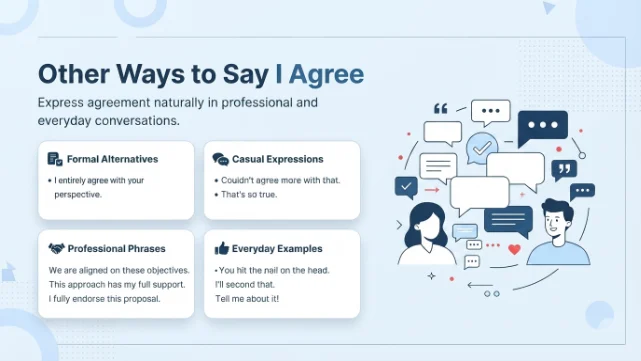
Formal Alternatives to “I Agree”
- I concur – Used in formal writing or business settings
- That is a valid point – Common in discussions and debates
- I am of the same opinion – Polished, professional tone
- I fully support that view – Common in meetings and reports
Pro Tip: Use formal alternatives in emails, reports, and meetings where professionalism matters more than warmth.
Casual Alternatives
- Totally – Very common in everyday speech
- For sure – Friendly and relaxed
- Same here – Simple and conversational
- You read my mind – Playful way to show agreement
Pro Tip: Save casual alternatives for friends, social media, or informal chats, not business emails.
Professional Alternatives
- I second that – Common in meetings and group discussions
- That aligns with my thinking – Sounds thoughtful and collaborative
- I’m on board with that – Confident and professional
- Well said, I agree completely – Adds warmth without losing professionalism
Pro Tip: Professional alternatives work best when you want to sound confident without sounding cold.
Informal Expressions
- Yeah, definitely – Common in spoken English
- You bet – Friendly and enthusiastic
- No doubt about it – Strong informal agreement
- Right on – Casual and expressive
Pro Tip: Informal expressions are great for spoken English but should be avoided in formal writing.
Common Mistakes People Make Using “I Agree”
- Overusing it in every sentence
Example: “I agree, I agree, I completely agree” sounds repetitive and unnatural. - Using it in overly formal writing without variation
Example: Writing “I agree” five times in one report instead of varying the phrase. - Using casual alternatives in professional emails
Example: Writing “totally” in a formal business email to a client. - Confusing agreement with mild interest
Example: Saying “I agree” when you only mean “that’s interesting.” - Failing to add reasoning after agreeing
Example: Saying “I agree” without explaining why, which can sound insincere in discussions.
What Does “I Agree” Mean?
“I agree” is a simple phrase used to express that you share the same opinion, belief, or feeling as another person.
Grammar note: It is a subject + verb structure, often followed by “with” plus a noun or clause, such as “I agree with you” or “I agree that this plan works.”
Example Sentence: I agree that the new schedule makes more sense for the team.
When to Use “I Agree”
- Spoken: In casual conversations, debates, or quick verbal confirmations
- Written: In emails, reports, comments, or formal documents
- Formal: During meetings, negotiations, or professional discussions
- Informal: Chatting with friends or family, texting, or social media replies
“Alternatives to I agree help you sound natural instead of repetitive.”
Is It Professional or Polite to Say “I Agree”?
“I agree” is both polite and professional in most contexts, making it one of the safest agreement phrases in English.
Business Example: “I agree with your proposal to extend the deadline by one week.”
Polite? Yes Professional? Yes
Pros and Cons of Using “I Agree”
Pros:
- Simple and natural
- Clear and direct
- Works in almost any context
- Easy to understand for all English levels
Cons:
- Can sound repetitive if overused
- Lacks emotional depth
- Does not show enthusiasm
- Sounds plain in creative or persuasive writing
Other Ways to Say I Agree
These alternatives will help you sound more fluent, confident, and natural in different situations. Use them according to tone, context, and audience to express excitement, admiration, or approval.
1. Phrase: Absolutely
Meaning: A strong and confident way to show full agreement. Explanation: Used to emphasize certainty and enthusiasm. Example Sentence: “Should we launch the campaign this week?” “Absolutely, let’s do it.” Best Use: Meetings, discussions Worst Use: Very formal writing Tone: Confident, enthusiastic Context Variability: casual, professional, spoken
2. Phrase: I couldn’t agree more
Meaning: Expresses complete and enthusiastic agreement. Explanation: Adds emphasis to a shared opinion. Example Sentence: “This strategy makes total sense.” “I couldn’t agree more.” Best Use: Conversations, debates Worst Use: Very short replies Tone: Warm, enthusiastic Context Variability: casual, professional
3. Phrase: That’s exactly right
Meaning: Confirms that someone’s statement is correct. Explanation: Shows precise agreement with an idea. Example Sentence: “The budget needs to be revised first.” “That’s exactly right.” Best Use: Meetings, teaching Worst Use: Casual texting Tone: Confident, clear Context Variability: professional, spoken
4. Phrase: I’m with you on that
Meaning: Shows support and agreement with someone’s idea. Explanation: Common in group discussions and teamwork. Example Sentence: “Let’s postpone the trip until next month.” “I’m with you on that.” Best Use: Team discussions Worst Use: Formal reports Tone: Friendly, supportive Context Variability: casual, professional
5. Phrase: You make a good point
Meaning: Acknowledges and agrees with someone’s argument. Explanation: Common in debates and discussions. Example Sentence: “We should test the product before launch.” “You make a good point.” Best Use: Debates, meetings Worst Use: Casual chats Tone: Thoughtful, respectful Context Variability: professional, spoken
6. Phrase: I concur
Meaning: A formal way to say you agree. Explanation: Common in legal, academic, or business settings. Example Sentence: “The evidence supports this conclusion.” “I concur.” Best Use: Formal writing Worst Use: Everyday chats Tone: Formal, precise Context Variability: professional
7. Phrase: That aligns with my thinking
Meaning: Shows agreement by connecting ideas. Explanation: Common in business and strategic discussions. Example Sentence: “We should focus on customer retention first.” “That aligns with my thinking.” Best Use: Business meetings Worst Use: Informal talk Tone: Professional, thoughtful Context Variability: professional
8. Phrase: Totally
Meaning: An informal way to express strong agreement. Explanation: Very common in spoken English among friends. Example Sentence: “This movie was amazing.” “Totally.” Best Use: Casual talk Worst Use: Business writing Tone: Casual, enthusiastic Context Variability: casual, spoken
9. Phrase: For sure
Meaning: A relaxed way to confirm agreement. Explanation: Common in everyday spoken English. Example Sentence: “We should grab lunch later.” “For sure.” Best Use: Friendly chats Worst Use: Formal emails Tone: Casual, friendly Context Variability: casual, spoken
10. Phrase: Same here
Meaning: Indicates you feel or think the same way. Explanation: Common when sharing feelings or opinions. Example Sentence: “I think we need a break.” “Same here.” Best Use: Casual conversations Worst Use: Professional writing Tone: Friendly, simple Context Variability: casual, spoken
11. Phrase: You read my mind
Meaning: Shows you were thinking the exact same thing. Explanation: A playful way to express strong agreement. Example Sentence: “Let’s order pizza tonight.” “You read my mind.” Best Use: Friendly talk Worst Use: Business meetings Tone: Playful, warm Context Variability: casual, spoken
12. Phrase: I second that
Meaning: Formally supports someone’s suggestion. Explanation: Common in group decisions and meetings. Example Sentence: “I propose we move the deadline.” “I second that.” Best Use: Meetings, votes Worst Use: Texting friends Tone: Confident, formal Context Variability: professional
13. Phrase: I’m on board with that
Meaning: Shows willingness to support an idea or plan. Explanation: Common in teamwork and project discussions. Example Sentence: “Let’s switch to the new software system.” “I’m on board with that.” Best Use: Team projects Worst Use: Formal essays Tone: Confident, cooperative Context Variability: professional, casual
14. Phrase: Well said, I agree completely
Meaning: Praises the statement while confirming agreement. Explanation: Adds warmth to professional agreement. Example Sentence: “Customer trust matters more than short-term profit.” “Well said, I agree completely.” Best Use: Meetings, presentations Worst Use: Quick replies Tone: Respectful, warm Context Variability: professional
15. Phrase: Yeah, definitely
Meaning: A casual but strong confirmation of agreement. Explanation: Common in spoken English among peers. Example Sentence: “This plan sounds solid.” “Yeah, definitely.” Best Use: Casual talk Worst Use: Formal writing Tone: Casual, confident Context Variability: casual, spoken
16. Phrase: You bet
Meaning: An enthusiastic and informal way to agree. Explanation: Common in friendly and energetic conversations. Example Sentence: “Are you excited for the trip?” “You bet.” Best Use: Friendly chats Worst Use: Business emails Tone: Energetic, casual Context Variability: casual, spoken
17. Phrase: No doubt about it
Meaning: Expresses strong certainty and agreement. Explanation: Common when confirming something is clearly true. Example Sentence: “This is the best option we have.” “No doubt about it.” Best Use: Casual and professional talk Worst Use: Very formal writing Tone: Confident, assertive Context Variability: casual, professional
18. Phrase: Right on
Meaning: An informal expression of agreement or approval. Explanation: Common in relaxed, friendly conversations. Example Sentence: “We finished the project early.” “Right on.” Best Use: Casual talk Worst Use: Formal settings Tone: Casual, upbeat Context Variability: casual, spoken
19. Phrase: I am of the same opinion
Meaning: A formal way to express shared views. Explanation: Common in academic or professional writing. Example Sentence: “The report needs more data before publishing.” “I am of the same opinion.” Best Use: Formal writing Worst Use: Casual chats Tone: Formal, polished Context Variability: professional
20. Phrase: That’s a valid point
Meaning: Acknowledges that someone’s argument is reasonable. Explanation: Common in debates and discussions. Example Sentence: “We should consider the long-term costs.” “That’s a valid point.” Best Use: Debates, meetings Worst Use: Informal texting Tone: Thoughtful, respectful Context Variability: professional, spoken
21. Phrase: I fully support that view
Meaning: Shows strong professional agreement with an idea. Explanation: Common in leadership and business contexts. Example Sentence: “We should invest more in employee training.” “I fully support that view.” Best Use: Business meetings Worst Use: Casual conversations Tone: Confident, formal Context Variability: professional
22. Phrase: That makes sense to me
Meaning: Confirms understanding and agreement with logic. Explanation: Common in both casual and professional talk. Example Sentence: “We should test the app before release.” “That makes sense to me.” Best Use: Discussions, meetings Worst Use: Formal essays Tone: Calm, agreeable Context Variability: casual, professional, spoken
23. Phrase: Exactly what I was thinking
Meaning: Shows you had the same idea before it was said. Explanation: Common in casual and semi-professional talk. Example Sentence: “We should simplify the design.” “Exactly what I was thinking.” Best Use: Team chats Worst Use: Formal documents Tone: Friendly, confident Context Variability: casual, professional
24. Phrase: I share your view
Meaning: A formal way to express agreement with someone’s opinion. Explanation: Common in professional and diplomatic language. Example Sentence: “We need stronger data privacy policies.” “I share your view.” Best Use: Formal discussions Worst Use: Casual texting Tone: Formal, respectful Context Variability: professional
25. Phrase: That’s spot on
Meaning: Confirms that something is exactly correct. Explanation: Common in casual and semi-formal spoken English. Example Sentence: “The issue is our marketing timing.” “That’s spot on.” Best Use: Discussions, feedback Worst Use: Legal documents Tone: Confident, casual Context Variability: casual, professional, spoken
26. Phrase: Agreed
Meaning: A short and direct way to confirm agreement. Explanation: Common in both spoken and written English. Example Sentence: “Let’s finalize the plan today.” “Agreed.” Best Use: Quick replies, emails Worst Use: Detailed explanations Tone: Simple, direct Context Variability: casual, professional, spoken
27. Phrase: I’m in agreement with you
Meaning: A polite and clear way to confirm shared opinion. Explanation: Common in professional conversations. Example Sentence: “We should delay the announcement.” “I’m in agreement with you.” Best Use: Meetings, emails Worst Use: Casual texting Tone: Polite, clear Context Variability: professional
28. Phrase: Couldn’t have said it better myself
Meaning: Praises the statement while confirming full agreement. Explanation: Common when someone expresses your exact thoughts. Example Sentence: “Honesty builds long-term trust.” “Couldn’t have said it better myself.” Best Use: Conversations, presentations Worst Use: Legal writing Tone: Warm, impressed Context Variability: casual, professional
29. Phrase: That’s how I see it too
Meaning: Confirms a shared perspective or opinion. Explanation: Common in personal and professional discussions. Example Sentence: “The design needs to be simpler.” “That’s how I see it too.” Best Use: Discussions, feedback Worst Use: Formal reports Tone: Calm, agreeable Context Variability: casual, professional, spoken
30. Phrase: I’m in complete agreement
Meaning: A strong and formal way to confirm full agreement. Explanation: Common in professional and written communication. Example Sentence: “We need to revise the timeline immediately.” “I’m in complete agreement.” Best Use: Formal writing, meetings Worst Use: Casual chats Tone: Formal, confident Context Variability: professional
“Professional reaction phrases show maturity and strong communication skills.”
Mini Quiz
1. Which phrase is most appropriate in a formal business email?
a) Totally b) I concur c) You bet d) Right on
2. Which phrase would you use casually with a friend?
a) I am of the same opinion b) I fully support that view c) For sure d) I share your view
3. Which phrase adds praise while agreeing?
a) Agreed b) Couldn’t have said it better myself c) I second that d) That’s a valid point
4. Which phrase is best in a formal meeting vote?
a) Same here b) I second that c) You read my mind d) Right on
(Answers: 1-b, 2-c, 3-b, 4-b)
Comparison Table: Top Alternatives
| Phrase | Tone | Best Use |
|---|---|---|
| Absolutely | Confident, enthusiastic | Meetings, discussions |
| I couldn’t agree more | Warm, enthusiastic | Conversations |
| I concur | Formal, precise | Formal writing |
| That aligns with my thinking | Professional, thoughtful | Business meetings |
| Totally | Casual, enthusiastic | Casual talk |
| I second that | Confident, formal | Meetings, votes |
| That’s a valid point | Thoughtful, respectful | Debates |
| I fully support that view | Confident, formal | Business meetings |
| Agreed | Simple, direct | Emails, quick replies |
| I’m in complete agreement | Formal, confident | Formal writing |
FAQs
What are some professional ways to say I agree?
Professional alternatives include I concur, I fully support that view, and that aligns with my thinking, which sound polished in meetings and emails.
What is a casual way to say I agree?
Casual alternatives include totally, for sure, and same here, which are common in everyday spoken English.
Is it rude to keep saying I agree in a conversation?
It is not rude, but repeating the same phrase too often can sound unnatural, so varying your language keeps conversations engaging.
Can I use I agree in formal writing?
Yes, I agree is acceptable in formal writing, though phrases like I concur or I am of the same opinion sound more polished.
What is the most confident way to say I agree?
Absolutely and I couldn’t agree more are strong, confident ways to express full agreement.
Conclusion
Learning different ways to say I agree helps you sound more fluent, confident, and natural in both spoken and written English. From formal alternatives like I concur to casual expressions like totally, choosing the right phrase depends on your audience and context.
Practice using these alternatives daily in conversations, emails, and discussions to build stronger communication skills. Paying attention to tone will help you sound both polite and professional in every situation.
Try using three new alternatives this week and notice how your conversations start to feel more natural and confident.
Discover More Related Articles:

Jennifer Wilson is an experienced writer and content creator with over 20 years of expertise in digital publishing, lifestyle, and informative content. Holding a degree in English Literature, she contributes to Responary.Com, where she shares engaging, well-researched articles that help readers stay informed and inspired.