Quick Answer
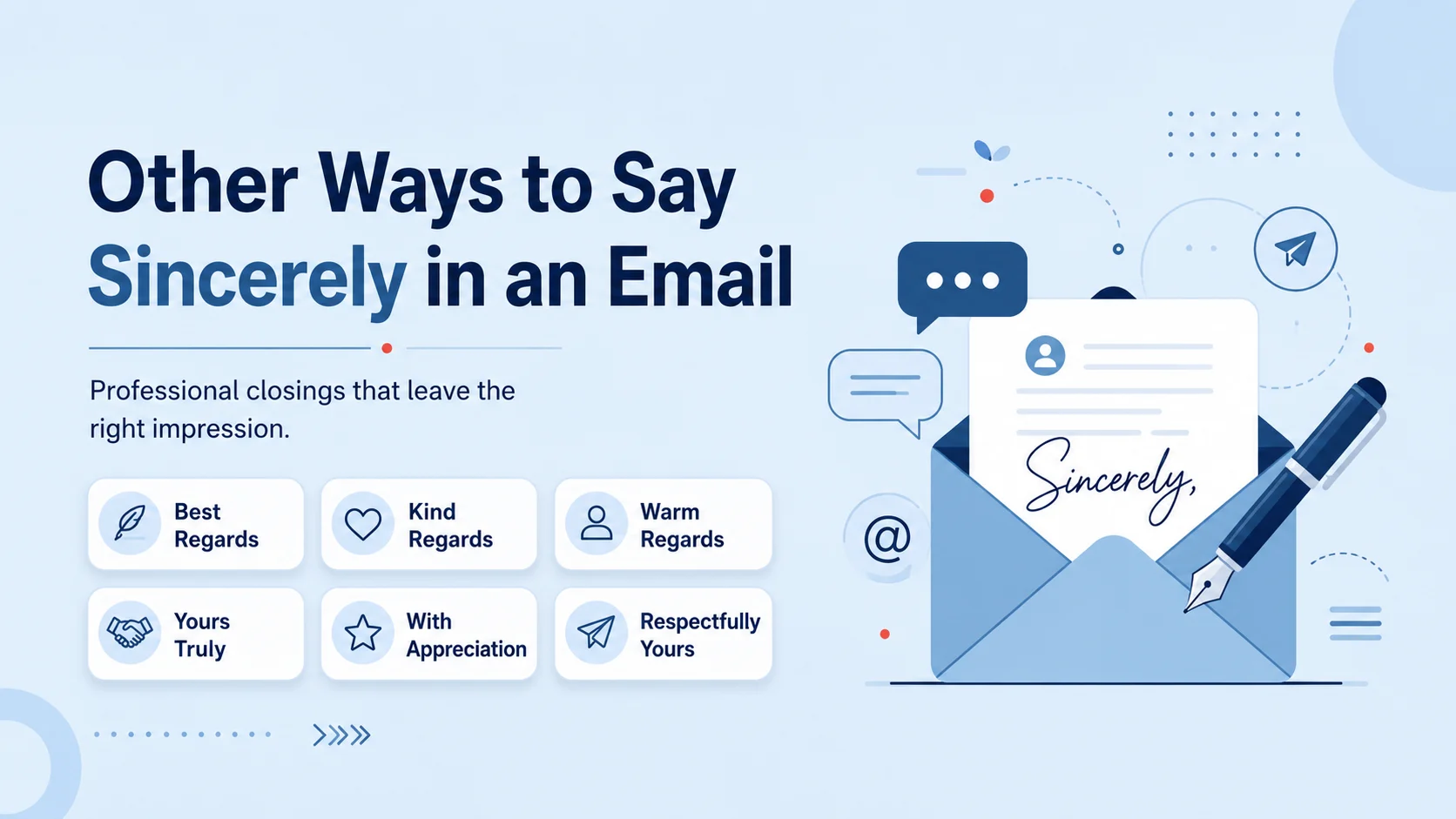
Looking for alternatives to “sincerely” in an email? The best options depend on tone and relationship. Top picks: Best regards, Warm regards, Kind regards, Thank you, With appreciation.
“Sincerely” is one of the most common email sign-offs in English, used to close a message in a polite and respectful way. People rely on it in job applications, business letters, and formal correspondence because it feels safe and professional.
But using the same closing every time can make your writing sound repetitive and impersonal. Learning other ways to say sincerely helps you match your tone to the situation, whether that’s a formal report, a friendly check-in, or a professional follow-up.
Building a wider range of email closings also helps you express excitement in English when appropriate, sound more natural to native speakers, and avoid sounding like a template. This guide breaks down 30 alternatives, organized by tone, so you always know which one fits.
“The right tone makes your English sound professional and confident.”
Quick Categories
Formal alternatives to “Sincerely”
- Yours faithfully
- Respectfully
- Yours truly
- With respect
Pro Tip: Use formal closings for first contact, legal matters, or messages to senior executives you have never met.
Casual alternatives
- Thanks
- Take care
- Talk soon
- All the best
Pro Tip: Save casual sign-offs for coworkers or contacts you email regularly and know well.
Professional alternatives
- Best regards
- Kind regards
- Warm regards
- With appreciation
Pro Tip: These closings work for almost any business email and are the safest default when you are unsure.
Informal expressions
- Cheers
- Speak soon
- Thanks again
- Best
Pro Tip: Informal expressions suit internal team chats and emails to close colleagues, not client-facing letters.
“A closing line is small, but it shapes how the whole email feels.”
Common Mistakes People Make Using “Sincerely”
- Using it with people you know well | it can feel cold and distant.
- Example: “Sincerely, John” to a coworker you talk to daily.
- Example: “Sincerely, John” to a coworker you talk to daily.
- Pairing it with a casual email body | the tone clashes.
- Example: “Hey! Quick question about lunch. Sincerely, Mia.”
- Example: “Hey! Quick question about lunch. Sincerely, Mia.”
- Misspelling it as “Sincerly.”
- Example: “Sincerly, the HR Team.”
- Example: “Sincerly, the HR Team.”
- Forgetting the comma after it.
- Example: “Sincerely Robert” instead of “Sincerely, Robert.”
- Example: “Sincerely Robert” instead of “Sincerely, Robert.”
- Repeating it in every single email, making writing sound robotic.
- Example: Using “Sincerely” in a thank-you note, a complaint, and a casual update alike.
What Does “Sincerely” Mean?
“Sincerely” is an adverb used as a formal email or letter closing to show honesty and respect toward the reader. Grammatically, it stands alone before a comma, followed by the sender’s name on the next line.
Example Sentence: “Thank you for your time. Sincerely, Anna Roberts.”
When to Use “Sincerely”
- Formal job applications and cover letters
- First-time emails to clients or executives
- Official business correspondence
- Written communication more than spoken (you would never say “sincerely” out loud to end a conversation)
- Formal contexts more than informal ones
Is It Professional or Polite to Say “Sincerely”?
“Sincerely” is both polite and professional, but it can feel overly formal or generic in modern workplace emails, especially with familiar contacts.
Business Example: “Please find the attached invoice for your review. Sincerely, Accounts Department.”
Polite? Yes Professional? Yes, though sometimes seen as impersonal
“Formality and warmth are not opposites. The best closings balance both.”
Pros and Cons of Using “Sincerely”
Pros:
- Simple and universally understood
- Widely accepted in formal writing
- Common usage across industries
- Easy to use correctly
Cons:
- Can feel too formal for daily emails
- Overused in cover letters and templates
- Limited emotional range
- Not ideal for warm or personal messages
Other Ways to Say Sincerely in an Email
These alternatives will help you sound more fluent, confident, and natural in different situations. Use them according to tone, context, and audience to express excitement, admiration, or professional reaction phrases where needed.
1. Phrase: Best regards
Meaning: A polite, neutral closing showing goodwill. Explanation: One of the most common professional reaction phrases used to end business emails. Example Sentence: “Looking forward to your feedback. Best regards, Sarah.” Best Use: business emails Worst Use: personal letters Tone: professional, neutral, safe Context Variability: professional, spoken rarely
2. Phrase: Kind regards
Meaning: A warm but professional closing. Explanation: Slightly friendlier than “best regards” while staying formal. Example Sentence: “Thank you for the update. Kind regards, Tom.” Best Use: client emails Worst Use: legal letters Tone: warm, polite, professional Context Variability: professional, casual-professional
3. Phrase: Warm regards
Meaning: A friendly, approachable sign-off. Explanation: Adds personal warmth without becoming too casual. Example Sentence: “It was great connecting today. Warm regards, Lisa.” Best Use: networking emails Worst Use: strict formal reports Tone: friendly, approachable, respectful Context Variability: professional, casual
4. Phrase: Yours faithfully
Meaning: A formal closing used when the recipient’s name is unknown. Explanation: Common in British English formal letters. Example Sentence: “Dear Sir or Madam, please review the attached form. Yours faithfully.” Best Use: formal unnamed letters Worst Use: everyday emails Tone: very formal, traditional Context Variability: formal writing only
5. Phrase: Yours truly
Meaning: A traditional, respectful closing. Explanation: Slightly old-fashioned but still accepted in formal writing. Example Sentence: “Thank you for considering my application. Yours truly, David.” Best Use: cover letters Worst Use: casual chats Tone: formal, respectful, classic Context Variability: formal writing
6. Phrase: Respectfully
Meaning: A closing that emphasizes deep respect for the reader. Explanation: Often used when addressing authority figures. Example Sentence: “I appreciate your consideration. Respectfully, Maria.” Best Use: official complaints Worst Use: friendly emails Tone: formal, deferential Context Variability: formal only
7. Phrase: With appreciation
Meaning: Expresses thanks while closing the message. Explanation: Combines gratitude with professionalism. Example Sentence: “Thank you for your patience. With appreciation, the Support Team.” Best Use: thank-you emails Worst Use: cold outreach Tone: grateful, professional Context Variability: professional
8. Phrase: Thank you
Meaning: A simple closing that shows gratitude. Explanation: Direct and versatile across formal and semi-formal emails. Example Sentence: “I look forward to hearing from you. Thank you, Alex.” Best Use: most business emails Worst Use: overly formal legal letters Tone: polite, warm, simple Context Variability: professional, casual
9. Phrase: Many thanks
Meaning: A friendly way to say thank you while closing. Explanation: Common in British and international business English. Example Sentence: “Many thanks for your quick response.” Best Use: collaborative emails Worst Use: first formal contact Tone: friendly, appreciative Context Variability: professional, casual
10. Phrase: Take care
Meaning: A caring, casual closing. Explanation: Shows personal warmth toward the reader. Example Sentence: “Talk soon. Take care, Jenny.” Best Use: close colleagues Worst Use: formal reports Tone: caring, casual Context Variability: casual, spoken
11. Phrase: All the best
Meaning: A friendly wish for good outcomes. Explanation: Works well when ending an email on a positive note. Example Sentence: “Hope the launch goes smoothly. All the best, Ryan.” Best Use: semi-formal emails Worst Use: legal documents Tone: positive, friendly Context Variability: casual, professional
12. Phrase: Best
Meaning: A short, modern closing. Explanation: Popular in fast-paced workplace communication. Example Sentence: “See you at the meeting. Best, Chris.” Best Use: internal emails Worst Use: formal introductions Tone: casual, efficient Context Variability: casual, professional
13. Phrase: Cheers
Meaning: A relaxed, friendly closing. Explanation: Common in informal or creative workplace cultures. Example Sentence: “Thanks for the quick turnaround. Cheers, Sam.” Best Use: informal teams Worst Use: client-facing emails Tone: casual, upbeat Context Variability: casual, spoken
14. Phrase: Speak soon
Meaning: A closing that signals continued communication. Explanation: Suggests an ongoing conversation or relationship. Example Sentence: “I will send the file tomorrow. Speak soon, Emma.” Best Use: ongoing projects Worst Use: one-time formal emails Tone: friendly, forward-looking Context Variability: casual, professional
15. Phrase: Talk soon
Meaning: Similar to “speak soon,” used to close friendly emails. Explanation: Common with familiar coworkers or clients. Example Sentence: “Let’s finalize this next week. Talk soon, Nina.” Best Use: familiar contacts Worst Use: formal proposals Tone: casual, warm Context Variability: casual
16. Phrase: Thanks again
Meaning: Reinforces gratitude at the end of an email. Explanation: Useful after someone has already helped you. Example Sentence: “Thanks again for your support. Talk soon, Owen.” Best Use: follow-up emails Worst Use: first contact Tone: grateful, warm Context Variability: casual, professional
17. Phrase: With gratitude
Meaning: A heartfelt way to show thanks. Explanation: Slightly more emotional than “thank you.” Example Sentence: “Your guidance meant a lot. With gratitude, Hannah.” Best Use: mentorship emails Worst Use: routine business updates Tone: sincere, warm Context Variability: professional, personal
18. Phrase: Warmly
Meaning: A short, affectionate closing. Explanation: Popular among creatives and modern professionals. Example Sentence: “Excited to work together. Warmly, Grace.” Best Use: personal-professional emails Worst Use: legal correspondence Tone: warm, personal Context Variability: professional, casual
19. Phrase: Regards
Meaning: A short, neutral professional closing. Explanation: Simple alternative when you want to stay brief. Example Sentence: “Please confirm by Friday. Regards, Peter.” Best Use: quick business emails Worst Use: emotional messages Tone: neutral, efficient Context Variability: professional
20. Phrase: Yours sincerely
Meaning: A formal British variant of “sincerely.” Explanation: Used when the recipient’s name is known. Example Sentence: “Dear Mr. Lee, thank you for the opportunity. Yours sincerely, Claire.” Best Use: UK formal letters Worst Use: casual emails Tone: formal, respectful Context Variability: formal writing
21. Phrase: With respect
Meaning: Shows admiration and formality together. Explanation: Slightly stronger in tone than “respectfully.” Example Sentence: “I understand the decision. With respect, Daniel.” Best Use: sensitive formal topics Worst Use: everyday updates Tone: formal, careful Context Variability: formal
22. Phrase: Looking forward to hearing from you
Meaning: A closing that signals anticipation of a reply. Explanation: Functions as both a sign-off and a call to action. Example Sentence: “I have attached the report. Looking forward to hearing from you.” Best Use: proposals, follow-ups Worst Use: simple confirmations Tone: proactive, professional Context Variability: professional
23. Phrase: Wishing you a great day
Meaning: A friendly, upbeat closing. Explanation: Adds positivity to end the message. Example Sentence: “Talk soon. Wishing you a great day, Olivia.” Best Use: customer service emails Worst Use: serious formal notices Tone: cheerful, kind Context Variability: casual, professional
24. Phrase: In appreciation
Meaning: A variation of “with appreciation.” Explanation: Slightly more formal phrasing of gratitude. Example Sentence: “Thank you for your continued trust. In appreciation, the Team.” Best Use: formal thank-you notes Worst Use: casual chats Tone: grateful, formal Context Variability: professional
25. Phrase: Gratefully
Meaning: A short, feeling-driven closing. Explanation: Expresses genuine thanks in one word. Example Sentence: “Your feedback was invaluable. Gratefully, Marcus.” Best Use: thank-you emails Worst Use: neutral business updates Tone: sincere, warm Context Variability: professional, personal
26. Phrase: Yours respectfully
Meaning: Combines formality with respect. Explanation: Used in very formal or hierarchical contexts. Example Sentence: “I await your response. Yours respectfully, Officer Diaz.” Best Use: government or legal emails Worst Use: everyday work emails Tone: formal, deferential Context Variability: formal only
27. Phrase: Take care and best wishes
Meaning: A caring, positive closing. Explanation: Combines warmth with good wishes. Example Sentence: “Hope the project goes well. Take care and best wishes, Zoe.” Best Use: friendly professional emails Worst Use: strict corporate reports Tone: kind, warm Context Variability: casual, professional
28. Phrase: Until next time
Meaning: Signals a future interaction. Explanation: Useful for newsletters or recurring communication. Example Sentence: “Thanks for reading. Until next time, the Editorial Team.” Best Use: newsletters Worst Use: one-time formal emails Tone: friendly, forward-looking Context Variability: casual, professional
29. Phrase: Faithfully yours
Meaning: A formal alternative word order of “yours faithfully.” Explanation: Slightly less common but still accepted formally. Example Sentence: “We appreciate your patience. Faithfully yours, the Committee.” Best Use: formal institutional letters Worst Use: casual emails Tone: formal, traditional Context Variability: formal writing
30. Phrase: Appreciatively
Meaning: A one-word closing that expresses thanks. Explanation: Compact and warm, ideal for short thank-you emails. Example Sentence: “Thanks for the quick reply. Appreciatively, Ben.” Best Use: brief thank-you notes Worst Use: long formal letters Tone: warm, concise Context Variability: professional, personal
“Great writers do not just avoid repetition. They choose words that match the moment.”
Mini Quiz:
1. Which closing is best for a first-time formal letter to an unnamed recipient?
A) Cheers B) Yours faithfully C) Talk soon D) Best
2. Which closing fits a casual email to a close coworker?
A) Yours respectfully B) With respect C) Take care D) Yours sincerely
3. Which closing best expresses gratitude in a short thank-you email?
A) Regards B) Appreciatively C) Faithfully yours D) With respect
4. True or False: “Sincerely” is a common choice for a casual chat message.
A) True B) False
Answers: 1-B, 2-C, 3-B, 4-B
Comparison Table: Top Alternatives
| Phrase | Tone | Best Use |
|---|---|---|
| Best regards | Professional | Business emails |
| Kind regards | Warm, professional | Client emails |
| Warm regards | Friendly | Networking emails |
| Yours faithfully | Very formal | Unnamed formal letters |
| Yours truly | Formal | Cover letters |
| Respectfully | Formal | Official complaints |
| With appreciation | Grateful | Thank-you emails |
| Thank you | Polite, simple | Most business emails |
| Take care | Casual, caring | Close colleagues |
| Warmly | Warm, personal | Personal-professional emails |
FAQs
Is “sincerely” too formal for everyday emails?
Yes, in many workplaces it can feel stiff for daily messages, so alternatives like “best regards” or “thanks” often work better.
What is the most professional alternative to “sincerely”?
“Best regards” and “kind regards” are considered the safest professional alternatives across industries.
Can I use “sincerely” with someone I email every day?
It is possible, but it may sound distant. A warmer or shorter closing usually fits better with familiar contacts.
What is the British version of “sincerely”?
“Yours sincerely” is used when the recipient’s name is known, and “yours faithfully” when it is not.
Which closing works best for a thank-you email?
“With appreciation,” “gratefully,” and “many thanks” are strong choices for expressing thanks in writing.
Conclusion
Learning other ways to say sincerely gives you more control over how your emails sound and how your reader perceives you. Instead of relying on one closing for every message, you can match your tone to the relationship, the occasion, and the level of formality required.
Practice using a few of these alternatives daily, paying attention to formal alternatives for business writing and casual options for familiar contacts. Over time, choosing the right sign-off will become second nature, and your emails will sound more fluent, confident, and professional.
Discover More Related Articles:
- Other Ways to Say Looking Forward to It | That Sound Professional In 2026
- Other Ways to Say In My Opinion| For IELTS & TOEFL In 2026

Richard Scott is an experienced author dedicated to creating compelling and well-researched content for online audiences. As a contributor to Responary.com, he enjoys sharing knowledge through clear, engaging, and informative articles that connect with readers worldwide.