Quick Answer
Looking for fresh ways to wish someone recovery without repeating the same tired phrase? Here are five strong alternatives you can use right away: wishing you a speedy recovery, take care of yourself, thinking of you during this time, hope you feel better soon, sending healing thoughts your way.
“Get well soon” is one of the most common phrases in English for wishing someone a fast recovery from illness or injury. People use it in cards, texts, emails, and casual conversation because it is short, warm, and instantly understood. However, repeating the same expression every time can feel generic, especially in professional or emotionally sensitive situations.
Learning alternatives to get well soon helps you match your message to the relationship, the setting, and the seriousness of the situation. A close friend recovering from a cold needs a different tone than a colleague recovering from surgery. Choosing the right words also helps you express excitement in English for someone’s return to health, or express calm reassurance when the moment calls for gentleness.
This guide breaks down 30 alternatives across formal, casual, professional, and informal categories, with clear examples so you always know exactly what to say.
“The right tone makes your English sound professional and confident.”
Quick Categories
Formal Alternatives to “Get Well Soon”
- Wishing you a speedy recovery
- We hope for your swift and full recovery
- Please accept our best wishes for your health
- May you regain your strength and health soon
Pro Tip: Formal alternatives work best in written cards, emails to superiors, or official company messages. Keep the sentence structure complete and avoid contractions.
Casual Alternatives
- Feel better soon
- Hope you’re back on your feet soon
- Rest up and feel better
- Get some rest, you’ll be good as new
Pro Tip: Casual alternatives suit friends and family. Pair them with a personal detail, such as mentioning a shared memory, to make the message feel warmer.
Professional Alternatives
- Wishing you a smooth and speedy recovery
- Take all the time you need to recover
- Thinking of you and hoping for a quick recovery
- We’re all rooting for your recovery
Pro Tip: In workplace messages, focus on reassurance rather than humor. Mention that their responsibilities are covered so they can rest without worry.
Informal Expressions
- Hope you bounce back soon
- Sending you good vibes to heal fast
- Feel better real soon, we miss you
- Get well quick, we need you back
Pro Tip: Informal expressions are ideal for texts and social media. Avoid using them in emails to clients or senior management.
“Small changes in wording can completely shift how caring your message sounds.”
Common Mistakes
- Using “get well soon” in serious medical situations without warmth.
Example: “Get well soon!” texted after major surgery can feel too casual; try “Wishing you a full and comfortable recovery” instead. - Repeating the exact same phrase across every relationship.
Example: Sending “Get well soon” to both your boss and your best friend misses the chance to match tone to relationship. - Adding humor when the situation is emotionally heavy
- Example: “Get well soon” alone feels thin; “Get well soon, let me know if you need anything” adds real value.
- Using formal alternatives in casual texts, making them sound stiff.
Example: Texting a close friend “Please accept our best wishes for your health” feels distant and overly formal.
What Does “Get Well Soon” Mean?
“Get well soon” is a short expression used to wish someone a quick recovery from illness, injury, or a medical procedure. Grammatically, it is an imperative sentence functioning as a set phrase or fixed expression, so it does not change form based on subject or tense.
Example Sentence: “I heard you caught the flu, get well soon.”
When to Use “Get Well Soon”
- Sending a card or text to a sick friend or family member
- Writing a short note in a workplace group card
- Responding to a colleague who mentions they are unwell
- Spoken: Common in casual conversation and phone calls
- Written: Common in texts, cards, and social media comments
- Formal: Rare on its own; usually paired with more detail in professional settings
- Informal: Very common and widely accepted among friends and family
Is It Professional or Polite to Say “Get Well Soon”?
“Get well soon” is polite and friendly, but it is not always professional on its own, especially in serious workplace communication or messages to senior leadership. It can feel too brief for situations involving surgery, hospitalization, or long-term illness.
Business-style example: Instead of just “Get well soon,” a professional email might say: “Please take the time you need to recover fully. Your team has everything covered, and we look forward to your return.”
Polite? Yes Professional? No (in most formal or serious cases)
Pros and Cons of Using “Get Well Soon”
Pros:
- Simple and natural
- Friendly tone
- Common usage
- Easy to understand
Cons:
- Too informal for work
- Overused
- Limited emotional range
- Not suitable for formal writing
“Confidence in English comes from having more than one way to say the same thing.”
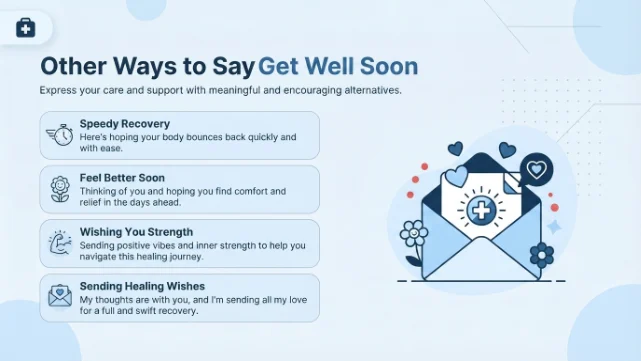
Other Ways to Say “Get Well Soon”
These alternatives will help you sound more fluent, confident, and natural in different situations. Use them according to tone, context, and audience to express excitement, warmth, or professional care when someone is recovering.
1. Phrase: Wishing you a speedy recovery
Meaning: A formal wish for someone to recover quickly. Explanation: Common in cards and professional messages. Example Sentence: “Wishing you a speedy recovery after your surgery.” Best Use: Cards, emails Worst Use: Casual texting Tone: Formal, warm Context Variability: professional, written
2. Phrase: Hope you feel better soon
Meaning: A gentle, caring wish for improved health. Explanation: Slightly softer than “get well soon.” Example Sentence: “I hope you feel better soon, take it easy this week.” Best Use: Friends, family Worst Use: Formal letters Tone: Warm, personal Context Variability: casual, spoken
3. Phrase: Take care of yourself
Meaning: A reminder to rest and prioritize health. Explanation: Focuses on self-care rather than speed of recovery. Example Sentence: “Take care of yourself and don’t rush back to work.” Best Use: Close friends, coworkers Worst Use: Very formal documents Tone: Caring, supportive Context Variability: casual, professional
4. Phrase: Sending healing thoughts your way
Meaning: An emotional expression of support during illness. Explanation: Often used for serious or long-term health issues. Example Sentence: “Sending healing thoughts your way during this difficult time.” Best Use: Serious illness, cards Worst Use: Minor colds Tone: Gentle, sincere Context Variability: written, emotional
5. Phrase: We hope for your swift and full recovery
Meaning: A formal, complete wish for total healing. Explanation: Common in official or workplace messages. Example Sentence: “On behalf of the team, we hope for your swift and full recovery.” Best Use: Company emails Worst Use: Text messages Tone: Formal, professional Context Variability: professional, written
6. Phrase: Rest up and feel better
Meaning: A casual instruction to rest while recovering. Explanation: Common among friends and informal relationships. Example Sentence: “Rest up and feel better, we miss you at practice.” Best Use: Friends, teammates Worst Use: Business emails Tone: Casual, friendly Context Variability: casual, spoken
7. Phrase: Hope you’re back on your feet soon
Meaning: A wish for someone to return to normal activity. Explanation: Idiomatic phrase implying full physical recovery. Example Sentence: “Hope you’re back on your feet soon, the team isn’t the same without you.” Best Use: Injuries, casual settings Worst Use: Formal writing Tone: Friendly, encouraging Context Variability: casual, spoken
8. Phrase: Thinking of you during this time
Meaning: An expression of emotional support and care. Explanation: Does not directly mention illness, making it versatile. Example Sentence: “Thinking of you during this time, let us know how we can help.” Best Use: Serious situations Worst Use: Minor illnesses Tone: Compassionate, sincere Context Variability: written, emotional
9. Phrase: May you regain your strength and health soon
Meaning: A formal, almost poetic wish for full recovery. Explanation: Often used in cards or ceremonial messages. Example Sentence: “May you regain your strength and health soon, dear friend.” Best Use: Cards, formal notes Worst Use: Everyday texting Tone: Formal, heartfelt Context Variability: written, formal
10. Phrase: Get well quick, we need you back
Meaning: A casual, upbeat wish that includes a personal reason. Explanation: Adds warmth by expressing that the person is missed. Example Sentence: “Get well quick, we need you back on the team.” Best Use: Coworkers, friends Worst Use: Serious illness Tone: Playful, warm Context Variability: casual, spoken
11. Phrase: Wishing you comfort and a fast recovery
Meaning: Combines emotional comfort with a wish for healing speed. Explanation: Suitable for both physical and emotional recovery. Example Sentence: “Wishing you comfort and a fast recovery after your procedure.” Best Use: Hospital cards Worst Use: Casual chats Tone: Gentle, formal Context Variability: written, professional
12. Phrase: Hope you bounce back soon
Meaning: An informal wish for quick recovery. Explanation: Uses the idiom “bounce back,” implying resilience. Example Sentence: “Hope you bounce back soon, you’re one of the strongest people I know.” Best Use: Friends, casual notes Worst Use: Formal emails Tone: Encouraging, casual Context Variability: casual, spoken
13. Phrase: Please accept our best wishes for your health
Meaning: A formal, respectful expression of concern. Explanation: Common in professional or institutional correspondence. Example Sentence: “Please accept our best wishes for your health and speedy return.” Best Use: Official letters Worst Use: Informal texts Tone: Formal, respectful Context Variability: professional, written
14. Phrase: Sending you good vibes to heal fast
Meaning: An informal, energetic wish for recovery. Explanation: Popular in social media and text messages. Example Sentence: “Sending you good vibes to heal fast, feel better soon!” Best Use: Social media, texts Worst Use: Business settings Tone: Upbeat, casual Context Variability: informal, spoken
15. Phrase: We’re all rooting for your recovery
Meaning: Expresses collective support from a group. Explanation: Common in workplace or team messages. Example Sentence: “We’re all rooting for your recovery, take the time you need.” Best Use: Team emails Worst Use: One-on-one casual chats Tone: Supportive, professional Context Variability: professional, written
16. Phrase: Take all the time you need to recover
Meaning: Reassures someone there is no pressure to rush. Explanation: Often used alongside workplace accommodations. Example Sentence: “Take all the time you need to recover, your role will be here.” Best Use: Manager to employee Worst Use: Very casual texts Tone: Reassuring, professional Context Variability: professional, spoken
17. Phrase: Feel better real soon, we miss you
Meaning: A warm, informal wish showing personal connection. Explanation: Adds emotional weight through the phrase “we miss you.” Example Sentence: “Feel better real soon, we miss you at dinner.” Best Use: Family, close friends Worst Use: Formal writing Tone: Warm, informal Context Variability: casual, spoken
18. Phrase: Get some rest, you’ll be good as new
Meaning: An informal, optimistic wish for full recovery. Explanation: Uses the idiom “good as new” for a light tone. Example Sentence: “Get some rest, you’ll be good as new by next week.” Best Use: Friends, minor illness Worst Use: Serious diagnoses Tone: Light, optimistic Context Variability: casual, spoken
19. Phrase: Wishing you strength during your recovery
Meaning: Focuses on emotional and physical resilience. Explanation: Suitable for longer recovery periods. Example Sentence: “Wishing you strength during your recovery, you are not alone.” Best Use: Serious illness, cards Worst Use: Casual texts Tone: Compassionate, sincere Context Variability: written, emotional
20. Phrase: Hope your recovery is smooth and quick
Meaning: A professional wish for an uncomplicated healing process. Explanation: Common in workplace or client-facing messages. Example Sentence: “Hope your recovery is smooth and quick, let us know if you need anything.” Best Use: Professional emails Worst Use: Very informal chats Tone: Professional, caring Context Variability: professional, written
21. Phrase: Sending prayers for your healing
Meaning: A faith-based expression of support during illness. Explanation: Appropriate when the recipient shares similar beliefs. Example Sentence: “Sending prayers for your healing and comfort.” Best Use: Religious or spiritual contexts Worst Use: Secular workplace emails Tone: Heartfelt, sincere Context Variability: written, emotional
22. Phrase: I hope this message finds you feeling stronger
Meaning: A polite, indirect way to ask about recovery progress. Explanation: Common opening line in emails to someone unwell. Example Sentence: “I hope this message finds you feeling stronger each day.” Best Use: Emails Worst Use: Quick texts Tone: Polite, formal Context Variability: professional, written
23. Phrase: Get well soon, you’re missed around here
Meaning: Combines a classic wish with a personal touch. Explanation: Reinforces that the person’s absence is noticed. Example Sentence: “Get well soon, you’re missed around here.” Best Use: Coworkers, friends Worst Use: Very formal letters Tone: Warm, friendly Context Variability: casual, professional
24. Phrase: Hoping for good news about your health soon
Meaning: Expresses concern while awaiting medical updates. Explanation: Useful when the outcome is still uncertain. Example Sentence: “Hoping for good news about your health soon.” Best Use: Serious or ongoing illness Worst Use: Minor colds Tone: Concerned, sincere Context Variability: written, emotional
25. Phrase: Wishing you ease and comfort as you heal
Meaning: Focuses on reducing discomfort during recovery. Explanation: Gentle phrasing suited to post-surgery messages. Example Sentence: “Wishing you ease and comfort as you heal from surgery.” Best Use: Cards, hospital notes Worst Use: Casual texting Tone: Gentle, formal Context Variability: written, professional
26. Phrase: Get better soon, we’ve got things covered
Meaning: Reassures someone that responsibilities are handled. Explanation: Common in workplace messages to reduce stress. Example Sentence: “Get better soon, we’ve got things covered at the office.” Best Use: Workplace messages Worst Use: Personal cards Tone: Supportive, professional Context Variability: professional, spoken
27. Phrase: Hope you recover fully and quickly
Meaning: A direct, warm wish for complete healing. Explanation: Balances formality with genuine care. Example Sentence: “Hope you recover fully and quickly, take care.” Best Use: Emails, cards Worst Use: Very casual slang contexts Tone: Warm, balanced Context Variability: professional, written
28. Phrase: Stay strong, better days are ahead
Meaning: An encouraging phrase focused on emotional resilience. Explanation: Useful for longer or harder recovery journeys. Example Sentence: “Stay strong, better days are ahead, we believe in you.” Best Use: Serious illness, encouragement Worst Use: Minor ailments Tone: Motivational, sincere Context Variability: written, emotional
29. Phrase: Sending positive energy for a fast recovery
Meaning: An informal, upbeat wish for quick healing. Explanation: Popular in casual and social media messages. Example Sentence: “Sending positive energy for a fast recovery, feel better!” Best Use: Social media, texts Worst Use: Formal business letters Tone: Upbeat, casual Context Variability: informal, spoken
30. Phrase: Wishing you renewed health and energy soon
Meaning: A formal, complete wish for restored wellbeing. Explanation: Suitable for closing formal cards or letters. Example Sentence: “Wishing you renewed health and energy soon, take care of yourself.” Best Use: Formal cards, closings Worst Use: Quick casual texts Tone: Formal, warm Context Variability: written, professional
“Choosing the right phrase shows the other person you truly care about their recovery.”
Mini Quiz / Self-Check
1. Which phrase is best suited for a formal workplace email to a senior manager recovering from surgery?
A) Get well quick, we need you back B) We hope for your swift and full recovery C) Sending you good vibes to heal fast D) Hope you bounce back soon
2. Which alternative works best in a casual text to a close friend with a minor cold?
A) Please accept our best wishes for your health B) May you regain your strength and health soon C) Feel better real soon, we miss you D) We’re all rooting for your recovery
3. Which phrase is most appropriate for someone facing a serious or long-term illness?
A) Get some rest, you’ll be good as new B) Sending healing thoughts your way C) Get well quick, we need you back D) Hope you’re back on your feet soon
4. True or False: “Get well soon” is always appropriate in professional emails to executives. A) True B) False
Answers: 1-B, 2-C, 3-B, 4-B
Comparison Table: Top Alternatives
| Phrase | Tone | Best Use |
|---|---|---|
| Wishing you a speedy recovery | Formal, warm | Cards, emails |
| Hope you feel better soon | Warm, personal | Friends, family |
| Take care of yourself | Caring, supportive | Close friends, coworkers |
| Sending healing thoughts your way | Gentle, sincere | Serious illness, cards |
| We hope for your swift and full recovery | Formal, professional | Company emails |
| Rest up and feel better | Casual, friendly | Friends, teammates |
| Thinking of you during this time | Compassionate, sincere | Serious situations |
| Hope you bounce back soon | Encouraging, casual | Friends, casual notes |
| We’re all rooting for your recovery | Supportive, professional | Team emails |
| Sending positive energy for a fast recovery | Upbeat, casual | Social media, texts |
FAQs
What can I say instead of “get well soon” in a professional email?
Use phrases like “We hope for your swift and full recovery” or “Take all the time you need to recover” for a professional tone.
Is “get well soon” appropriate for serious illness?
It can feel too brief for serious situations; consider phrases like “Sending healing thoughts your way” instead.
What are casual alternatives to “get well soon” for friends?
Try “Feel better real soon, we miss you” or “Get some rest, you’ll be good as new.”
Can I use “get well soon” in a formal card?
It is acceptable, but formal alternatives like “Wishing you a speedy recovery” often sound more polished.
How do I choose the right alternative to “get well soon”?
Match the phrase to the relationship, the setting, and the seriousness of the illness for the most natural tone.
Conclusion
Learning alternatives to get well soon gives you the flexibility to match your words to any relationship or situation, from a quick text to a close friend to a formal message to a colleague. Practicing these phrases daily builds real confidence in both spoken and written English.
Tone awareness is what separates good English from great English. The more you notice how formality, warmth, and context shift a message, the more naturally you will choose the right words every time.
Discover More Related Articles:
- Other Ways to Say Thank You in Spanish | Common Phrases & Expressions In 2026
- Other Ways to Say You’re Welcome |After Thank You In 2026

Jennifer Wilson is an experienced writer and content creator with over 20 years of expertise in digital publishing, lifestyle, and informative content. Holding a degree in English Literature, she contributes to Responary.Com, where she shares engaging, well-researched articles that help readers stay informed and inspired.