Quick Answer
Looking for other ways to say sorry that sound natural, sincere, and appropriate for any situation? The best alternatives include: I apologize, my mistake, I regret this, please forgive me, and my bad.
“Sorry” is one of the most common words in English, used to express regret, acknowledge a mistake, or show empathy. People use it in daily conversations, workplace emails, customer service interactions, and personal relationships.
However, repeating the same word again and again can make your English sound repetitive and less sincere. Learning alternatives to sorry helps you match your tone to the situation, whether you need a formal apology at work or a casual comment among friends.
Just like learners search for ways to express excitement in English, mastering apology language builds confidence and fluency. The right phrase can make your apology sound more genuine, professional, and emotionally accurate.
“The right words don’t just say sorry, they show you mean it.”
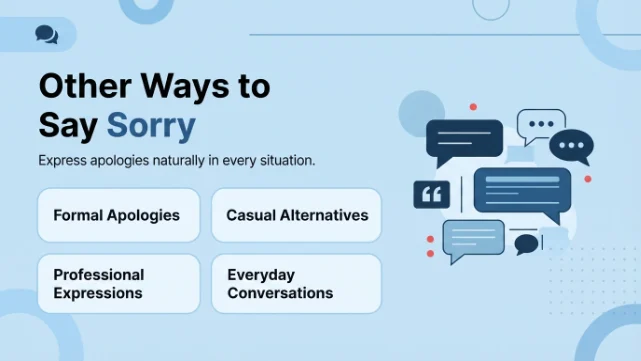
Quick Categories
Formal Alternatives to “Sorry”
- I apologize
- Please accept my apologies
- I sincerely regret
- I take full responsibility
Pro Tip: Use formal alternatives in emails, business meetings, and written communication to sound professional and respectful.
Casual Alternatives
- My bad
- Oops, sorry about that
- My mistake
- Whoops
Pro Tip: Save casual alternatives for friends, family, or informal chats. They can sound careless in professional settings.
Professional Alternatives
- I apologize for the inconvenience
- I regret any confusion this may have caused
- Thank you for your patience, and I apologize
- Please allow me to correct this
Pro Tip: Pair professional apologies with a solution or next step to sound confident, not just regretful.
Informal Expressions
- Sorry about that
- My fault
- Ugh, sorry
- Didn’t mean to do that
Pro Tip: Informal expressions work well in spoken conversation but should be avoided in written business communication.
“Every apology carries a tone. Choose yours carefully.”
Common Mistakes
- Overusing “sorry” without context
Example: “Sorry, sorry, sorry” (unclear what the apology is for) - Using casual phrases in professional emails
Example: “My bad for the late report” (too informal for work) - Apologizing without taking responsibility
Example: “Sorry you feel that way” (shifts blame instead of owning the mistake) - Repeating the same phrase in every situation
Example: Saying “I’m sorry” for both a minor delay and a major error - Skipping the apology explanation
Example: “Sorry.” (with no context, sounds insincere)
What Does “Sorry” Mean?
“Sorry” is an adjective used to express regret, sympathy, or an apology for a mistake, mistake, or inconvenience.
Grammar Note: “Sorry” is typically followed by “for” + noun/gerund, or “that” + clause. Example: “I’m sorry for being late.”
Example Sentence: “I’m sorry, I didn’t mean to interrupt you.”
When to Use “Sorry”
- Apologizing for a mistake or error
- Expressing sympathy for someone’s situation
- Acknowledging inconvenience caused to others
- Interrupting someone politely
Spoken vs Written:
- Spoken: Casual, quick, often paired with tone of voice
- Written: Requires more context and explanation
Formal vs Informal:
- Formal: Used in business emails, official statements
- Informal: Used in texting, casual conversation
Is It Professional or Polite to Say “Sorry”?
“Sorry” is polite and widely accepted in everyday interactions, but it is not always considered professional on its own, especially in business writing where more formal apology language is expected.
Business Example: “I apologize for the delay in responding to your email.”
Polite? ✔️ Yes Professional? ❌ No (in most formal writing, without added context)
Pros and Cons of Using “Sorry”
Pros:
- Simple and natural
- Widely understood
- Common in everyday usage
- Easy to use in any tense
Cons:
- Too informal for serious business writing
- Overused in daily speech
- Limited emotional depth
- Can sound insincere without explanation
“Fluency isn’t about knowing more words, it’s about knowing the right word at the right time.”
Other Ways to Say “Sorry”
These alternatives will help you sound more fluent, confident, and natural in different situations. Use them according to tone, context, and audience to express regret, responsibility, or empathy.
1. Phrase: I apologize
Meaning: A formal way to express regret. Explanation: Commonly used in professional and written communication. Example Sentence: “I apologize for the confusion caused by my earlier email.” Best Use: Business, formal writing Worst Use: Casual texting Tone: Formal, respectful, sincere Context Variability: professional
2. Phrase: My bad
Meaning: A casual admission of fault. Explanation: Used informally among friends or peers. Example Sentence: “My bad, I forgot to send the file.” Best Use: Friends, casual chats Worst Use: Formal emails Tone: Casual, relaxed, friendly Context Variability: casual, spoken
3. Phrase: Please accept my apologies
Meaning: A polite, formal apology request. Explanation: Used in official or written apologies. Example Sentence: “Please accept my apologies for the delay in shipment.” Best Use: Business letters Worst Use: Everyday speech Tone: Formal, polite, professional Context Variability: professional
4. Phrase: I regret
Meaning: Expresses sorrow or disappointment about an action. Explanation: Common in formal writing and speeches. Example Sentence: “I regret any inconvenience this may have caused.” Best Use: Official statements Worst Use: Casual conversation Tone: Formal, serious, reflective Context Variability: professional
5. Phrase: My mistake
Meaning: A direct acknowledgment of an error. Explanation: Neutral tone, works in both casual and semi-formal settings. Example Sentence: “My mistake, I misread the instructions.” Best Use: Work, casual settings Worst Use: Very formal writing Tone: Neutral, direct, honest Context Variability: casual, professional, spoken
6. Phrase: Oops, sorry about that
Meaning: A light, casual apology. Explanation: Used for small, harmless mistakes. Example Sentence: “Oops, sorry about that, I spilled some water.” Best Use: Everyday situations Worst Use: Serious apologies Tone: Playful, casual, light Context Variability: casual, spoken
7. Phrase: I take full responsibility
Meaning: A strong acceptance of blame. Explanation: Used when owning a serious mistake. Example Sentence: “I take full responsibility for the missed deadline.” Best Use: Workplace, leadership Worst Use: Minor issues Tone: Formal, accountable, serious Context Variability: professional
8. Phrase: I apologize for the inconvenience
Meaning: A professional way to acknowledge trouble caused. Explanation: Frequently used in customer service. Example Sentence: “I apologize for the inconvenience this issue has caused you.” Best Use: Customer service, business Worst Use: Personal relationships Tone: Professional, polite, formal Context Variability: professional
9. Phrase: Whoops
Meaning: An informal exclamation acknowledging a small error. Explanation: Very casual and often used humorously. Example Sentence: “Whoops, wrong file attached.” Best Use: Friends, informal chats Worst Use: Business communication Tone: Casual, humorous, light Context Variability: casual, spoken
10. Phrase: I owe you an apology
Meaning: Acknowledges that an apology is deserved. Explanation: Slightly formal, often used in personal relationships. Example Sentence: “I owe you an apology for how I reacted yesterday.” Best Use: Personal relationships Worst Use: Quick casual remarks Tone: Sincere, reflective, respectful Context Variability: spoken, professional
11. Phrase: Please forgive me
Meaning: A heartfelt request for pardon. Explanation: Used in emotional or serious apologies. Example Sentence: “Please forgive me for missing your birthday.” Best Use: Personal, emotional situations Worst Use: Minor errors Tone: Sincere, emotional, humble Context Variability: spoken
12. Phrase: That was my fault
Meaning: A clear statement owning the mistake. Explanation: Neutral and direct, used in many settings. Example Sentence: “That was my fault, I should have checked twice.” Best Use: Work, personal life Worst Use: Very formal documents Tone: Honest, direct, neutral Context Variability: casual, professional, spoken
13. Phrase: I regret any confusion caused
Meaning: Formal acknowledgment of misunderstanding. Explanation: Common in professional emails. Example Sentence: “I regret any confusion caused by the earlier update.” Best Use: Business writing Worst Use: Casual talk Tone: Formal, careful, professional Context Variability: professional
14. Phrase: Didn’t mean to do that
Meaning: An informal way to express unintentional error. Explanation: Common in spoken conversation. Example Sentence: “Didn’t mean to do that, let me fix it.” Best Use: Casual conversation Worst Use: Formal writing Tone: Casual, apologetic, light Context Variability: casual, spoken
15. Phrase: I feel terrible about this
Meaning: Expresses strong regret or guilt. Explanation: Used when the mistake has emotional weight. Example Sentence: “I feel terrible about this, I should have called you earlier.” Best Use: Personal relationships Worst Use: Minor issues Tone: Emotional, sincere, heavy Context Variability: spoken
16. Phrase: Please excuse my error
Meaning: A polite, semi-formal apology. Explanation: Common in professional writing. Example Sentence: “Please excuse my error in the earlier report.” Best Use: Emails, official documents Worst Use: Everyday speech Tone: Formal, polite, respectful Context Variability: professional
17. Phrase: I’m at fault here
Meaning: A direct admission of blame. Explanation: Used to clearly own responsibility. Example Sentence: “I’m at fault here, I misunderstood the instructions.” Best Use: Work, discussions Worst Use: Very formal writing Tone: Honest, direct, serious Context Variability: casual, professional
18. Phrase: My apologies
Meaning: A short, formal apology. Explanation: Common in emails and quick professional exchanges. Example Sentence: “My apologies for the late reply.” Best Use: Business emails Worst Use: Deep personal apologies Tone: Formal, brief, polite Context Variability: professional
19. Phrase: I should have known better
Meaning: Expresses regret over a preventable mistake. Explanation: Common in personal reflection or casual talk. Example Sentence: “I should have known better than to leave it unlocked.” Best Use: Personal life Worst Use: Formal reports Tone: Reflective, honest, casual Context Variability: spoken
20. Phrase: I hope you can forgive me
Meaning: A humble request for pardon. Explanation: Used in emotionally significant apologies. Example Sentence: “I hope you can forgive me for forgetting our plans.” Best Use: Personal relationships Worst Use: Business writing Tone: Humble, sincere, emotional Context Variability: spoken
21. Phrase: I want to make this right
Meaning: Expresses intent to fix the mistake. Explanation: Often paired with an apology and action plan. Example Sentence: “I want to make this right, let me resend the file.” Best Use: Work, customer service Worst Use: Very casual talk Tone: Responsible, proactive, sincere Context Variability: professional, spoken
22. Phrase: Sorry for the trouble
Meaning: A simple acknowledgment of inconvenience caused. Explanation: Used in both casual and semi-formal settings. Example Sentence: “Sorry for the trouble, I’ll fix it right away.” Best Use: Customer interactions, daily life Worst Use: Serious formal apologies Tone: Polite, light, casual Context Variability: casual, professional
23. Phrase: I never meant to hurt you
Meaning: Expresses regret over emotional impact. Explanation: Used in personal, emotional conversations. Example Sentence: “I never meant to hurt you with my comment.” Best Use: Relationships Worst Use: Business context Tone: Emotional, sincere, gentle Context Variability: spoken
24. Phrase: I apologize for any inconvenience caused
Meaning: A formal, slightly longer apology for disruption. Explanation: Frequently used in official communication. Example Sentence: “I apologize for any inconvenience caused by the system downtime.” Best Use: Business, official notices Worst Use: Personal texting Tone: Formal, professional, polite Context Variability: professional
25. Phrase: My sincere apologies
Meaning: A heartfelt, formal apology. Explanation: Used when a stronger tone of sincerity is needed. Example Sentence: “My sincere apologies for the misunderstanding.” Best Use: Formal letters, serious matters Worst Use: Small casual mistakes Tone: Formal, sincere, respectful Context Variability: professional
26. Phrase: I dropped the ball
Meaning: An idiomatic way to admit a failure or mistake. Explanation: Common in workplace conversation. Example Sentence: “I dropped the ball on following up with the client.” Best Use: Work, informal meetings Worst Use: Formal written apologies Tone: Casual, honest, idiomatic Context Variability: casual, professional, spoken
27. Phrase: I regret the error
Meaning: A formal, short acknowledgment of a mistake. Explanation: Often used in official corrections. Example Sentence: “I regret the error in the previous statement.” Best Use: Official corrections, media Worst Use: Casual speech Tone: Formal, serious, brief Context Variability: professional
28. Phrase: Please forgive the oversight
Meaning: A polite way to acknowledge a small mistake. Explanation: Common in professional writing. Example Sentence: “Please forgive the oversight in the attached document.” Best Use: Emails, business writing Worst Use: Casual talk Tone: Polite, formal, careful Context Variability: professional
29. Phrase: I feel awful about this
Meaning: Expresses deep regret or guilt. Explanation: Used in emotionally charged personal situations. Example Sentence: “I feel awful about this, I should have told you sooner.” Best Use: Personal relationships Worst Use: Business communication Tone: Emotional, sincere, heavy Context Variability: spoken
30. Phrase: Let me make it up to you
Meaning: Offers to compensate for a mistake. Explanation: Common in personal and customer service contexts. Example Sentence: “Let me make it up to you by covering dinner tonight.” Best Use: Personal life, customer service Worst Use: Formal legal writing Tone: Warm, sincere, proactive Context Variability: casual, professional, spoken
“A good apology isn’t just about the word, it’s about the intention behind it.”
Mini Quiz
- Which phrase is best for a formal business email apologizing for a delay?
a) My bad b) I apologize for the delay c) Oops, sorry d) Whoops - Which phrase fits a casual apology among friends?
a) Please accept my apologies b) My sincere apologies c) My bad d) I take full responsibility - Which phrase is best for a customer service response?
a) I apologize for the inconvenience b) Whoops c) Didn’t mean to do that d) My fault - Which phrase expresses strong emotional regret in a personal relationship?
a) I regret the error b) I feel terrible about this c) My apologies d) I regret any confusion caused
Comparison Table: Top Alternatives
| Phrase | Tone | Best Use |
|---|---|---|
| I apologize | Formal | Business, official writing |
| My bad | Casual | Friends, informal chats |
| Please accept my apologies | Formal | Business letters |
| I regret | Formal | Official statements |
| My mistake | Neutral | Work, casual settings |
| I take full responsibility | Formal | Leadership, workplace |
| I apologize for the inconvenience | Professional | Customer service |
| I owe you an apology | Sincere | Personal relationships |
| Please forgive me | Emotional | Personal, serious situations |
| I dropped the ball | Casual | Work, informal meetings |
FAQs
1. What is a formal way to say sorry?
“I apologize” or “Please accept my apologies” are common formal alternatives used in business and official writing.
2. What can I say instead of sorry in a professional email?
Try “I apologize for the inconvenience” or “I regret any confusion this may have caused” for a professional tone.
3. Is “my bad” appropriate at work?
“My bad” is too casual for formal workplace writing but acceptable in relaxed team conversations among peers.
4. How do I apologize sincerely in English?
Use phrases like “I feel terrible about this” or “Please forgive me” to show genuine emotional regret.
5. What is the difference between “sorry” and “I apologize”? “
Sorry” is casual and common in daily speech, while “I apologize” is more formal and suited to professional or written communication.
Conclusion
Learning different ways to say sorry helps you communicate with more precision, sincerity, and professionalism. Instead of repeating the same phrase, you can choose words that match the seriousness of the situation, whether it is a small mistake or a heartfelt apology.
Practice these alternatives daily in conversations, emails, and writing exercises. Paying attention to tone, formal or informal, will help you sound more fluent, confident, and genuinely apologetic in any context.
Try using one new alternative today in a real conversation or email, and notice how it changes the way your message is received.
Discover More Related Articles:
- Other Ways to Say Happy Holidays | For Every Relationship In 2026
- Other Ways to Say Happy New Year | That Sound More Personal In 2026

Jennifer Wilson is an experienced writer and content creator with over 20 years of expertise in digital publishing, lifestyle, and informative content. Holding a degree in English Literature, she contributes to Responary.Com, where she shares engaging, well-researched articles that help readers stay informed and inspired.