Quick Answer
When someone experiences a death in the family, finding the right words matters. Instead of repeating the same phrase, you can use warmer, more personal alternatives that still feel sincere and respectful.
“Sorry for your loss” is one of the most common phrases used in English to express sympathy after someone has died. People say it at funerals, in condolence cards, in text messages, and in professional emails when a colleague loses a family member.
While the phrase is polite and widely accepted, using it too often can make your message sound generic. Learning alternatives to sorry for your loss helps you sound more thoughtful and genuine, especially when you want to comfort someone in a more personal way.
This guide breaks down formal, casual, professional, and informal alternatives, along with grammar notes, tone guidance, and real examples. Whether you are writing a card, speaking at a service, or replying to a coworker, you will find the right words here.
“The right words at the right moment can bring real comfort to someone in grief.”
Quick Categories
Formal Alternatives to “Sorry for Your Loss”
- My deepest condolences
- Please accept my sincere condolences
- I offer my heartfelt sympathy
- My thoughts are with you during this difficult time
Pro Tip: Use formal alternatives in written condolence cards, obituaries, or emails to someone you do not know well.
Casual Alternatives
- Thinking of you
- I’m so sorry
- My heart goes out to you
- Sending you love
Pro Tip: Casual alternatives work best with close friends or family members where warmth matters more than formality.
Professional Alternatives
- Please accept our condolences on behalf of the team
- We are deeply sorry for your loss
- Our thoughts are with you and your family
- Wishing you strength during this difficult time
Pro Tip: In workplace emails, keep the tone respectful and brief. Avoid overly emotional language in professional settings.
Informal Expressions
- I’m here for you
- That really sucks, I’m sorry
- Sending hugs your way
- I can’t imagine how hard this is
Pro Tip: Informal expressions suit texts or verbal conversations with people you are already close to.
Common Mistakes People Make
- Overusing the same phrase repeatedly.
Example: Saying “sorry for your loss” in every single message instead of varying your wording. - Being too casual with someone you barely know.
Example: Texting “that really sucks” to a distant coworker instead of a formal condolence. - Adding unnecessary details about the death.
Example: “Sorry for your loss, was it sudden or expected?” right after hearing the news. - Using the phrase without any personal warmth.
Example: A flat, one-line “Sorry for your loss” with no follow-up support offered. - Forgetting to offer help alongside condolences.
Example: Saying “Sorry for your loss” but never mentioning you are available if they need anything.
“A sincere tone matters more than the exact words you choose.”
What Does “Sorry for Your Loss” Mean?
“Sorry for your loss” is a fixed expression of sympathy used when someone has experienced a death, usually of a close family member, friend, or pet. It is grammatically a shortened form of “I am sorry for your loss,” with the subject and verb removed for a more direct, spoken delivery.
Example Sentence: “I heard about your grandmother. Sorry for your loss.”
When to Use “Sorry for Your Loss”
- At a funeral or memorial service, spoken directly to the grieving person
- In a condolence card or sympathy note
- In a text message or phone call after hearing sad news
- In a workplace email when a colleague experiences a death in the family
Spoken: Often shortened and said softly, sometimes with a hand on the shoulder. Written: Usually expanded slightly to “I am so sorry for your loss.” Formal: Common in cards, emails, and official messages. Informal: Common in texts, calls, and casual conversation.
Is It Professional or Polite to Say “Sorry for Your Loss”?
This phrase is polite in almost every context, but it can feel slightly impersonal in a professional setting if used without any additional warmth or support.
Business-style example: “On behalf of the entire team, please accept our condolences during this difficult time. Let us know if you need any time off.”
Polite? ✔️ Yes Professional? ✔️ Yes, when paired with a supportive follow-up
Pros and Cons of Using “Sorry for Your Loss”
Pros:
- Simple and natural
- Widely understood and accepted
- Common usage across cultures
- Easy to say in the moment
Cons:
- Can sound repetitive if overused
- Sometimes feels impersonal
- Limited emotional range
- May feel like a scripted response rather than genuine sympathy
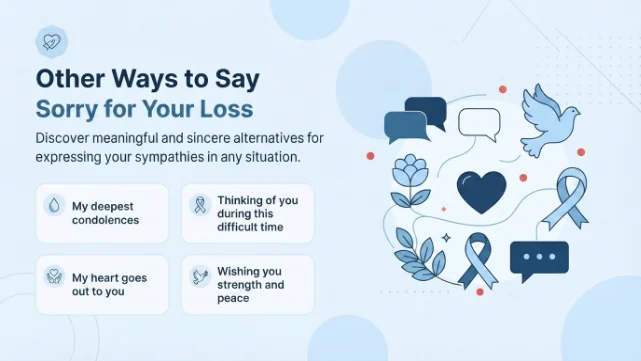
Other Ways to Say “Sorry for Your Loss”
These alternatives will help you sound more fluent, sincere, and natural when comforting someone in grief.
Use them according to tone, context, and your relationship with the person to express genuine sympathy and support.
1. Phrase: My deepest condolences
Meaning: A formal way to express sympathy for a death. Explanation: Common in cards, emails, and speeches. Example Sentence: “My deepest condolences to you and your family.” Best Use: Cards, formal emails Worst Use: Casual texting Tone: Formal, respectful, solemn Context Variability: professional, written
2. Phrase: Please accept my sincere condolences
Meaning: A polite, formal statement of sympathy. Explanation: Often used in written notes or business communication. Example Sentence: “Please accept my sincere condolences on the passing of your father.” Best Use: Formal letters, emails Worst Use: Spoken casual conversation Tone: Formal, sincere, polished Context Variability: professional, written
3. Phrase: I offer my heartfelt sympathy
Meaning: A warm, formal way to show you care about their loss. Explanation: Suitable for cards or speeches at services. Example Sentence: “I offer my heartfelt sympathy during this difficult time.” Best Use: Sympathy cards, speeches Worst Use: Quick text messages Tone: Warm, formal, compassionate Context Variability: professional, spoken
4. Phrase: My thoughts are with you during this difficult time
Meaning: A gentle way to show emotional support. Explanation: Works well when you want to avoid the word “sorry.” Example Sentence: “My thoughts are with you during this difficult time.” Best Use: Cards, emails, texts Worst Use: None, widely appropriate Tone: Gentle, supportive, sincere Context Variability: casual, professional, written
5. Phrase: Thinking of you
Meaning: A short, warm way to show you care. Explanation: Common in texts and casual notes. Example Sentence: “Thinking of you and your family today.” Best Use: Texts, quick notes Worst Use: Very formal letters Tone: Warm, casual, gentle Context Variability: casual, spoken
6. Phrase: I’m so sorry
Meaning: A simple, direct expression of sympathy. Explanation: Common in everyday conversation. Example Sentence: “I’m so sorry, I know how close you were.” Best Use: In-person conversation Worst Use: Formal business email Tone: Sincere, simple, warm Context Variability: casual, spoken
7. Phrase: My heart goes out to you
Meaning: An emotional expression of shared sadness. Explanation: Shows deep empathy in a personal way. Example Sentence: “My heart goes out to you and your children.” Best Use: Close friends, family Worst Use: Formal workplace note Tone: Emotional, warm, personal Context Variability: casual, written
8. Phrase: Sending you love
Meaning: A casual, affectionate way to show support. Explanation: Popular in texts and social media messages. Example Sentence: “Sending you love and strength this week.” Best Use: Texts, social media Worst Use: Formal condolence letters Tone: Casual, affectionate, gentle Context Variability: casual, spoken
9. Phrase: Please accept our condolences on behalf of the team
Meaning: A professional, group expression of sympathy. Explanation: Used when a manager or company addresses an employee. Example Sentence: “Please accept our condolences on behalf of the team.” Best Use: Workplace emails Worst Use: Personal texts Tone: Professional, respectful, formal Context Variability: professional, written
10. Phrase: We are deeply sorry for your loss
Meaning: A professional way to express collective sympathy. Explanation: Common in HR or company-wide messages. Example Sentence: “We are deeply sorry for your loss and are here to support you.” Best Use: Company emails Worst Use: Personal casual chat Tone: Professional, sincere, supportive Context Variability: professional, written
11. Phrase: Our thoughts are with you and your family
Meaning: A workplace-friendly way to show care. Explanation: Balances professionalism with warmth. Example Sentence: “Our thoughts are with you and your family during this time.” Best Use: Work emails, cards Worst Use: None, broadly suitable Tone: Professional, warm, respectful Context Variability: professional, written
12. Phrase: Wishing you strength during this difficult time
Meaning: A supportive phrase focused on encouragement. Explanation: Often used alongside condolences. Example Sentence: “Wishing you strength during this difficult time.” Best Use: Cards, emails Worst Use: Very casual texting Tone: Supportive, respectful, gentle Context Variability: professional, written
13. Phrase: I’m here for you
Meaning: An offer of ongoing support, not just words. Explanation: Shows you are available beyond the initial condolence. Example Sentence: “I’m here for you, whatever you need.” Best Use: Close friends, family Worst Use: Formal business note Tone: Supportive, personal, warm Context Variability: casual, spoken
14. Phrase: That really sucks, I’m sorry
Meaning: A blunt, informal way to acknowledge pain. Explanation: Best used only with very close friends. Example Sentence: “That really sucks, I’m sorry you’re going through this.” Best Use: Close friends Worst Use: Formal or professional settings Tone: Informal, honest, casual Context Variability: casual, spoken
15. Phrase: Sending hugs your way
Meaning: A gentle, casual gesture of comfort. Explanation: Common in texts when in-person contact isn’t possible. Example Sentence: “Sending hugs your way, call me anytime.” Best Use: Texts, messages Worst Use: Formal letters Tone: Casual, affectionate, comforting Context Variability: casual, spoken
16. Phrase: I can’t imagine how hard this is
Meaning: An empathetic acknowledgment of their pain. Explanation: Shows humility rather than assuming you understand fully. Example Sentence: “I can’t imagine how hard this is for you right now.” Best Use: In-person, close relationships Worst Use: Formal business email Tone: Empathetic, honest, gentle Context Variability: casual, spoken
17. Phrase: Wishing you peace and comfort
Meaning: A gentle phrase focused on healing. Explanation: Common in sympathy cards. Example Sentence: “Wishing you peace and comfort in the days ahead.” Best Use: Cards, written notes Worst Use: Quick verbal exchange Tone: Gentle, calm, respectful Context Variability: professional, written
18. Phrase: My condolences to you and your family
Meaning: A slightly formal, direct expression of sympathy. Explanation: Common in both spoken and written condolences. Example Sentence: “My condolences to you and your family.” Best Use: Cards, in-person Worst Use: None, broadly appropriate Tone: Respectful, sincere, formal Context Variability: professional, spoken
19. Phrase: I’m holding you in my thoughts
Meaning: A caring, gentle way to show ongoing support. Explanation: Softer alternative to “thinking of you.” Example Sentence: “I’m holding you in my thoughts this week.” Best Use: Texts, cards Worst Use: Very formal business notes Tone: Gentle, caring, sincere Context Variability: casual, written
20. Phrase: May they rest in peace
Meaning: A respectful phrase referring to the deceased. Explanation: Used alongside condolences, not as a full replacement. Example Sentence: “May they rest in peace. My condolences to your family.” Best Use: Cards, speeches Worst Use: Casual quick texts alone Tone: Respectful, solemn, formal Context Variability: professional, spoken
21. Phrase: I share in your grief
Meaning: An expression of shared sadness and empathy. Explanation: Suggests you also feel the loss personally. Example Sentence: “I share in your grief; she meant so much to all of us.” Best Use: Close friends, family Worst Use: Workplace emails Tone: Emotional, personal, sincere Context Variability: casual, spoken
22. Phrase: You have my deepest sympathy
Meaning: A formal, sincere expression of care. Explanation: Slightly more personal than “condolences.” Example Sentence: “You have my deepest sympathy during this time.” Best Use: Cards, formal notes Worst Use: Casual texting Tone: Formal, sincere, warm Context Variability: professional, written
23. Phrase: I’m thinking of you and your loved ones
Meaning: A caring phrase that includes the wider family. Explanation: Useful when multiple people are grieving. Example Sentence: “I’m thinking of you and your loved ones today.” Best Use: Texts, cards Worst Use: None, widely suitable Tone: Warm, caring, gentle Context Variability: casual, written
24. Phrase: My heart breaks for you
Meaning: A strong emotional expression of sympathy. Explanation: Shows deep personal sadness on their behalf. Example Sentence: “My heart breaks for you and your family.” Best Use: Close relationships Worst Use: Formal business email Tone: Emotional, heartfelt, personal Context Variability: casual, spoken
25. Phrase: Please know I’m thinking of you
Meaning: A reassuring way to express ongoing support. Explanation: Reminds the person they are not alone. Example Sentence: “Please know I’m thinking of you every day this week.” Best Use: Texts, cards Worst Use: Very formal letters Tone: Reassuring, warm, sincere Context Variability: casual, written
26. Phrase: Sending strength and comfort your way
Meaning: A supportive phrase focused on resilience. Explanation: Common in cards and social media messages. Example Sentence: “Sending strength and comfort your way during this time.” Best Use: Cards, messages Worst Use: Very formal business notes Tone: Supportive, gentle, warm Context Variability: casual, written
27. Phrase: I’m so sorry for your family’s loss
Meaning: A direct way to acknowledge the whole family’s grief. Explanation: Useful when addressing a family rather than one person. Example Sentence: “I’m so sorry for your family’s loss.” Best Use: Cards, in-person Worst Use: None, broadly suitable Tone: Sincere, respectful, warm Context Variability: professional, spoken
28. Phrase: Words can’t express how sorry I am
Meaning: An emphatic way to show deep sympathy. Explanation: Used when a simple phrase feels insufficient. Example Sentence: “Words can’t express how sorry I am for your loss.” Best Use: Cards, emotional moments Worst Use: Quick casual texts Tone: Heartfelt, formal, sincere Context Variability: professional, spoken
29. Phrase: You and your family are in my prayers
Meaning: A spiritual expression of support and hope. Explanation: Common among religious communities. Example Sentence: “You and your family are in my prayers.” Best Use: Cards, religious contexts Worst Use: Secular workplace settings Tone: Spiritual, warm, sincere Context Variability: casual, written
30. Phrase: I’m deeply saddened by this loss
Meaning: A formal way to express personal sorrow. Explanation: Common in written condolences and speeches. Example Sentence: “I’m deeply saddened by this loss and thinking of you all.” Best Use: Cards, formal emails Worst Use: Casual quick texts Tone: Formal, sincere, respectful Context Variability: professional, written
“Choosing the right words shows the person they are not grieving alone.”
Mini Quiz
- Which phrase is best for a formal workplace email?
a) That really sucks, I’m sorry b) Please accept our condolences on behalf of the team c) Sending hugs your way - Which phrase works best in a quick text to a close friend?
a) I offer my heartfelt sympathy b) Thinking of you c) Please accept my sincere condolences - Which phrase would sound out of place in a formal condolence card?
a) My deepest condolences b) That really sucks, I’m sorry c) Wishing you peace and comfort - Which phrase includes the entire family, not just one person?
a) My condolences to you and your family b) I’m so sorry c) Sending you love
Answers: 1-b, 2-b, 3-b, 4-a
Comparison Table: Top Alternatives
| Phrase | Tone | Best Use |
|---|---|---|
| My deepest condolences | Formal, respectful | Cards, formal emails |
| Please accept my sincere condolences | Formal, polished | Formal letters |
| My thoughts are with you during this difficult time | Gentle, supportive | Cards, texts, emails |
| Thinking of you | Warm, casual | Quick texts |
| My heart goes out to you | Emotional, personal | Close friends |
| We are deeply sorry for your loss | Professional, sincere | Company emails |
| Our thoughts are with you and your family | Professional, warm | Work emails |
| I’m here for you | Supportive, personal | Close friends, family |
| Wishing you peace and comfort | Gentle, calm | Sympathy cards |
| You have my deepest sympathy | Formal, warm | Cards, formal notes |
FAQs
Q: Is “sorry for your loss” too casual for a workplace email?
A: No, it is appropriate, but pairing it with a professional alternative like “please accept our condolences” sounds more polished.
Q: What can I say instead of “sorry for your loss” to a close friend?
A: Try “my heart goes out to you” or “I’m here for you” for a more personal touch.
Q: Are there religious alternatives to “sorry for your loss”?
A: Yes, phrases like “you and your family are in my prayers” or “may they rest in peace” are common in religious contexts.
Q: Can I text “sorry for your loss” or should I call instead?
A: Texting is acceptable for a quick message, but a call or an in-person visit feels more personal for close relationships.
Q: How many alternatives should I know for condolences?
A: Knowing five to ten formal and casual alternatives is enough to sound natural without repeating yourself.
Conclusion
Learning other ways to say sorry for your loss helps you offer comfort in a way that feels sincere, personal, and appropriate to the situation. Whether you are writing a formal card, sending a quick text, or speaking at a service, the right words can bring real comfort to someone who is grieving.
Practice using these alternatives daily so they come naturally when you need them most. Pay attention to tone, context, and your relationship with the person, since the same message can sound warm to one person and impersonal to another.
Discover More Related Articles:
- Other Ways to Say Happy Holidays | For Every Relationship In 2026
- Other Ways to Say Happy New Year | That Sound More Personal In 2026

Richard Scott is an experienced author dedicated to creating compelling and well-researched content for online audiences. As a contributor to Responary.com, he enjoys sharing knowledge through clear, engaging, and informative articles that connect with readers worldwide.