Quick Answer
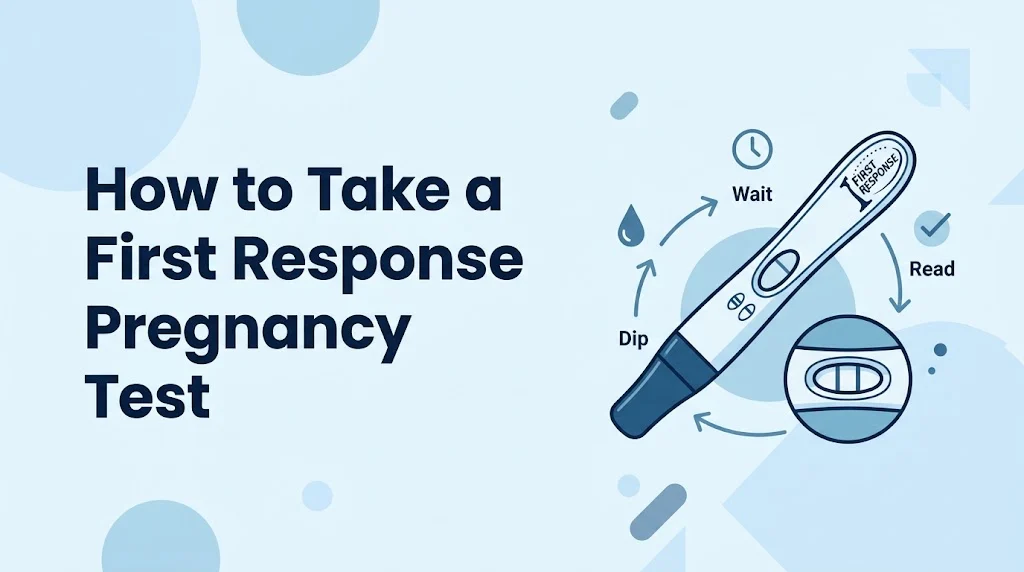
To take a First Response pregnancy test, check the expiration date, open the test only when ready, place the absorbent tip in your urine according to your specific test instructions, then wait and read the result within the stated time window. Different First Response tests have different timing instructions, so the package insert should always be followed.
Check the expiration date, collect your urine, use the test correctly, wait for the result, read the lines carefully
Taking a pregnancy test can feel like one of those tiny tasks that suddenly becomes a very big moment. Whether you are testing after a missed period, checking early because you are curious, or simply want a clear answer, knowing exactly how to use the test can make the process less stressful.
First Response offers several pregnancy tests, including Early Result, Rapid Result, Digital, and strip-style tests, and the instructions are not identical for every product. For example, the Early Result test is designed for testing up to 6 days before a missed period, while the Rapid Result test is intended for use on the day of your missed period.
The key is simple: use the exact instructions for your test, time the test carefully, and interpret the result only within the manufacturer’s recommended window.
Before You Start: Simple And Careful
- Check the expiration date first
Use this before opening the package so you know the test is still within its usable period.
Meaning: An expired test may not provide reliable results. - Read the package instructions
Use this before touching the test because different First Response products can have different testing and reading times.
Meaning: The instructions for your specific product take priority. - Have a timer ready
Use this before starting so you do not have to guess how long the test has been developing.
Meaning: Accurate timing helps you interpret the test correctly. - Open the wrapper only when ready
Use this immediately before testing rather than leaving the test exposed.
Meaning: Keeping the test protected until use helps you follow the manufacturer’s directions. - Check which First Response test you have
Use this if you are unsure whether your test is Early Result, Rapid Result, Digital, or a strip test.
Meaning: The testing method and timing can vary by product. - Keep the test dry until use
Use this when preparing your testing area.
Meaning: The test should only contact urine as directed. - Use a clean, dry cup if your instructions allow it
Use this if you prefer collecting urine rather than testing directly in the stream.
Meaning: Some First Response tests allow cup collection as an alternative method. - Do not reuse the test
Use this reminder after completing a test.
Meaning: Pregnancy tests are designed for single use. - Keep the test away from children
Use this when storing unused tests at home.
Meaning: The manufacturer advises keeping the product out of children’s reach. - Do not freeze the test
Use this when storing unopened tests.
Meaning: First Response instructions specify storage conditions and advise against freezing. - Check the test window before starting
Use this so you know where to look for the result.
Meaning: Familiarity with the result window makes reading easier. - Keep the instructions nearby
Use this when taking the test for the first time.
Meaning: You can quickly check timing or result interpretation if you become unsure. - Choose a calm place to test
Use this when you want privacy and fewer distractions.
Meaning: A quiet environment makes it easier to follow each step carefully. - Avoid guessing the timing
Use this whenever you begin the test.
Meaning: Use a clock or timer rather than estimating seconds or minutes. - Remember that product instructions differ
Use this if you find conflicting instructions online.
Meaning: The directions printed for your exact First Response test should be your main reference.
Choosing The Right Testing Time
- Test on the day of your expected period
Use this when you want a highly reliable testing point with an Early Result test.
Meaning: First Response states its Early Result test is over 99% accurate from the day of the expected period. - Test earlier only if your specific test allows it
Use this when you want to test before your expected period.
Meaning: Early testing is possible with some First Response products, but the chance of detecting pregnancy can be lower earlier on. - Know your test’s earliest testing day
Use this before testing several days early.
Meaning: The Early Result test is designed to detect pregnancy up to 6 days before a missed period. - Understand that early negatives can happen
Use this if you test before your expected period and receive a negative result.
Meaning: Pregnancy hormone levels may not yet be high enough to detect. - Consider testing again if your period does not arrive
Use this after an early negative result.
Meaning: A later test may detect rising hCG that was too low during the first test. - Do not assume every First Response test has the same timing
Use this when switching between products.
Meaning: Early Result, Rapid Result, Digital, and strip tests have different instructions. - Rapid Result is intended for the day of your missed period
Use this when you have the Rapid Result version.
Meaning: Its manufacturer guidance differs from the Early Result test. - Early Result can be used before a missed period
Use this when you have the Early Result version.
Meaning: This product is designed for earlier detection. - Do not confuse expected period with missed period
Use this when calculating your testing date.
Meaning: The two dates can differ, particularly when cycles are irregular. - Know that hCG rises as pregnancy progresses
Use this when trying to understand early testing.
Meaning: A very early test may not detect enough hCG even when pregnancy has begun. - Follow your exact product’s timing
Use this whenever online advice differs from your package.
Meaning: The product insert provides the instructions designed for that test. - Do not rely only on symptoms
Use this when deciding whether to test.
Meaning: A pregnancy test detects hCG rather than relying on symptoms alone. - Do not panic over an early negative
Use this if you tested before your expected period.
Meaning: Testing too early can produce a negative even when pregnancy is possible. - Retest according to the manufacturer’s guidance
Use this when your period still has not arrived after a negative test.
Meaning: A later test can provide more information as hCG increases. - Use the test when you can follow the instructions carefully
Use this if you are distracted, rushed, or unsure of the timing.
Meaning: Careful technique matters for getting an interpretable result.
Using The First Response Test Correctly
- Remove the test from its foil wrapper
Use this immediately before performing the test.
Meaning: This prepares the device for use. - Remove the overcap when instructed
Use this on the Early Result style test before applying urine.
Meaning: The absorbent tip needs to be exposed according to the instructions. - Hold the test by the thumb grip
Use this when positioning the test.
Meaning: The grip provides the intended way to hold the device. - Keep the absorbent tip pointing downward
Use this while applying urine.
Meaning: First Response specifically instructs users to maintain this position. - Place the absorbent tip in your urine stream for 5 seconds when instructed
Use this for the Early Result in-stream test.
Meaning: The manufacturer’s instructions specify 5 seconds for this testing method. - Use a clean cup when the product allows it
Use this if direct-stream testing is inconvenient.
Meaning: Some First Response tests allow the absorbent tip to be immersed in collected urine. - Do not guess the immersion time
Use this when testing with collected urine.
Meaning: Different First Response products can require different immersion times. - Replace the cap when directed
Use this after applying urine to the Early Result test.
Meaning: The instructions direct you to replace the overcap before laying the test down. - Place the test on a flat surface
Use this while waiting for the result.
Meaning: The test should develop in the position specified by the manufacturer. - Keep the result window facing upward
Use this while waiting for a line-based result.
Meaning: This follows the manufacturer’s recommended positioning. - Look for the test to show that it is working
Use this while waiting for the result.
Meaning: A developing indicator or control line helps show that the test has processed correctly. - Do not move the test unnecessarily
Use this while the result is developing.
Meaning: Leaving it on a stable surface helps you follow the instructions consistently. - Start your timer immediately when instructed
Use this after applying urine.
Meaning: Accurate timing prevents premature or delayed interpretation. - Keep the test away from excess moisture
Use this when setting up your testing area.
Meaning: The device should be handled according to its instructions rather than exposed to unnecessary liquid. - Follow the package insert instead of mixing instructions from different models
Use this when watching multiple online tutorials.
Meaning: First Response products do not all use identical testing times.
Reading A Positive Result
- Look for two pink lines on a line-based test
Use this when reading an Early Result test.
Meaning: Two pink lines indicate that hCG was detected and normally indicate pregnancy. - Do not worry if one line is lighter
Use this when one of the two lines appears faint.
Meaning: First Response says the two lines do not have to be equally dark. - Read the result within the specified window
Use this whenever you see lines developing.
Meaning: Results should be interpreted according to the timing instructions for your product. - Treat a positive result as important information
Use this when a pregnancy test indicates pregnancy.
Meaning: A positive result generally means hCG was detected. - Arrange confirmation with a healthcare professional
Use this after a positive result.
Meaning: First Response recommends confirmation with a healthcare professional. - Do not compare your line darkness with someone else’s test
Use this when looking at pregnancy-test photos online.
Meaning: Line appearance can vary and does not provide a reliable comparison between people. - Do not keep checking the test long after the reading window
Use this when you are tempted to inspect it again later.
Meaning: The manufacturer gives a specific period for interpreting results. - Use the result guide for your exact test
Use this when the display or lines look unfamiliar.
Meaning: Result formats differ among First Response products. - Remember that digital tests use words instead of lines
Use this if you have a First Response Digital test.
Meaning: The Digital test displays a clear pregnancy or non-pregnancy result. - Do not diagnose from a photograph alone
Use this when you are unsure about a faint line.
Meaning: A healthcare professional can help when the result is unclear. - Keep the package information available
Use this after a positive result if you need to identify your exact test.
Meaning: Product-specific information can be useful when discussing the test. - Remember that a positive result detects hCG
Use this when trying to understand what the test actually measures.
Meaning: First Response tests detect human chorionic gonadotropin in urine. - Do not assume every faint mark is a positive line
Use this when the result window looks unusual.
Meaning: Results should be read exactly as described in the product instructions. - Follow up if you have questions about the result
Use this when the test does not look like the examples.
Meaning: Professional guidance is appropriate when a result is uncertain. - Take a positive result seriously but stay calm
Use this when the result is unexpected.
Meaning: A home test can provide useful information, while healthcare confirmation can guide next steps.
Reading A Negative Result
- Look for the expected single control line
Use this when reading a line-based First Response test.
Meaning: One appropriate line generally indicates a negative result on these tests. - Remember that early testing can affect a negative result
Use this when testing before your expected period.
Meaning: hCG may still be below the detectable level. - Retest if your period does not arrive
Use this after an early negative result.
Meaning: A later test may detect increased hCG. - Do not read a negative result outside the allowed window
Use this when checking the test much later.
Meaning: First Response warns against interpreting results after the specified reading period. - Check that the control line appeared
Use this whenever the test looks negative.
Meaning: The control line helps indicate that the test worked properly. - Do not assume every negative means the same thing
Use this when testing very early.
Meaning: Timing can influence whether enough hCG is present to detect pregnancy. - Repeat the test when appropriate
Use this if your period remains absent after a negative result.
Meaning: Retesting can provide a clearer answer as hormone levels change. - Use a fresh test for retesting
Use this when performing another home pregnancy test.
Meaning: Pregnancy tests are intended for single use. - Check your test’s instructions before repeating it
Use this if you have switched to another First Response product.
Meaning: Testing and reading times may vary by model. - Do not interpret symptoms as a test result
Use this when symptoms are making you uncertain.
Meaning: The test is designed to detect hCG rather than diagnose pregnancy from symptoms. - Do not keep staring at the result window indefinitely
Use this when anxiety makes you repeatedly check it.
Meaning: The manufacturer’s reading window is the appropriate time for interpretation. - Contact a healthcare professional if uncertainty continues
Use this when repeated testing and missed periods leave you unsure.
Meaning: Professional evaluation can help clarify the situation. - Remember that cycle dates can be miscalculated
Use this when your period timing is unpredictable.
Meaning: An unexpected negative can partly reflect uncertainty about when the period was actually due. - Do not assume early testing is conclusive
Use this after testing several days before your expected period.
Meaning: Detection rates can be lower several days before the expected period. - Stay patient if you tested very early
Use this when the first result is negative but pregnancy remains possible.
Meaning: Waiting and retesting can provide more reliable information.
Understanding Faint Lines
- A faint second line can still matter
Use this when two pink lines appear but one is lighter.
Meaning: First Response states that one line may be lighter than the other. - Read the line during the official window
Use this when you notice a faint mark.
Meaning: Only results observed according to the test instructions should be interpreted. - Do not judge line darkness as a measurement of pregnancy health
Use this when comparing line intensity.
Meaning: Home tests are designed primarily to indicate whether hCG is detected. - Do not compare tests taken on different days as exact measurements
Use this when monitoring changing line appearance.
Meaning: Urine concentration and testing conditions can vary. - Use another test if the result is unclear
Use this when you cannot confidently interpret the window.
Meaning: Repeating the test can help resolve uncertainty. - Check the official result examples
Use this when a faint line is confusing.
Meaning: Manufacturer examples provide the appropriate visual reference for that test. - Do not interpret random marks outside the result area
Use this when the test looks unusual.
Meaning: The designated result window is what the instructions tell you to interpret. - Keep track of when you read the test
Use this when you are documenting the result.
Meaning: Timing matters when interpreting home pregnancy tests. - Do not rely on old test photos online
Use this when searching for examples.
Meaning: Different products and test versions can display results differently. - Check the control indicator first
Use this when the result is confusing.
Meaning: A missing control indicator can mean the test is invalid. - Repeat an invalid test with a new device
Use this when no valid control indication appears.
Meaning: An invalid test does not provide a usable pregnancy result. - Do not treat evaporation marks as confirmed pregnancy
Use this when you notice a questionable mark after the reading period.
Meaning: Results should not be interpreted outside the manufacturer’s specified window. - Ask a healthcare professional when uncertainty remains
Use this when home results are confusing.
Meaning: Professional evaluation can provide clarification. - Remember that early testing is more uncertain
Use this when testing before the expected period.
Meaning: hCG may not yet be detectable in every pregnancy. - Focus on the official instructions rather than internet guesses
Use this when conflicting explanations appear online.
Meaning: Your specific product’s instructions are the most relevant reference.
Common Mistakes To Avoid
- Do not use an expired test
Use this before every test.
Meaning: Expired tests may produce unreliable results. - Do not skip the instructions
Use this even if you have used a pregnancy test before.
Meaning: Different models can have different procedures. - Do not guess the number of seconds
Use this when applying urine.
Meaning: Follow the exact timing provided for your product. - Do not over-wet the test
Use this when using a urine stream.
Meaning: Apply urine only as directed. - Do not hold the absorbent tip upward during testing
Use this when positioning an in-stream test.
Meaning: First Response specifically directs users to keep the absorbent tip pointing downward. - Do not use a dirty collection cup
Use this when collecting urine for a cup-based test.
Meaning: Follow the manufacturer’s instructions for collecting a clean sample. - Do not read the test too early
Use this when you are impatient for an answer.
Meaning: The result may need the full specified development time. - Do not read the result too late
Use this when checking an old test.
Meaning: First Response provides a defined interpretation window. - Do not reuse the test
Use this after an unsuccessful attempt.
Meaning: Use a new test if you need to test again. - Do not mix instructions from different products
Use this when watching multiple tutorials.
Meaning: First Response products can have different testing and reading times. - Do not panic over a negative early test
Use this when testing before the expected period.
Meaning: Earlier testing can miss pregnancy because hCG may be too low. - Do not assume symptoms confirm pregnancy
Use this when you notice possible pregnancy symptoms.
Meaning: Symptoms alone cannot establish a pregnancy. - Do not ignore an invalid result
Use this when the control line or required indicator does not appear.
Meaning: An invalid test should be repeated with a new test according to the instructions. - Do not store the test incorrectly
Use this when keeping tests at home.
Meaning: Follow the storage conditions printed on the package. - Do not rely on social-media interpretations
Use this when someone online gives a different reading.
Meaning: Product instructions and qualified healthcare advice are more appropriate for medical decisions.
Digital First Response Tests
- Check that the digital test is ready
Use this before applying urine to a First Response Digital test.
Meaning: The digital device has a readiness indicator before use. - Hold the absorbent tip downward
Use this while applying urine.
Meaning: This is part of the manufacturer’s positioning instructions. - Apply urine for the specified time
Use this when testing directly in the urine stream.
Meaning: The Digital instructions specify 5 seconds for that method. - A clean cup can be an alternative
Use this if collecting urine is easier.
Meaning: The Digital instructions allow urine collection in a clean, dry cup. - Replace the overcap after testing
Use this when instructed by the Digital test directions.
Meaning: The device is then placed correctly while processing. - Place the display facing upward
Use this while waiting.
Meaning: This follows the manufacturer’s recommended position. - Look for the clock indicator
Use this shortly after applying urine.
Meaning: The blinking indicator shows that the Digital test is processing. - Wait for the digital result
Use this instead of trying to interpret lines.
Meaning: The Digital test provides a written result. - Expect a YES+ or NO- display
Use this when reading the Digital test.
Meaning: These are the result formats described in the manufacturer’s instructions. - Read the result at the recommended time
Use this when the display appears.
Meaning: Following the specified timing reduces confusion. - Do not compare a digital test with a line test
Use this when using multiple test styles.
Meaning: The displays are designed differently. - Keep the digital test dry
Use this when handling the device.
Meaning: Only the absorbent tip should be exposed to urine. - Follow the digital package insert
Use this when instructions online differ.
Meaning: Product versions can vary. - Confirm a positive result with a healthcare professional
Use this after receiving a positive digital result.
Meaning: First Response recommends healthcare confirmation. - Use a new test if the digital result does not appear correctly
Use this when the device does not complete the test.
Meaning: A test that does not provide a valid result should not be interpreted as positive or negative.
Quick And Casual Testing Tips
- Set up everything before starting
Use this when you want a smooth testing process.
Meaning: Having the test and timer ready reduces unnecessary stress. - Choose a private space
Use this when you want to concentrate.
Meaning: Privacy can make the process feel more comfortable. - Keep your timer nearby
Use this before applying urine.
Meaning: Accurate timing is easier when your timer is already ready. - Take a breath before reading
Use this if you feel nervous.
Meaning: Staying calm can help you focus on the actual result. - Read the instructions once before testing
Use this when using a new test type.
Meaning: You will know what to expect before the test begins. - Check the result only at the correct time
Use this if you tend to keep checking early.
Meaning: The manufacturer’s reading window is what matters. - Keep the package nearby
Use this if you need to verify the result.
Meaning: The packaging can identify the exact product and its instructions. - Do not rush the process
Use this when you are eager for an answer.
Meaning: Taking a few extra moments to follow directions carefully can prevent avoidable mistakes. - Do not rely on memory from another test
Use this when you have used another brand previously.
Meaning: Procedures can vary between brands and products. - Use a clean surface
Use this when laying down a test stick.
Meaning: The manufacturer’s instructions call for a flat surface during development. - Keep the test away from spills
Use this when setting up your testing area.
Meaning: Unintended liquid can interfere with proper handling. - Follow the exact product instructions
Use this as your main rule throughout the process.
Meaning: The manufacturer’s directions are more reliable than generic testing advice. - Record the testing date if helpful
Use this when you are tracking your cycle.
Meaning: Knowing when you tested can be useful if you need to retest. - Do not overthink every tiny detail
Use this when anxiety starts taking over.
Meaning: Focus on the official instructions and result window. - Ask for professional advice when needed
Use this when a result or situation remains unclear.
Meaning: A healthcare professional can provide individualized medical guidance.
When To Retest Or Get Help
- Retest after an early negative when appropriate
Use this if your period still has not arrived.
Meaning: A later test may detect hCG that was not detectable earlier. - Use a fresh test for a repeat test
Use this when you need another result.
Meaning: Pregnancy tests are single-use devices. - Contact a healthcare professional after a positive result
Use this when a home test indicates pregnancy.
Meaning: First Response recommends confirming pregnancy with a healthcare professional. - Seek medical advice when repeated results conflict
Use this when tests do not give you a clear answer.
Meaning: Professional evaluation can clarify confusing results. - Repeat an invalid test
Use this when the required control indicator does not appear.
Meaning: An invalid test does not provide a reliable pregnancy result. - Do not treat an invalid test as negative
Use this when the test fails to show the required control indicator.
Meaning: The test did not work correctly and needs to be repeated. - Consider the timing of your first test
Use this when deciding whether a negative is conclusive.
Meaning: Testing earlier than the expected period can reduce detection rates. - Remember that cycle dates can vary
Use this if your periods are irregular.
Meaning: The estimated expected period may not always be exact. - Do not ignore concerning symptoms
Use this when you have symptoms that worry you regardless of the home-test result.
Meaning: A home pregnancy test is not a complete medical evaluation. - Talk with a healthcare professional if you remain unsure
Use this after repeated uncertainty.
Meaning: Professional guidance can provide a clearer next step. - Follow local medical advice after a positive result
Use this when pregnancy is confirmed or strongly suspected.
Meaning: Healthcare guidance can help with appropriate next steps. - Keep your test information available
Use this when discussing your result with a healthcare professional.
Meaning: Knowing which test you used can help explain the result. - Do not make major medical decisions from an unclear result alone
Use this when the test is invalid or ambiguous.
Meaning: An uncertain home result needs clarification rather than guesswork. - Repeat testing according to the product guidance
Use this when your first result is negative but your period remains absent.
Meaning: First Response recommends retesting in this situation. - Use professional care for personalized questions
Use this when your circumstances are different from the standard instructions.
Meaning: Individual medical situations may require advice beyond a home test.
FAQs
Can I take a First Response test before my missed period?
Some First Response tests can be used earlier. The Early Result test is designed to detect pregnancy up to 6 days before a missed period, although detection is less reliable the earlier you test.
Do I have to use first morning urine?
Not necessarily. First Response states that certain tests can be used at any time of day, although first morning urine generally contains a higher concentration of hCG.
What does two pink lines mean?
For applicable line-based First Response tests, two pink lines indicate that hCG was detected and generally mean pregnancy.
What if the second line is very faint?
If two pink lines appear within the appropriate reading window, First Response says one line may be lighter than the other.
What does one line mean?
For the applicable line-based tests, one control line generally indicates a negative result. If you tested early and your period does not arrive, First Response recommends retesting according to its guidance.
Conclusion
Knowing how to take a First Response pregnancy test correctly can make an already emotional moment feel much more manageable. The biggest things to remember are checking the expiration date, identifying your exact test, following its instructions, timing the test accurately, and reading the result only within the recommended window.
If you test early and receive a negative result, remember that pregnancy hormone levels can still be too low to detect. If your period does not arrive, follow the manufacturer’s retesting guidance. A positive result should be discussed with a healthcare professional for confirmation.
When in doubt, skip the guesswork and check the instructions that came with your exact test. That little leaflet can save you a lot of unnecessary stress.
Discover More Related Articles:
- How to Set Up Automatic Text Reply on iPhone | Certain Text Messages In 2026
- Flirty Responses to How Was Your Day | That Keep the Conversation Going In 2026

Laura Adams is a dedicated content writer and blogger known for crafting clear, informative, and engaging articles. As a contributor to Responary.com, she specializes in creating reader-friendly content that educates, inspires, and keeps audiences informed on a wide range of subjects.