Quick Answer
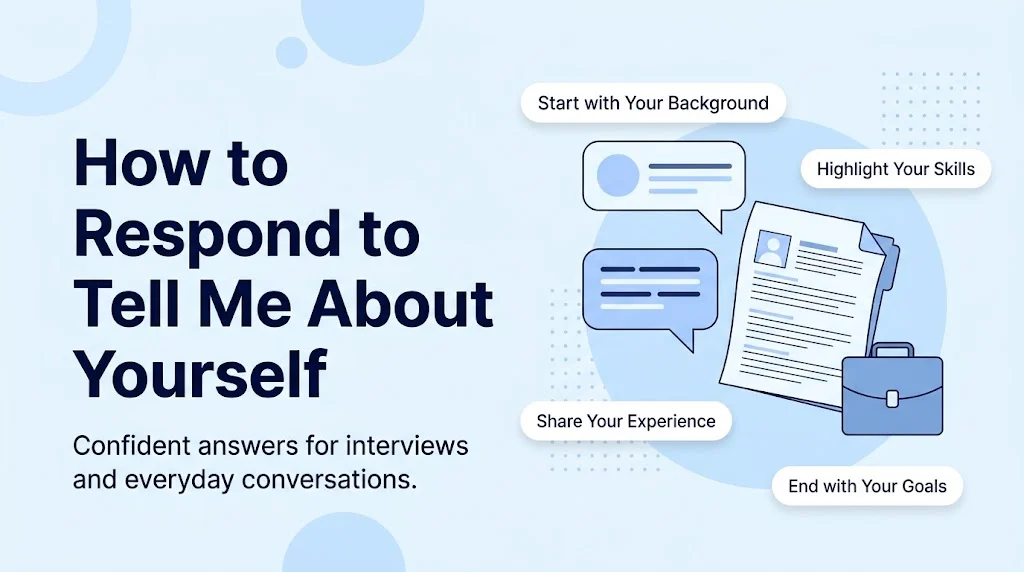
The best way to respond to Tell Me About Yourself is to give a short, confident introduction that highlights your background, strengths, and goals. Your answer should match the situation, whether you are in a job interview, meeting someone new, or chatting casually.
Try these ready-to-use responses: I’d be happy to tell you about myself, I’m someone who loves learning new things, I’m passionate about what I do, I enjoy solving problems and working with people, Let me give you a quick introduction.
“Tell me about yourself” sounds like a simple question until someone actually asks it. Suddenly, your mind goes blank, your life story feels either too long or too short, and you start wondering where to begin. Whether you hear it during a job interview, a college admission meeting, a first date, or a casual conversation with new people, knowing how to respond can make a big difference.
The secret is to keep your answer relevant, natural, and confident. You do not need to share every detail about your life or deliver a speech worthy of an award. Instead, choose a response that fits the moment and gives the other person a reason to keep listening. From professional introductions to funny replies and casual conversation starters, these examples will help you find the right words without overthinking every sentence.
1. Professional Responses
Use these replies when you want to sound polished, mature, and professional in a workplace or networking setting.
– I’d be happy to tell you about my professional background and interests.
Use this when an interviewer or colleague asks for an introduction.
Meaning: You are confidently opening the door to a professional conversation.
– I’m someone who values growth, teamwork, and continuous learning.
Use this when introducing yourself in a professional environment.
Meaning: You are highlighting qualities that matter in many workplaces.
– My background has helped me develop strong communication and problem-solving skills.
Use this when your experience has prepared you for a new opportunity.
Meaning: You are emphasizing transferable professional strengths.
– I enjoy taking on challenges and finding practical solutions.
Use this when discussing your working style.
Meaning: You are presenting yourself as proactive and solution-oriented.
– I’m passionate about doing meaningful work and making a positive contribution.
Use this when explaining your professional motivation.
Meaning: You want your work to have value and purpose.
– I would describe myself as organized, adaptable, and goal-oriented.
Use this when asked to summarize your personality at work.
Meaning: You are emphasizing reliability and flexibility.
– I enjoy collaborating with others and learning from different perspectives.
Use this during team interviews or networking events.
Meaning: You value cooperation and different viewpoints.
– I’m always looking for opportunities to improve my skills and knowledge.
Use this when discussing professional development.
Meaning: You are showing a commitment to continuous improvement.
– My main strengths are communication, responsibility, and a willingness to learn.
Use this when you need a concise professional introduction.
Meaning: You are identifying practical strengths without exaggerating.
– I like setting clear goals and working consistently toward them.
Use this when describing your approach to work.
Meaning: You are presenting yourself as disciplined and focused.
– I value honesty, accountability, and respectful communication.
Use this when explaining your professional values.
Meaning: You want others to see you as trustworthy and considerate.
– I enjoy learning new systems and finding ways to work more efficiently.
Use this when applying for a role involving new processes or technology.
Meaning: You are showing curiosity and a practical mindset.
– I’m interested in opportunities where I can contribute and continue growing.
Use this when speaking with a recruiter.
Meaning: You want a role that offers both contribution and development.
– I try to bring a positive attitude and a strong work ethic to everything I do.
Use this when asked about your approach to responsibilities.
Meaning: You are highlighting dedication and optimism.
– I’d describe myself as someone who takes responsibility and follows through.
Use this when reliability is important to the role.
Meaning: You want to communicate that people can depend on you.
2. Job Interview Responses
These examples help you answer the question confidently while keeping your response relevant to the job.
– I have a background in [your field], and I’m excited to apply my skills to this role.
Use this when interviewing for a position related to your experience.
Meaning: You are connecting your background directly to the opportunity.
– My experience has taught me how to manage priorities and work toward clear goals.
Use this when the position requires organization.
Meaning: You are showing that you understand how to manage responsibilities.
– I’m interested in this position because it aligns with my skills and career goals.
Use this when explaining why the role appeals to you.
Meaning: You are showing that your application has a clear purpose.
– I enjoy solving problems, learning from feedback, and improving my performance.
Use this when the interviewer wants to understand your work habits.
Meaning: You are presenting yourself as open to growth.
– I’m looking for a role where I can contribute to the team and develop professionally.
Use this when discussing your next career step.
Meaning: You want to add value while continuing to learn.
– One of my strengths is staying focused when working toward a deadline.
Use this for a position with time-sensitive responsibilities.
Meaning: You are highlighting your ability to manage pressure.
– I enjoy breaking complex tasks into manageable steps.
Use this when the role involves planning or problem-solving.
Meaning: You approach difficult work in an organized way.
– I believe good communication is essential to producing strong results.
Use this during an interview for a collaborative role.
Meaning: You understand the importance of keeping people aligned.
– I’m proud of the progress I’ve made and excited about what I can learn next.
Use this when discussing your career journey.
Meaning: You appreciate your development and remain ambitious.
– I try to understand the goal first, then focus on the best way to achieve it.
Use this for analytical or project-based positions.
Meaning: You think about outcomes before choosing an approach.
– I bring curiosity, consistency, and a willingness to take initiative.
Use this when the employer values independent thinking.
Meaning: You are showing that you can learn and act proactively.
– My background has helped me become adaptable when priorities change.
Use this for a fast-paced workplace.
Meaning: You can adjust when circumstances shift.
– I’m motivated by opportunities to solve real problems and help a team succeed.
Use this when explaining what drives you.
Meaning: You care about practical results and teamwork.
– I would describe myself as dependable, eager to learn, and committed to quality.
Use this when you want a concise summary of your work style.
Meaning: You are emphasizing reliability and attention to standards.
– I’d love to share how my experience and strengths connect with this position.
Use this as an opening before explaining your background.
Meaning: You are directing the conversation toward your suitability for the role.
3. Responses for Freshers With No Experience
If you are a recent graduate or applying for your first job, focus on education, projects, transferable skills, and your willingness to learn.
– I’m a recent graduate who is eager to apply my knowledge in a real workplace.
Use this when attending your first job interview.
Meaning: You are presenting yourself as ready to begin your career.
– Although I’m new to the professional world, I’m motivated to learn and contribute.
Use this when you lack formal work experience.
Meaning: You are acknowledging your starting point while showing enthusiasm.
– My education has helped me develop a strong foundation in [your subject].
Use this when your studies relate to the position.
Meaning: You are connecting your academic background to the job.
– I enjoy learning new skills and putting what I learn into practice.
Use this when the employer values training and development.
Meaning: You are showing that you learn through action.
– I’m looking for an opportunity to build experience and prove what I can do.
Use this when applying for an entry-level role.
Meaning: You are expressing ambition and readiness to work.
– My academic projects have taught me how to research, organize, and solve problems.
Use this when you have relevant school or university projects.
Meaning: You are highlighting experience gained outside a formal job.
– I consider myself curious, responsible, and open to constructive feedback.
Use this when discussing your strengths as a beginner.
Meaning: You are showing that you can learn and accept guidance.
– I’m excited to work with experienced people and learn from their knowledge.
Use this when interviewing for a trainee position.
Meaning: You are expressing a willingness to grow through mentorship.
– I’ve developed teamwork and time-management skills through my studies.
Use this when you have group projects or academic responsibilities to discuss.
Meaning: You are identifying transferable skills despite limited employment history.
– I’m ready to take on new responsibilities and learn the right way to do the job.
Use this for internships or junior positions.
Meaning: You are communicating commitment and a practical attitude.
– I enjoy setting goals and working steadily to achieve them.
Use this when asked about your motivation.
Meaning: You are showing discipline and determination.
– I’m interested in this field because it matches my strengths and interests.
Use this when explaining your career choice.
Meaning: You are connecting your interests with your professional direction.
– I may be at the beginning of my career, but I bring enthusiasm and commitment.
Use this when you want to emphasize your potential.
Meaning: You are focusing on your readiness rather than your lack of experience.
– I like understanding how things work and finding ways to improve them.
Use this for technical, analytical, or operational roles.
Meaning: You are showing curiosity and a problem-solving mindset.
– I’m hoping to turn my knowledge into practical skills and meaningful results.
Use this when explaining what you want from your first role.
Meaning: You want to move from learning concepts to applying them.
4. Short and Simple Responses
Sometimes you only need a few sentences to introduce yourself. These options work well for quick interviews and everyday introductions.
– I’m a friendly, hardworking person who enjoys learning new things.
Use this when you need a quick personal introduction.
Meaning: You are sharing a few positive qualities without overexplaining.
– I’m passionate about my goals and always looking for ways to grow.
Use this when someone asks about your personality or ambitions.
Meaning: You are expressing motivation and a desire to improve.
– I enjoy meeting new people and learning from their experiences.
Use this at networking events or social gatherings.
Meaning: You are showing openness to new connections.
– I’m someone who values honesty, kindness, and personal growth.
Use this when you want to describe your values.
Meaning: You are communicating what matters to you.
– I like keeping busy, learning new skills, and working toward my goals.
Use this for a general introduction.
Meaning: You are presenting yourself as active and motivated.
– I’m curious by nature and enjoy exploring new ideas.
Use this when talking to someone new.
Meaning: You are showing interest in learning and discovery.
– I try to approach life with a positive attitude and an open mind.
Use this in casual or professional conversations.
Meaning: You are highlighting optimism and flexibility.
– I’m a practical person who likes finding solutions.
Use this when describing your personality.
Meaning: You prefer taking useful action rather than dwelling on problems.
– I enjoy spending time with good people and doing meaningful things.
Use this for a friendly, personal introduction.
Meaning: You value relationships and purposeful activities.
– I’m always working on becoming a better version of myself.
Use this when personal development is part of the conversation.
Meaning: You are showing a commitment to self-improvement.
– I’m a mix of ambition, curiosity, and a pretty good sense of humor.
Use this with someone who appreciates personality.
Meaning: You are presenting yourself as motivated but approachable.
– I enjoy a good challenge and learning something new along the way.
Use this when describing what excites you.
Meaning: You are showing that challenges can motivate you.
– I’m someone who appreciates the little things and works toward the big things.
Use this for a thoughtful introduction.
Meaning: You value everyday happiness as well as long-term goals.
– I’d say I’m thoughtful, adaptable, and always learning.
Use this when you want a neat three-part summary.
Meaning: You are describing yourself as considerate and open to growth.
– I’m still figuring things out, but I’m enjoying the journey.
Use this when you want to sound honest and relaxed.
Meaning: You are acknowledging growth without pretending to have everything settled.
5. Confident Responses
These replies help you sound self-assured without appearing arrogant.
– I know my strengths, and I’m always working to build on them.
Use this in an interview or personal introduction.
Meaning: You recognize your abilities and believe in continued improvement.
– I’m someone who takes initiative and follows through on commitments.
Use this when reliability is important.
Meaning: You are showing that you take action and finish what you start.
– I believe in setting ambitious goals and putting in the work to reach them.
Use this when discussing your ambitions.
Meaning: You combine confidence with effort.
– I’m comfortable taking responsibility and learning from the outcome.
Use this when describing your decision-making style.
Meaning: You are willing to own your choices and learn from experience.
– I bring a strong work ethic and a willingness to tackle challenges.
Use this in a professional setting.
Meaning: You are emphasizing determination and readiness.
– I’m proud of my progress, but I know there is always room to improve.
Use this when asked about personal development.
Meaning: You balance self-confidence with humility.
– I trust my ability to learn, adapt, and contribute.
Use this when facing a new opportunity.
Meaning: You believe you can handle new responsibilities.
– I focus on what I can control and take action where it matters.
Use this when describing your approach to challenges.
Meaning: You prefer practical action over unnecessary worry.
– I’m comfortable sharing ideas and listening to different perspectives.
Use this when teamwork and communication matter.
Meaning: You can express yourself while respecting others.
– I like turning ideas into plans and plans into results.
Use this for leadership or project-based roles.
Meaning: You are focused on execution and outcomes.
– I take my responsibilities seriously and approach new opportunities with enthusiasm.
Use this during a formal introduction.
Meaning: You are showing dedication and positive energy.
– I’m motivated by progress, not by being perfect.
Use this when explaining your growth mindset.
Meaning: You prioritize improvement over unrealistic expectations.
– I’m comfortable stepping outside my comfort zone when growth requires it.
Use this when discussing new challenges.
Meaning: You are willing to take constructive risks.
– I try to bring value wherever I work or contribute.
Use this when talking about your professional goals.
Meaning: You want your involvement to make a meaningful difference.
– I’m confident in what I offer and open to what I can learn.
Use this for a balanced and memorable introduction.
Meaning: You combine self-belief with a willingness to grow.
6. Friendly Responses for Meeting New People
Use these examples when someone wants to know more about you at a party, event, class, or casual gathering.
– I’m pretty easygoing and enjoy meeting people from different backgrounds.
Use this when starting a conversation with someone new.
Meaning: You are presenting yourself as approachable and open-minded.
– I enjoy good conversations, new experiences, and a little adventure.
Use this at a social gathering.
Meaning: You are sharing interests that can lead to follow-up questions.
– I spend my time balancing work, personal interests, and time with people I care about.
Use this when someone asks about your everyday life.
Meaning: You are giving a broad picture of your lifestyle.
– I’m someone who appreciates humor and does not take every little thing too seriously.
Use this with someone who seems relaxed and friendly.
Meaning: You are showing a lighthearted side of your personality.
– I love discovering new places, trying new things, and making memories.
Use this when talking to someone socially.
Meaning: You are highlighting curiosity and enjoyment of new experiences.
– I’m a big fan of learning from people and hearing their stories.
Use this at a networking event or gathering.
Meaning: You are showing genuine interest in other people.
– I like keeping life interesting while staying grounded in what matters.
Use this when you want a thoughtful but casual introduction.
Meaning: You value new experiences without losing sight of your priorities.
– I’m a little quiet at first, but I open up once I feel comfortable.
Use this if you are naturally reserved.
Meaning: You are honestly describing your social style.
– I enjoy simple things, good company, and conversations that go somewhere.
Use this with someone who seems interested in getting to know you.
Meaning: You value meaningful social connections.
– I’m always curious about something, whether it is a new hobby or a random fact.
Use this when you want to sound fun and relatable.
Meaning: You are presenting yourself as naturally curious.
– I enjoy spending time with friends, exploring my interests, and working toward my goals.
Use this for a balanced introduction.
Meaning: You are sharing both your social and personal priorities.
– I’m the kind of person who likes making people feel comfortable.
Use this when friendliness is an important part of your personality.
Meaning: You want others to feel welcome around you.
– I like trying new things, even if I am not great at them right away.
Use this in a relaxed conversation.
Meaning: You are showing openness and a willingness to learn.
– I’m happiest when I’m learning, laughing, or spending time with my favorite people.
Use this to give a warm personal introduction.
Meaning: You are sharing what brings you joy.
– That depends on whether you want the short version or the interesting version!
Use this with someone who has a playful personality.
Meaning: You are keeping the conversation light while inviting them to engage.
7. Funny Responses
If the setting is relaxed and the other person enjoys humor, these replies can make the question less awkward.
– I’m a work in progress with excellent potential.
Use this with friends or in a casual introduction.
Meaning: You are joking about personal growth while remaining positive.
– I’m basically a collection of hobbies, snacks, and unfinished plans.
Use this with someone who appreciates relatable humor.
Meaning: You are poking fun at the many things that make up everyday life.
– I’m the main character in a very low-budget comedy.
Use this with friends who enjoy internet-style jokes.
Meaning: You are describing your life in a self-deprecating, playful way.
– I have big dreams, a decent playlist, and absolutely no idea what to eat.
Use this in a casual social setting.
Meaning: You are combining ambition with an everyday relatable struggle.
– I’m 50% ambition and 50% wondering what is happening.
Use this with someone who enjoys light humor.
Meaning: You are joking about balancing goals with life’s unpredictability.
– I’m a professional overthinker learning to become more mysterious.
Use this with friends who know you well.
Meaning: You are teasing yourself about thinking too much.
– I’m a limited edition, but the instruction manual is missing.
Use this when you want a quirky introduction.
Meaning: You are presenting yourself as unique but still figuring things out.
– I’m powered by coffee, curiosity, and questionable decisions.
Use this with someone who enjoys playful exaggeration.
Meaning: You are jokingly describing the things that keep you going.
– I’m trying to become the person my younger self thought I would be.
Use this when you want humor with a thoughtful twist.
Meaning: You are acknowledging personal growth and expectations.
– I’m a little bit organized and a little bit walking plot twist.
Use this in a friendly conversation.
Meaning: You are describing yourself as both dependable and unpredictable.
– I have several talents, and remembering why I entered a room is not one of them.
Use this with people who enjoy everyday humor.
Meaning: You are making fun of common moments of forgetfulness.
– I’m full of potential and occasionally distracted by snacks.
Use this with a friend or casual acquaintance.
Meaning: You are mixing ambition with a relatable weakness.
– I’m currently accepting compliments and career opportunities.
Use this in a playful networking conversation.
Meaning: You are jokingly expressing confidence and openness to opportunities.
– I’m an interesting person, according to at least three people who know me.
Use this when you want a self-aware joke.
Meaning: You are using exaggerated uncertainty to make your introduction funny.
– I could explain, but the movie adaptation would be three hours long.
Use this with someone who likes witty replies.
Meaning: You are joking that your life story is too complicated for a quick answer.
8. Responses for College and University Introductions
These answers work well when meeting classmates, speaking to professors, or introducing yourself during an academic interview.
– I’m currently studying [your subject], and I’m especially interested in [your area of interest].
Use this when introducing yourself in class.
Meaning: You are giving others a clear picture of your academic interests.
– I chose this field because I enjoy learning how it connects to real-world problems.
Use this when someone asks why you selected your subject.
Meaning: You are showing that your studies have a purpose.
– I’m interested in developing skills that will help me in my future career.
Use this during an academic interview.
Meaning: You are connecting your education with your long-term goals.
– I enjoy group projects because they help me learn from other people.
Use this when discussing your learning style.
Meaning: You value collaboration in an educational environment.
– I’m particularly interested in research and exploring new ideas.
Use this when applying for an academic program.
Meaning: You are expressing intellectual curiosity.
– I’m still exploring my options, but I’m excited to discover what interests me most.
Use this when you have not chosen a specific career path.
Meaning: You are being honest about your uncertainty while staying open-minded.
– My goal is to build a strong foundation and gain practical experience.
Use this when discussing your academic ambitions.
Meaning: You want to connect theoretical knowledge with real-world skills.
– I enjoy subjects that challenge me to think critically and solve problems.
Use this during a classroom introduction.
Meaning: You are describing your interest in challenging academic work.
– Outside my studies, I enjoy [your hobby] and spending time with friends.
Use this when classmates want to know you personally.
Meaning: You are sharing a little about your life beyond school.
– I’m someone who learns best by asking questions and practicing what I learn.
Use this when describing your learning style.
Meaning: You are explaining how you develop understanding.
– I hope to use my education to make a meaningful contribution in my field.
Use this in an admissions interview.
Meaning: You are expressing a long-term purpose for your studies.
– I’m looking forward to meeting people and learning from their experiences.
Use this at orientation or a university event.
Meaning: You are showing enthusiasm for building connections.
– I enjoy balancing academic goals with activities that keep me creative.
Use this when asked about your interests.
Meaning: You value both learning and personal development.
– I’m motivated by progress and enjoy seeing how much I can improve over time.
Use this in an academic or scholarship interview.
Meaning: You value growth and steady effort.
– I’m excited to explore this subject more deeply and discover where it can take me.
Use this when introducing your academic interests.
Meaning: You are showing enthusiasm for future learning.
9. Responses That Highlight Your Strengths
Use these replies when you want to describe your best qualities without sounding like you memorized a résumé.
– I’m a good listener, and I try to understand people before responding.
Use this when communication is important.
Meaning: You value understanding and thoughtful interaction.
– I’m organized and enjoy making complicated tasks easier to manage.
Use this when discussing your working habits.
Meaning: You can structure work in a practical way.
– I adapt quickly when I need to learn something new.
Use this when applying for a changing or fast-paced role.
Meaning: You are comfortable adjusting to new situations.
– I’m dependable, and I take my commitments seriously.
Use this when reliability matters.
Meaning: You want people to know they can count on you.
– I enjoy finding creative solutions when the obvious approach does not work.
Use this when the role requires innovation.
Meaning: You are willing to think beyond the usual options.
– I communicate clearly and appreciate honest feedback.
Use this in a team interview.
Meaning: You value transparency and improvement.
– I stay calm by focusing on the next practical step.
Use this when describing how you handle pressure.
Meaning: You approach challenges methodically.
– I’m comfortable working independently while knowing when to ask for help.
Use this when discussing your work style.
Meaning: You balance independence with good judgment.
– I pay attention to details without losing sight of the bigger picture.
Use this for roles that require planning or accuracy.
Meaning: You can manage details while understanding overall goals.
– I enjoy helping people and finding ways to make their work easier.
Use this for service-oriented or collaborative positions.
Meaning: You value practical support and teamwork.
– I’m persistent when working toward something important.
Use this when discussing challenging goals.
Meaning: You are willing to keep trying when progress takes time.
– I learn quickly when I have a clear goal and the chance to practice.
Use this when discussing your learning ability.
Meaning: You understand how to develop new skills through action.
– I try to turn constructive criticism into something useful.
Use this when asked about feedback.
Meaning: You view feedback as an opportunity to improve.
– I bring consistency to my work, even when the task is not exciting.
Use this when reliability and discipline are important.
Meaning: You understand the value of following through on routine responsibilities.
– I’m good at connecting ideas and looking at problems from different angles.
Use this for creative or analytical settings.
Meaning: You approach problems with curiosity and flexibility.
10. Responses for Online Meetings and Video Calls
These introductions are useful for remote interviews, virtual classes, webinars, and online networking.
– Hi, I’m [your name]. I work in [your field] and enjoy learning about new ideas.
Use this at the start of a virtual meeting.
Meaning: You are giving a brief and relevant introduction.
– I’m joining from [your location], and my main area of interest is [your subject].
Use this during a virtual class or international meeting.
Meaning: You are sharing your location and professional or academic focus.
– I’m glad to be here and looking forward to learning from everyone.
Use this during a webinar or team introduction.
Meaning: You are expressing enthusiasm and openness.
– My background is in [your field], and I’m currently focusing on [your goal].
Use this during a remote networking session.
Meaning: You are connecting your experience with your current priorities.
– I enjoy collaborative projects and finding practical ways to solve problems.
Use this when joining a remote team.
Meaning: You are highlighting your contribution to group work.
– I’m currently working on developing my skills in [your area].
Use this when meeting people in your industry.
Meaning: You are sharing your current learning goals.
– I’m excited to connect with everyone and hear about your experiences.
Use this when introducing yourself to an unfamiliar group.
Meaning: You are encouraging a friendly and collaborative atmosphere.
– I would describe myself as curious, adaptable, and focused on learning.
Use this when you need a short virtual introduction.
Meaning: You are summarizing your main personal qualities.
– Outside work, I enjoy [your hobby], which helps me stay balanced.
Use this when the meeting includes personal introductions.
Meaning: You are adding a relatable detail about your life.
– I’m here to share what I know and learn from the group.
Use this during a workshop or discussion.
Meaning: You are showing that you value mutual learning.
– My experience has helped me develop a practical approach to challenges.
Use this when speaking to a professional audience.
Meaning: You are describing how you approach difficult tasks.
– I’m interested in how different people approach the same problem.
Use this in collaborative online sessions.
Meaning: You appreciate different perspectives and methods.
– I’m happy to give a quick overview of my background and what I’m working toward.
Use this when asked to introduce yourself unexpectedly.
Meaning: You are offering a clear structure for your introduction.
– I enjoy working toward shared goals and keeping communication clear.
Use this when meeting a remote project team.
Meaning: You value coordination and collaboration.
– I’m looking forward to making useful connections and sharing ideas.
Use this at a virtual networking event.
Meaning: You are expressing interest in meaningful professional relationships.
11. Responses for Personal and Dating Conversations
When someone asks about you on a first date or through a dating app, give them a glimpse of your personality and leave room for follow-up questions.
– I’m someone who values genuine connections and good conversations.
Use this when getting to know a potential romantic partner.
Meaning: You are showing that meaningful communication matters to you.
– I enjoy laughing, trying new things, and spending time with people I care about.
Use this on a first date.
Meaning: You are sharing the things that make your life enjoyable.
– I’m a little reserved at first, but I become more talkative once I’m comfortable.
Use this if you are naturally shy.
Meaning: You are explaining your personality honestly.
– I’m ambitious about my goals but also believe in enjoying the present.
Use this when discussing your lifestyle.
Meaning: You value both future plans and current happiness.
– I appreciate honesty, kindness, and people who can make me laugh.
Use this when someone asks what matters to you.
Meaning: You are sharing your relationship values.
– I love learning about people and discovering what makes them unique.
Use this when you want to encourage a deeper conversation.
Meaning: You are showing curiosity about others.
– I’m independent, but I always make time for the people who matter to me.
Use this when describing your lifestyle or relationships.
Meaning: You value autonomy and close connections.
– I enjoy simple plans, spontaneous adventures, and conversations that last too long.
Use this on a relaxed date.
Meaning: You are sharing a fun and approachable side of yourself.
– I’m still growing as a person, and I appreciate people who grow with me.
Use this when discussing what you value in a relationship.
Meaning: You value mutual development and understanding.
– I like people who are comfortable being themselves.
Use this when talking about personality and compatibility.
Meaning: You appreciate authenticity.
– I’m happiest when life has a good balance of ambition, laughter, and peace.
Use this when someone asks what your ideal lifestyle looks like.
Meaning: You value achievement without sacrificing happiness.
– I enjoy meaningful conversations, but I can absolutely appreciate a silly joke.
Use this with someone who has a playful personality.
Meaning: You are showing both depth and a sense of humor.
– I’m someone who remembers the little things people tell me.
Use this when describing how you connect with others.
Meaning: You value thoughtfulness and attention.
– I appreciate effort, consistency, and people who mean what they say.
Use this when discussing relationship expectations.
Meaning: You value sincerity and dependable behavior.
– I could tell you about myself, but I would love to hear your story too.
Use this when you want to keep a date conversational.
Meaning: You are inviting a balanced exchange rather than making the conversation one-sided.
12. Clever and Memorable Responses
These replies add personality while still answering the question in a meaningful way.
– I’m a curious mind with a practical side and a soft spot for good stories.
Use this when you want an interesting personal introduction.
Meaning: You are describing yourself as thoughtful, practical, and imaginative.
– I believe the best way to know me is through what I care about and how I treat people.
Use this during a deeper conversation.
Meaning: You value actions and personal values over appearances.
– I’m a combination of lessons learned, goals ahead, and experiences that shaped me.
Use this when you want a reflective answer.
Meaning: You recognize how your past and ambitions contribute to your identity.
– I like asking questions, challenging assumptions, and staying open to new ideas.
Use this in an intellectual or professional discussion.
Meaning: You value curiosity and independent thinking.
– I’m someone who believes consistency often matters more than motivation.
Use this when describing your personal philosophy.
Meaning: You believe steady effort is essential for progress.
– I try to leave people and places a little better than I found them.
Use this when discussing your values.
Meaning: You want your presence to have a positive impact.
– I enjoy connecting the dots between what I learn and what I do.
Use this when describing your approach to learning or work.
Meaning: You like turning knowledge into practical action.
– I’m not defined by one thing; I’m a mix of interests, values, and experiences.
Use this when you want a thoughtful introduction.
Meaning: You see your identity as more complex than a single label.
– I believe curiosity keeps life interesting and humility keeps us learning.
Use this in a thoughtful conversation.
Meaning: You value exploration and the ability to keep improving.
– I’m someone who prefers progress over perfection.
Use this when explaining how you approach challenges.
Meaning: You focus on improvement rather than unrealistic standards.
– I enjoy finding meaning in small things and opportunities in difficult situations.
Use this when you want to express optimism.
Meaning: You try to learn from everyday experiences and challenges.
– I’m interested in people, ideas, and the stories behind both.
Use this when meeting someone who enjoys thoughtful conversation.
Meaning: You are curious about what shapes people and their perspectives.
– I try to stay grounded in my values while remaining open to change.
Use this when describing your personal outlook.
Meaning: You balance consistency with adaptability.
– I’m building a life that reflects what matters to me, one decision at a time.
Use this in a reflective personal conversation.
Meaning: You are describing a deliberate approach to life.
– The short version is that I’m learning, growing, and trying to make it count.
Use this when you want to end an introduction on a memorable note.
Meaning: You are expressing a positive commitment to personal growth.
FAQs
What is the best way to respond to Tell Me About Yourself?
Start with a brief introduction, mention your relevant background or interests, highlight two strengths, and finish with your current goal.
How do I answer Tell Me About Yourself in a job interview?
Use a simple present, past, and future structure. Aim for about 60 to 90 seconds unless the interviewer requests more detail.
What should I say if I have no work experience?
Talk about your education, projects, volunteer work, transferable skills, and willingness to learn.
How can I answer without sounding nervous?
Prepare a few key points instead of memorizing every sentence. Practice aloud, pause before answering, and remember that the question is an opportunity to introduce yourself, not a test of perfection.
Should I talk about my personal life?
It depends on the situation. In a job interview, focus mainly on professional experience and relevant interests.
Conclusion
Knowing how to respond to Tell Me About Yourself can make interviews, introductions, and everyday conversations feel much easier. The trick is not to memorize a perfect speech but to understand which parts of your story matter in that moment. Highlight your strengths, share a little personality, and keep your answer relevant to the person asking.
Whether you are a fresher preparing for your first interview, a professional exploring new opportunities, or someone meeting new people, confidence comes from practicing and being genuine. Choose a few examples from this list, personalize them with your real experiences, and practice until they sound natural. Save this guide for your next introduction, and remember: your story is worth telling.
Discover More Related Articles:

Jennifer Wilson is an experienced writer and content creator with over 20 years of expertise in digital publishing, lifestyle, and informative content. Holding a degree in English Literature, she contributes to Responary.Com, where she shares engaging, well-researched articles that help readers stay informed and inspired.